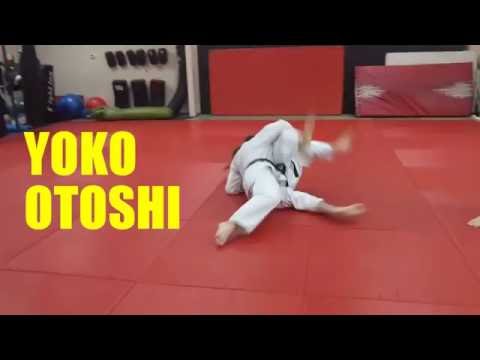
Yoko Otoshi

Подсемейство

Перевод: side drop

Дистанция и классификация

Категория
Удар и защитаЗамкиБлижний бойБой против нескольких
Дистанция
БлижняяСредняяДальняя

Обзор

Yoko Otoshi, the side drop, is a sacrifice throw in which tori drops to one side while extending a leg in front of uke's advance, using a strong lateral pull to bring uke crashing down over tori's outstretched body. [1],[2] The technique relies primarily on timing and the pull of the arms rather than leg sweeping or body contact — tori creates an obstacle with their extended body and uses uke's forward momentum to complete the throw. [2],[3] Yoko otoshi is considered one of the purest expressions of the judo principle of using an opponent's momentum against them. [3]

Также известна как
Side Drop[1]Lateral Drop Throw[2]Yoko OtoshiJP[3]
Используется в

История и происхождение

Yoko otoshi is one of the original Kodokan sacrifice throws and appears in the gokyo no waza. [1] The technique exemplifies Jigoro Kano's principle of maximum efficiency with minimum effort, as it requires very little physical strength when timed correctly. [1],[2]

Страна происхождения· показано в случайном порядке

  • Япония横落とし(Yoko Otoshi)Дзюдо, Бразильское джиу-джитсу
  • БразилияБразильское джиу-джитсу

Эффективность

Yoko otoshi (side drop) drops to the side while pulling the opponent forward and downward, using the attacker's body weight as a lever. [1],[2]

Родословная

Yoko otoshi is part of the Kodokan judo yoko-sutemi-waza syllabus. [1]

Соревновательные результаты

Yoko otoshi is scored in IJF competition. [1]

Изображения

Изображений для этой техники пока нет.

Войдите, чтобы предложить изображение.

Биомеханический механизм

Primary ActionPulling and lifting with the arms to load the opponent over the shoulder or upper back
Joints InvolvedAttacker's shoulders (loading point), elbows (pulling action), hips (turning under the opponent)
Force VectorForward and downward rotation — the pulling arm creates circular momentum while the body turns underneath
Kuzushi (Off-balancing)Forward — breaking the opponent's balance forward over their toes allows the turning entry

Позиция и вход

From judo gripUse push-pull timing (kuzushi) to catch the opponent as they step, sweep the support foot in the direction of their movement
From clinch (collar tie)Push or pull to make the opponent step, sweep the stepping foot at the exact moment it lifts off the mat

Видео

YOKO OTOSHI 3 Variations

0
Yoko Otoshi·welcomematstevescott

Yoko Otoshi (Side Drop) is a popular and effective throw and has a lot of variations. This video presents three effectiv

1 video

Изучить технику

Учебных курсов по этой технике пока нет.

Войдите, чтобы предложить курс.

Оценки

Уровень опасности

Риск травмы для человека, к которому применяется техника

6
Высокий6/10

Yoko-Sutemi-Waza; lateral falling sacrifice; shoulder/rib impact risk

Сложность

Уровень мастерства, необходимый для надёжного выполнения техники

Продвинутый
Допустимость на соревнованиях

Разрешена ли техника по основным соревновательным правилам

IJF — Legal throwing technique
IJF Sport and Organisation Rules 2025, Article 27PDF
IBJJF — Legal at all belt levels
IBJJF Rules Book v6.0, June 2024PDF
UWW — Legal in both freestyle and Greco-Roman
UWW International Wrestling Rules, January 2026PDF
Unified MMA — Legal throwing technique
Unified Rules of MMA, August 2025PDF
FIAS Sport Sambo — Legal
FIAS International Sambo Competition RulesPDF
FIAS Combat Sambo — Legal
FIAS Combat Sambo RulesPDF

Заметки по тренировке

Yoko otoshi (side drop) throws uke by falling to the side while pulling them past you — a pure hand technique executed as a sacrifice (Kodokan Judo, Kano, 1986)
There is no leg contact in yoko otoshi — the throw is accomplished entirely through grip work and your falling body weight
Fall to the side while pulling uke strongly in the same direction — your body weight amplifies the pull
The key is timing: execute when uke is moving laterally, adding your fall to their existing momentum
Yoko otoshi requires exceptional grip strength and pulling technique — the arms do all the work
This throw works well against opponents who circle laterally in a predictable pattern
In randori, use yoko otoshi when uke steps sideways to avoid your forward attacks — redirect their lateral movement

Типичные ошибки

!Trying to trip or sweep with the legs — yoko otoshi uses no leg techniques; it's all hands
!Falling without pulling uke — your body drop alone does nothing unless uke is being pulled
!Pulling uke toward you instead of past you — they should go over the space where you just were
!Not committing fully to the side fall — a half-drop has no effect
!Attempting when uke is stationary with a strong base — yoko otoshi needs uke to be in motion
!Releasing the grips during the fall — the grips transmit all the throwing force
!Not directing uke's fall properly — pull them to the mat, not onto you

Связанные техники

Контрприёмы

Цепочка подготовки

1Grip Setup (Kumi-kata)establish the controlling grips needed for the throw
2Off-Balance (Kuzushi)break the opponent's balance in the throwing direction
3Entry (Tsukuri)position the body for the throw by turning, stepping, or loading
4Execution (Kake)complete the throwing action with full commitment and follow-through
5Fall (Sutemi)commit body weight to the ground to generate throwing force

Источники и ссылки

Основной источник

Kodokan Judo — Official Nage-waza Classification

1КнигаKodokan Judo — Official Nage-waza Classification

Traditional Judo throwing technique terminology (Kodokan Institute)

Official Kodokan ground technique classification system

3Учебная программаKodokan Judo Institute — Official Waza Names

Standard Japanese martial arts terminology (kanji/hiragana)

4ДругоеJapanese Martial Arts Standard Terminology (武道用語)

Established Japanese martial arts naming convention — native Japanese term (和語/漢語)

5ЦитатаKodokan Judo — Official Nage-waza Classification

Traditional Judo throwing technique terminology (Kodokan Institute)

Сообщество

Атлетизм

Requires

precise timing, ankle coordination, upper body kuzushi ability

Favours

excellent balance and quick reflexes

Key muscles

tibialis anterior, calves, hip rotators, forearms (grip)

Подтехники

Ищите по тому, что делает техника, — а не по её названию

Каждое движение в любом боевом искусстве обладает рядом универсальных свойств. Комбинируйте параметры ниже, чтобы найти нужный инструмент или сравнить аналоги из разных стилей.

Категория
Дистанция

Часто задаваемые вопросы

What's the difference between Yoko Otoshi and a counter groom?

Yoko Otoshi and a counter groom can look similar, but Yoko Otoshi uses a slightly different grip approach, such as coming through with a two-on-one grip variation.

Как работает Yoko Otoshi?

Yoko Otoshi, the side drop, is a sacrifice throw in which tori drops to one side while extending a leg in front of uke's advance, using a strong lateral pull to bring uke crashing down over tori's outstretched body. The technique relies primarily on timing and the pull of the arms rather than leg sweeping or body contact — tori creates an obstacle with their extended body and uses uke's forward momentum to complete the throw.

Откуда происходит Yoko Otoshi?

Yoko otoshi is one of the original Kodokan sacrifice throws and appears in the gokyo no waza. The technique exemplifies Jigoro Kano's principle of maximum efficiency with minimum effort, as it requires very little physical strength when timed correctly.

Разрешён ли Yoko Otoshi на соревнованиях?

IJF: разрешён — Legal throwing technique; IBJJF: разрешён — Legal at all belt levels; UWW: разрешён — Legal in both freestyle and Greco-Roman; Unified MMA: разрешён — Legal throwing technique; ADCC: разрешён — Legal; FIAS Sport Sambo: разрешён — Legal; FIAS Combat Sambo: разрешён — Legal

Насколько опасен Yoko Otoshi?

Оценка опасности 6/10. High — Yoko-Sutemi-Waza; lateral falling sacrifice; shoulder/rib impact risk

Как подготовить Yoko Otoshi?

Стандартная цепочка подготовки: Grip Setup (Kumi-kata) → Off-Balance (Kuzushi) → Entry (Tsukuri) → Execution (Kake) → Fall (Sutemi).

Как защититься от Yoko Otoshi?

Стандартные контрприёмы: Lower Centre of Gravity — bend knees and drop hips to make the throw harder to execute / Lift the Targeted Leg — raise the foot being attacked above the sweeping action / Counter-Throw — exploit the attacker's committed weight to throw them instead / Grip Break — deny the thrower their preferred gripping configuration.

Какие есть варианты Yoko Otoshi?

Распространённые варианты: Forward sweep (sweeping the foot in the direction the opponent is stepping); Rear sweep (sweeping the foot backward as the opponent retreats); Combination sweep (chaining sweeps to both feet); Counter sweep (timing the sweep as the opponent initiates their own attack).

Насколько эффективен Yoko Otoshi на соревнованиях?

Yoko otoshi is scored in IJF competition.

Какие типичные ошибки при выполнении Yoko Otoshi?

Основные ошибки, на которые стоит обратить внимание: Trying to trip or sweep with the legs — yoko otoshi uses no leg techniques; it's all hands / Falling without pulling uke — your body drop alone does nothing unless uke is being pulled / Pulling uke toward you instead of past you — they should go over the space where you just were / Not committing fully to the side fall — a half-drop has no effect.

Какие ещё названия есть у Yoko Otoshi?

Yoko Otoshi также известен как Side Drop, Lateral Drop Throw, Yoko Otoshi.