Tani otoshi in Depth
0
Standard Tani Otoshi·Shintaro Higashi
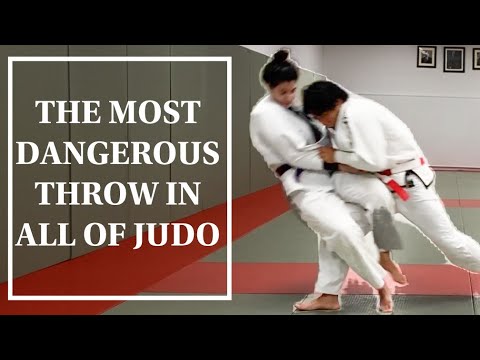
Tani Otoshi is the most dangerous throw in all of judo. The injury rate on this technique is crazy. Don't do it in pra…
Перевод: valley drop
Standard Tani Otoshi is the classical valley drop in which tori, from a standard gripping position, slides to one side, extends one leg behind uke's legs to form a barrier, and drops their body weight laterally while pulling uke backward over the outstretched leg. [1],[2] Uke falls backward over the combined obstacle of tori's leg and body, typically scoring ippon when executed with sufficient control and force. [2],[3]
Tani otoshi is one of the most frequently scored counter-throws at IJF World Championships and Olympic Games. [1]
Изображений для этой техники пока нет.
Войдите, чтобы предложить изображение.
Tani Otoshi is the most dangerous throw in all of judo. The injury rate on this technique is crazy. Don't do it in pra…
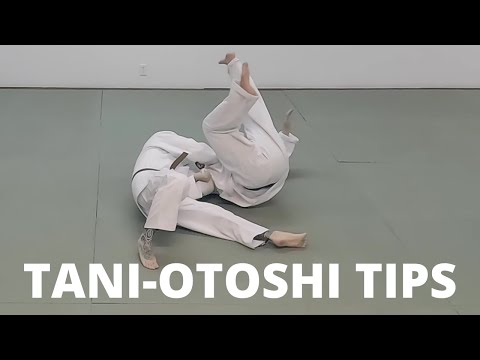
Riki sensei explained tani-otoshi (谷落 - valley drop) during judo class on 1-3-2022. 0:00 Abandon your upright position …
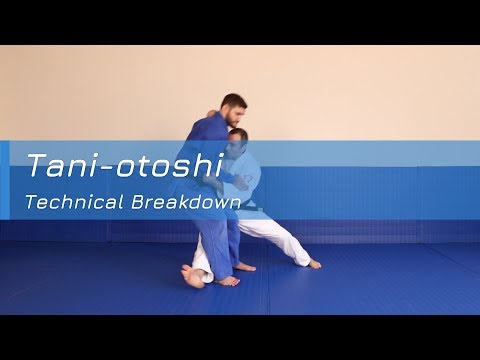
#efficientjudo #judo #judothrows Technical Breakdown from Tani-otoshi, looking how to perform the technique, some common…
Tani otoshi is a yoko sutemi waza (side sacrifice throw) in which the thrower abandons their upright position and drops to the ground, using gravity rather than muscular force to execute the technique. According to Shintaro Higashi, it is among the most dangerous throws in judo, comparable only to kani basami, because the thrower's weight drops uncontrollably onto the opponent's leg, risking ACL tears and other serious ligament damage regardless of the thrower's technical proficiency. Efficient Judo emphasizes that proper kuzushi (balance breaking) must occur backwards over the opponent's heels, with the thrower's head positioned in front of the opponent's chest to facilitate this break; common errors include insufficient kuzushi followed by lunging onto the nearest leg. Riki Judo Dojo stresses perpendicular body positioning, precise footwork (the blocking leg traveling behind the far heel), and proper hand mechanics—the pulling hand (hikite) breaks balance while the following hand (tsurite) controls—with the thrower looking straight ahead through the throw. All three instructors agree on the paramount importance of proper setup and timing, with Higashi and Efficient Judo detailing multiple variations and counters (including switches from failed turn throws and responses to opponent attacks), while Riki Judo Dojo emphasizes waza judo (technique-based execution) over muscular force. The instructors collectively stress that this throw requires careful, controlled practice and carries inherent risk.
Сформировано на основе 3 инструкторов
Учебных курсов по этой технике пока нет.
Войдите, чтобы предложить курс.
Риск травмы для человека, к которому применяется техника
Yoko-Sutemi-Waza; lateral falling sacrifice; shoulder/rib impact risk
Уровень мастерства, необходимый для надёжного выполнения техники
Разрешена ли техника по основным соревновательным правилам
Kodokan Judo — Official Nage-waza Classification
Traditional Judo throwing technique terminology (Kodokan Institute)
Official Kodokan ground technique classification system
Standard Japanese martial arts terminology (kanji/hiragana)
Established Japanese martial arts naming convention — native Japanese term (和語/漢語)
Traditional Judo throwing technique terminology (Kodokan Institute)
commitment, timing, body weight manipulation, falling skill
heavier build (body weight drives the throw), good ukemi
core rotators, hip flexors, abdominals
According to Shintaro Higashi, Tani Otoshi is the right choice when your opponent closes off the space by turning their hips and bringing their knees in front to defend against a turn throw to your dominant side. This defensive positioning makes turn throws very difficult, creating the ideal moment to go for Tani Otoshi.
Efficient Judo emphasizes that beginners often fail to completely break their opponent's balance backwards before lunging onto the closest leg, which leads to sitting on the knee and bending it sideways—risking serious ligament damage. Proper kuzushi (balance breaking) is essential for safety.
Riki Judo Dojo stresses that you must sit down (not back), keep your right knee bent as your leg travels across to go behind the opponent's heel, stay on the ball of your foot to allow proper bending, and position your head in front of the opponent's chest for balance breaking. Make sure to step past the opponent's toes or heel to reach properly.
Efficient Judo explains that when used as a timing technique, Tani Otoshi works best after your opponent attacks with a hip throw: first fully block their attack, wait for them to recover their balance, then immediately break their balance and execute the throw.
Standard Tani Otoshi is the classical valley drop in which tori, from a standard gripping position, slides to one side, extends one leg behind uke's legs to form a barrier, and drops their body weight laterally while pulling uke backward over the outstretched leg. Uke falls backward over the combined obstacle of tori's leg and body, typically scoring ippon when executed with sufficient control and force.
The standard tani otoshi has been taught at the Kodokan since the early 20th century and remains one of the most commonly applied side sacrifice throws at all levels of judo competition.
IJF: разрешён — Legal throwing technique; IBJJF: разрешён — Legal at all belt levels; UWW: разрешён — Legal in both freestyle and Greco-Roman; Unified MMA: разрешён — Legal throwing technique; ADCC: разрешён — Legal; FIAS Sport Sambo: разрешён — Legal; FIAS Combat Sambo: разрешён — Legal
Оценка опасности 6/10. High — Yoko-Sutemi-Waza; lateral falling sacrifice; shoulder/rib impact risk
Стандартная цепочка подготовки: Grip Setup (Kumi-kata) → Off-Balance (Kuzushi) → Entry (Tsukuri) → Execution (Kake).
Стандартные контрприёмы: Lower Centre of Gravity — bend knees and drop hips to make the throw harder to execute / Grip Break — deny the thrower their preferred gripping configuration / Stiff-Arm — maintain distance with straight arms to prevent the entry.
Распространённые варианты: Rear sacrifice (falling backward while pulling the opponent over); Side sacrifice (falling to the side to project the opponent laterally); Rolling sacrifice (combining a roll with the sacrifice throw for rotation); Counter sacrifice (using the opponent's forward pressure as the driving force).
Tani otoshi is one of the most frequently scored counter-throws at IJF World Championships and Olympic Games.
Основные ошибки, на которые стоит обратить внимание: Not stepping deep enough behind uke — your leg must be behind both their feet / Sitting down directly behind uke instead of to the side — you get trapped under them / Releasing the grips when sitting — maintain tension to pull uke over the leg / Extending the blocking leg but not sitting — just the leg alone won't throw them.
Standard Tani Otoshi также известен как Tani Otoshi, Classical Valley Drop, Standard Valley Drop Throw, Kihon Tani Otoshi.