How to do Tani Otoshi
0
Tani Otoshi·Sampson Judo
In this tutorial I am showing you how to do Tani Otoshi. Learning this technique provides an excellent foundation for fu…
Перевод: valley drop
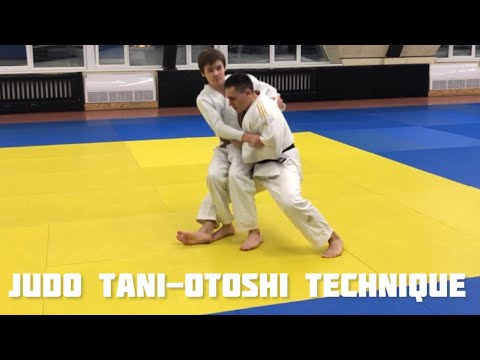
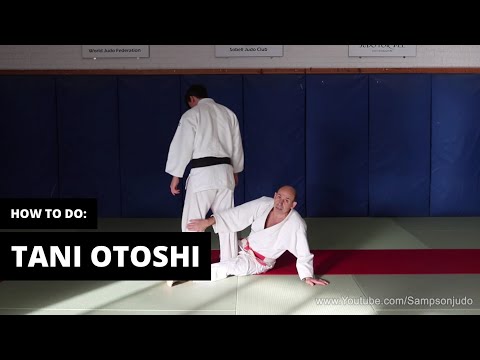
Tani Otoshi, the valley drop, is a side sacrifice throw in which tori drops to the ground beside uke while sweeping or blocking uke's legs from behind, causing uke to fall backward over tori's body into the 'valley' created by tori's position. [1],[2] The throw is executed by tori sliding their body alongside and slightly behind uke, extending one leg behind both of uke's legs as a trip, and pulling uke backward and downward with the arms. [2],[3] Tani otoshi is highly effective as a counter-throw, particularly against forward-moving opponents who attempt hip or shoulder throws. [3],[4]
Tani otoshi is part of the Kodokan judo yoko-sutemi-waza syllabus. [1]
Tani otoshi is frequently scored in IJF competition, particularly as a counter to forward throws. [1]
Изображений для этой техники пока нет.
Войдите, чтобы предложить изображение.
In this tutorial I am showing you how to do Tani Otoshi. Learning this technique provides an excellent foundation for fu…
Judo Tani-otoshi technique #judo #taniotoshi #judoka #judô #дзюдо
Учебных курсов по этой технике пока нет.
Войдите, чтобы предложить курс.
Риск травмы для человека, к которому применяется техника
Yoko-Sutemi-Waza; lateral falling sacrifice; shoulder/rib impact risk
Уровень мастерства, необходимый для надёжного выполнения техники
Разрешена ли техника по основным соревновательным правилам
Kodokan Judo — Official Nage-waza Classification
Traditional Judo throwing technique terminology (Kodokan Institute)
Official Kodokan ground technique classification system
Standard Japanese martial arts terminology (kanji/hiragana)
Established Japanese martial arts naming convention — native Japanese term (和語/漢語)
Traditional Judo throwing technique terminology (Kodokan Institute)
hip rotation speed, core strength, lower back stability
strong hips and core, good flexibility for turning entry
hip rotators, core, quadriceps, latissimus dorsi
Каждое движение в любом боевом искусстве обладает рядом универсальных свойств. Комбинируйте параметры ниже, чтобы найти нужный инструмент или сравнить аналоги из разных стилей.
Tani otoshi (valley drop) appears in 13 passages across 8 books — one of the most referenced sacrifice throws. The attacker drops behind the opponent's hip and drags them backward over their body. Frequently used as a counter-throw in judo and a takedown in BJJ. (Kano, Kodokan Judo; multiple book references)
You need to fully extend your leg so it goes past your opponent's leg to trap it between yours, and you must not cut your stepping action short. According to Sampson Judo, your leg needs to be positioned between the opponent's legs with full extension, as this allows gravity to drop your body more powerfully into the technique.
Your hand action should come up and around in a smooth, fast motion. Sampson Judo emphasizes that understanding how the mechanics work allows you to execute this hand action with maximum efficiency and minimum effort, which is the core principle of judo.
You should step forward and extend your leg, not step back. Sampson Judo stresses that stepping backwards is a mistake—instead, you need to move forward to properly trap your opponent's leg.
Your leg should stay on the mat with your toes touching down. Sampson Judo notes that after executing the throw, you extend your hips while keeping your leg on the mat to maintain control.
Tani Otoshi, the valley drop, is a side sacrifice throw in which tori drops to the ground beside uke while sweeping or blocking uke's legs from behind, causing uke to fall backward over tori's body into the 'valley' created by tori's position. The throw is executed by tori sliding their body alongside and slightly behind uke, extending one leg behind both of uke's legs as a trip, and pulling uke backward and downward with the arms.
Tani otoshi has been part of the Kodokan gokyo since its earliest formulation and is one of the most frequently used sacrifice throws in modern judo competition. The technique's popularity as a counter-throw increased dramatically during the late 20th century.
IJF: разрешён — Legal throwing technique; IBJJF: разрешён — Legal at all belt levels; UWW: разрешён — Legal in both freestyle and Greco-Roman; Unified MMA: разрешён — Legal throwing technique; ADCC: разрешён — Legal; FIAS Sport Sambo: разрешён — Legal; FIAS Combat Sambo: разрешён — Legal
Оценка опасности 6/10. High — Yoko-Sutemi-Waza; lateral falling sacrifice; shoulder/rib impact risk
Стандартная цепочка подготовки: Grip Setup (Kumi-kata) → Off-Balance (Kuzushi) → Entry (Tsukuri) → Execution (Kake) → Fall (Sutemi).
Стандартные контрприёмы: Lower Centre of Gravity — bend knees and drop hips to make the throw harder to execute / Block the Hip — post hand on the thrower's hip to prevent loading / Step Around — circle away from the throw direction to avoid being loaded / Grip Break — deny the thrower their preferred gripping configuration.
Распространённые варианты: Standard hip throw (full turn-in with hip below the opponent's centre of gravity); No-gi hip throw (adapted without gi grips, using overhook and collar tie); Drop hip throw (dropping to one knee to lower the fulcrum point); Combination hip throw (chaining from a failed foot technique or hand technique).
Tani otoshi is frequently scored in IJF competition, particularly as a counter to forward throws.
Основные ошибки, на которые стоит обратить внимание: Not extending the blocking leg far enough behind uke — they step over it / Sitting down without pulling uke backward — they simply stand over your seated body / Pulling straight backward instead of diagonally — the diagonal pull creates the rotational topple / Dropping too early before uke commits to their attack — tani otoshi is a counter, not an offensive throw.
Tani Otoshi также известен как Valley Drop, Valley Drop Throw, Tani Otoshi, Rear Trip.