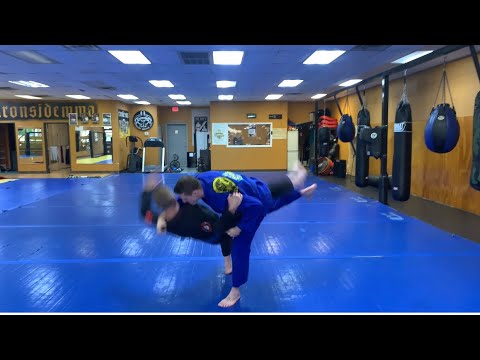
O SOTO GARI (Judo Drills at Home)
0
O Soto Gari·IronsideMartialArts
This video will give you a quick, basic description and demonstration of O Soto Gari so you can visualize when you're pr…
Перевод: major outer reap
O Soto Gari (major outer reap) is one of judo's most fundamental and powerful throws, in which the thrower steps alongside the opponent, drives the leg behind the opponent's supporting leg, and reaps it forward with a powerful sweeping action of the calf while pushing the opponent's upper body backward. [1] The throw creates a rotational force where the leg sweeps in one direction and the upper body is driven in the opposite direction, with the fulcrum at the point of contact between the thrower's reaping leg and the opponent's supporting leg. [1],[2] O-soto-gari is classified as a first-set technique in the Kodokan gokyo, taught to beginners for its clear demonstration of kuzushi (balance breaking) to the rear corner. [2],[3]
O soto gari was one of the original throws in Jigoro Kano's 1895 gokyo no waza and has been a cornerstone of judo instruction ever since. [1] The throw was famously used by Masahiko Kimura in his legendary 1949 match against Helio Gracie, and it remains one of the most commonly taught and scored throws in judo competition. [2],[3] Teddy Riner, the most decorated heavyweight in judo history, has used o-soto-gari as one of his primary competition techniques. [3]
O soto gari is one of the most commonly scored ippon techniques in Olympic judo and IJF World Championships. [1]
Изображений для этой техники пока нет.
Войдите, чтобы предложить изображение.
This video will give you a quick, basic description and demonstration of O Soto Gari so you can visualize when you're pr…
Учебных курсов по этой технике пока нет.
Войдите, чтобы предложить курс.
Риск травмы для человека, к которому применяется техника
O-Soto-Gari is one of judo's most dangerous throws; direct backward fall onto head/spine (Mifune 1956)
Уровень мастерства, необходимый для надёжного выполнения техники
Разрешена ли техника по основным соревновательным правилам
Kodokan Judo — Official Nage-waza Classification
Traditional Judo throwing technique terminology (Kodokan Institute)
Official Kodokan ground technique classification system
Standard Japanese martial arts terminology (kanji/hiragana)
Established Japanese martial arts naming convention — native Japanese term (和語/漢語)
Traditional Judo throwing technique terminology (Kodokan Institute)
precise timing, ankle coordination, upper body kuzushi ability
excellent balance and quick reflexes
tibialis anterior, calves, hip rotators, forearms (grip)
Каждое движение в любом боевом искусстве обладает рядом универсальных свойств. Комбинируйте параметры ниже, чтобы найти нужный инструмент или сравнить аналоги из разных стилей.
Counter O Soto Gari is a kaeshi-waza (counter technique) in which the defender defeats an incoming o-soto-gari by absorbing or blocking the reaping leg and then executing their own o-soto-gari against the attacker's now-vulnerable supporting leg. [1] The counter exploits the fact that an o-soto-gari attacker commits their weight forward onto one leg, creating an ideal target for a counter-reap. [1,2] The defender either steps the targeted leg out of danger or blocks the reap, then immediately attacks the attacker's standing leg with their own reaping action. [2,3]
Running O Soto Gari is a dynamic variation in which the thrower drives forward aggressively, taking several running steps to build momentum before executing the outer reap, using the accumulated forward force to overwhelm the opponent's defensive posture. [1] The running entry adds significant power to the reaping action but requires the thrower to maintain balance while moving forward at speed. [1,2] This variant is commonly seen in competition when the thrower catches the opponent moving backward and capitalises on the retreating momentum by chasing and reaping. [2,3]
Standard O Soto Gari executes the classical major outer reap where the thrower steps alongside the opponent, drives the upper body backward with the hands, and reaps the opponent's near leg from behind with a powerful backward sweep of the calf against the opponent's calf. [1] The reaping leg swings through in an arc, making contact behind the opponent's knee or calf and driving the leg forward while the opponent falls backward. [1,2] The technique requires strong kuzushi to the rear corner, loading the opponent's weight onto the leg that is about to be reaped. [2,3]
O soto gari appears in 34 passages across 7 books. One of the first throws taught to every judo beginner worldwide. The attacker reaps the opponent's leg from the outside while driving them backward. Jigoro Kano placed it in the first group (ikkyō) of the gokyo no waza. (7 books in corpus; Kano, Kodokan Judo)
You should position yourself at a slight angle rather than directly mirrored to your partner, and keep your weight forward. This off-center stance allows you to step through and brush your hip and leg close to your opponent's body while maintaining momentum in your favor, per Ironside Martial Arts.
Keep your toes pointed down and scrape them along the ground as you step, rather than lifting them up or hiking your leg. Ironside Martial Arts emphasizes this habit prevents toe and shin injuries when executing the technique at full speed.
When mirrored with your opponent, leaning back gives them the opportunity to throw you in return. By leaning forward as you step through, you maintain momentum advantage and prevent your opponent from reversing the technique, according to Ironside Martial Arts.
No—you only need to off-balance your opponent slightly and 'steer' them like a steering wheel rather than trying to forcefully throw them over. Once their weight is transferred onto the leg you're sweeping, the technique completes naturally, per Ironside Martial Arts.
O Soto Gari (major outer reap) is one of judo's most fundamental and powerful throws, in which the thrower steps alongside the opponent, drives the leg behind the opponent's supporting leg, and reaps it forward with a powerful sweeping action of the calf while pushing the opponent's upper body backward. The throw creates a rotational force where the leg sweeps in one direction and the upper body is driven in the opposite direction, with the fulcrum at the point of contact between the thrower's reaping leg and the opponent's supporting leg.
O soto gari was one of the original throws in Jigoro Kano's 1895 gokyo no waza and has been a cornerstone of judo instruction ever since. The throw was famously used by Masahiko Kimura in his legendary 1949 match against Helio Gracie, and it remains one of the most commonly taught and scored throws in judo competition.
IJF: разрешён — Legal throwing technique; IBJJF: разрешён — Legal at all belt levels; UWW: ограничен — Legal in freestyle, banned in Greco-Roman (no leg attacks below waist); Unified MMA: разрешён — Legal throwing technique; ADCC: разрешён — Legal; FIAS Sport Sambo: разрешён — Legal; FIAS Combat Sambo: разрешён — Legal
Оценка опасности 7/10. Very High — O-Soto-Gari is one of judo's most dangerous throws; direct backward fall onto head/spine (Mifune 1956)
Стандартная цепочка подготовки: Grip Setup (Kumi-kata) → Off-Balance (Kuzushi) → Entry (Tsukuri) → Execution (Kake).
Стандартные контрприёмы: Lower Centre of Gravity — bend knees and drop hips to make the throw harder to execute / Lift the Targeted Leg — raise the foot being attacked above the sweeping action / Counter-Throw — exploit the attacker's committed weight to throw them instead / Grip Break — deny the thrower their preferred gripping configuration.
Распространённые варианты: Forward sweep (sweeping the foot in the direction the opponent is stepping); Rear sweep (sweeping the foot backward as the opponent retreats); Combination sweep (chaining sweeps to both feet); Counter sweep (timing the sweep as the opponent initiates their own attack).
O soto gari is one of the most commonly scored ippon techniques in Olympic judo and IJF World Championships.
Основные ошибки, на которые стоит обратить внимание: Not driving the opponent's weight onto the target leg before reaping — the leg must be loaded to be taken / Standing too far away and reaching with the reaping leg — you must be chest-to-chest / Reaping too low at the ankle instead of through the thigh-to-knee area — the power zone is higher / Bending at the waist during the reap, which lifts your own centre and reduces forward pressure.
O Soto Gari также известен как O Soto Gari, Major Outer Reaping Throw, Large Outer Reap, Outside Leg Reap, Zadnyaya Podnozhka (задняя подножка).