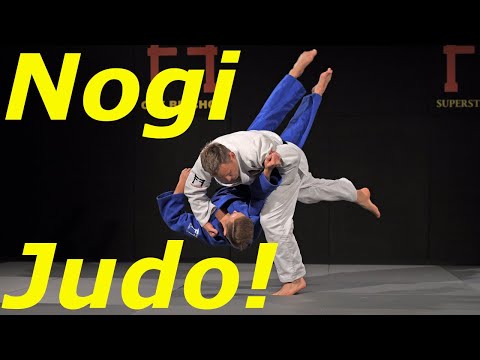
2 Ways to JUDO... Osoto Gari with Coach Cliff!
0
Running O Soto Gari·TeachMeGrappling Coach Brian
This video my friend Cliff Penick who was an international judo competitor with over 50 years judo experience demonstrat…
Перевод: major outer reap
Running O Soto Gari is a dynamic variation in which the thrower drives forward aggressively, taking several running steps to build momentum before executing the outer reap, using the accumulated forward force to overwhelm the opponent's defensive posture. [1] The running entry adds significant power to the reaping action but requires the thrower to maintain balance while moving forward at speed. [1],[2] This variant is commonly seen in competition when the thrower catches the opponent moving backward and capitalises on the retreating momentum by chasing and reaping. [2],[3]
Running o-soto-gari developed as a competitive adaptation, used by aggressive judoka who drive their opponents backward across the mat and then finish with the outer reap while maintaining forward pressure. [1] The technique became more prominent in modern competition judo where aggressive forward-driving tactics are rewarded by referees. [2],[3]
Running o soto gari amplifies the standard technique's power by adding forward momentum from a charging entry, making it difficult for the opponent to absorb the impact and particularly effective in transitions from grip fighting. [1]
The running o soto gari is a dynamic variation using forward momentum, developed in competitive judo as an aggressive entry. [1]
The running o soto gari is seen in IJF competition as an aggressive variant. [1]
Изображений для этой техники пока нет.
Войдите, чтобы предложить изображение.
This video my friend Cliff Penick who was an international judo competitor with over 50 years judo experience demonstrat…
Osoto Gari Broken Down By Travis Stevens. Learn some of the hidden tricks that these players use in order to pull of oso…
Fundamental judo ideas to get you off the ground and flying into your first Judo class. Check out our in-depth technique…
Running O Soto Gari, also called hopping O Soto Gari, represents an advanced competitive variation of the classical O Soto Gari foot-leg throw adapted for opponents with stronger balance and defensive awareness. TeachMeGrappling Coach Brian and Cliff Pennick distinguish between the traditional O Soto Gari—executed by stepping in shoulder-to-shoulder with the attacking leg at approximately 45 degrees, generating power through body lean and leg drive across the mat—and the hopping variant used at higher competitive levels. The hopping approach involves closing distance through rapid, short steps while simultaneously "clipping" or breaking the opponent's leg, then explosively driving forward and downward as the attacker hops into range, landing on the opponent to complete the throw. Travis Stevens' analysis of a 2019 World Championship match demonstrates the tactical deployment of this technique: the defender's outside leg becomes vulnerable when positioned too close to the attacker's lead leg during circular movement, particularly when the opponent's weight concentrates onto that trapped foot. Stevens emphasizes that timing the attack when the opponent cannot move the leg away—either due to being bent forward or weighted—ensures success. Shintaro Higashi contextualizes O Soto Gari within judo's fundamental framework (kazushi, tsukuri, kake) and notes numerous variations including cross-body entries and transitions from O Uchi. All three instructors stress that repetitive drilling (uchikomi) without full resistance builds proper body mechanics before live application.
Сформировано на основе 3 инструкторов
Учебных курсов по этой технике пока нет.
Войдите, чтобы предложить курс.
Риск травмы для человека, к которому применяется техника
O-Soto-Gari is one of judo's most dangerous throws; direct backward fall onto head/spine (Mifune 1956)
Уровень мастерства, необходимый для надёжного выполнения техники
Разрешена ли техника по основным соревновательным правилам
Kodokan Judo — Official Nage-waza Classification
Traditional Judo throwing technique terminology (Kodokan Institute)
Official Kodokan ground technique classification system
Standard Japanese martial arts terminology (kanji/hiragana)
Established Japanese martial arts naming convention — native Japanese term (和語/漢語)
Traditional Judo throwing technique terminology (Kodokan Institute)
driving power, leg strength for the reap, upper body control
long legs for deeper reaping action
glutes, hamstrings, hip adductors, core, shoulders
According to Coach Brian at TeachMeGrappling, start by getting your opponent's weight onto one leg, then step in shoulder-to-shoulder with your stance. Step with one foot first (your left if you're right-handed) so you have three legs in contact, then bring your sweeping leg up at a 45-degree angle like a flipper to drive across the mat.
Coach Brian explains that basic O Soto Gari is safer for training partners, while hopping O Soto Gari (hopi osoto gari) is used against balanced, experienced opponents. In the hopping version, you clip the back of the leg to break them down, then hop closer while keeping your head down before driving them into the mat.
Coach Brian recommends using uchi komis (repetition drills) where you step in and pop out multiple times, only finishing the full sweep on the last repetition. This lets you practice the footwork and positioning safely without executing the throw every time.
Coach Brian suggests thinking of the throw as a teeter-totter: as your leg goes up, your head goes down and you maintain shoulder-to-shoulder contact. You're throwing at a 45-degree angle rather than straight backwards, which helps with control and safety.
Running O Soto Gari is a dynamic variation in which the thrower drives forward aggressively, taking several running steps to build momentum before executing the outer reap, using the accumulated forward force to overwhelm the opponent's defensive posture. The running entry adds significant power to the reaping action but requires the thrower to maintain balance while moving forward at speed.
Running o-soto-gari developed as a competitive adaptation, used by aggressive judoka who drive their opponents backward across the mat and then finish with the outer reap while maintaining forward pressure. The technique became more prominent in modern competition judo where aggressive forward-driving tactics are rewarded by referees.
IJF: разрешён — Legal throwing technique; IBJJF: разрешён — Legal at all belt levels; UWW: ограничен — Legal in freestyle, banned in Greco-Roman (no leg attacks below waist); Unified MMA: разрешён — Legal throwing technique; ADCC: разрешён — Legal; FIAS Sport Sambo: разрешён — Legal; FIAS Combat Sambo: разрешён — Legal
Оценка опасности 7/10. Very High — O-Soto-Gari is one of judo's most dangerous throws; direct backward fall onto head/spine (Mifune 1956)
Стандартная цепочка подготовки: Grip Setup (Kumi-kata) → Off-Balance (Kuzushi) → Entry (Tsukuri) → Execution (Kake).
Стандартные контрприёмы: Lower Centre of Gravity — bend knees and drop hips to make the throw harder to execute / Lift the Targeted Leg — raise the foot being attacked above the sweeping action / Counter-Throw — exploit the attacker's committed weight to throw them instead / Grip Break — deny the thrower their preferred gripping configuration.
Распространённые варианты: Standing reap (full commitment reap with maximum body weight behind the …); Hopping reap (hopping forward while reaping for deeper penetration); Combination reap (chaining inside and outside reaps to catch the opponent a…); Counter reap (reaping as the opponent steps forward or attacks).
The running o soto gari is seen in IJF competition as an aggressive variant.
Основные ошибки, на которые стоит обратить внимание: Running forward without maintaining chest contact — you push the opponent back but lose connection for the reap / Reaping too early before generating enough backward momentum — the running buildup is what makes this variant powerful / Losing balance during the forward run and falling into the opponent without executing the throw / Not maintaining grip control during the aggressive drive forward.
Running O Soto Gari также известен как O Soto Gari, Hashiri O Soto Gari, Charging Outer Reap, Running Outside Reap.