Aiki nage
0
Aiki Nage·Aikido Koga Dojo
Перевод: harmony throw / aiki throw
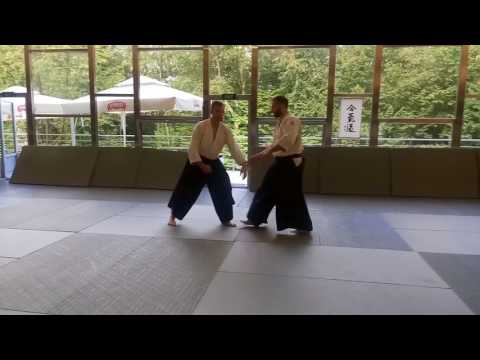
Aiki Nage is the Family-level grouping of the canonical aikido throws — the throws that most explicitly demonstrate the aiki principle of blending with and redirecting the opponent's energy. [1],[2] The six throws under this Family — Kokyu Nage (breath throw), Kaiten Nage (rotary throw), Koshi Nage (aikido hip throw), Tenchi Nage (heaven and earth throw), Tenbin Nage (balance throw), and Juji Nage (cross throw) — are taught across all major aikido lineages (Aikikai, Yoshinkan, Iwama-ryu, Tomiki, Ki Society) as foundational throwing vocabulary. [2],[3] Each throw expresses a different facet of aiki: kokyu-nage uses unified breath and timing to throw without apparent muscular force; kaiten-nage spirals the opponent over the thrower's bowed back; koshi-nage uses the entire body (not just the hip) as the throwing axis; tenchi-nage drives one of the opponent's hands up while the other goes down; tenbin-nage off-balances by hyperextending the elbow; juji-nage crosses the opponent's arms to create a triangular structural failure. [1],[4] The Family is taught after foundational ukemi (breakfall) and basic stance work in nearly every aikido curriculum. [3]
The canonical aiki nage throws were systematised by Morihei Ueshiba and his senior students during the 1930s-1950s, formalising techniques that derived from Daito-ryu aiki-jujutsu (Sokaku Takeda) and earlier koryu jujutsu. [1],[2] The six throws here — kokyu-nage, kaiten-nage, koshi-nage, tenchi-nage, tenbin-nage, juji-nage — appear in nearly every aikido curriculum across all major lineages. [2],[3] The naming and forms were standardised principally through the writings of Kisshomaru Ueshiba (Aikikai), Gozo Shioda (Yoshinkan), and Morihiro Saito (Iwama-ryu) in the 1960s-1980s. [3],[4]
The aiki nage throws are highly effective when applied with correct timing against committed attacks — the original training context. [1] They are notoriously difficult to apply against non-committing or grappling-trained opponents who refuse the kuzushi. [2] At elite level, aikidoka who cross-train in judo or BJJ (e.g., Tomiki, modern Shodokan) demonstrate that aiki principles can be adapted for competitive randori, but the pure forms are best understood as movement vocabulary rather than competitive sport techniques. [1],[2],[3]
Изображений для этой техники пока нет.
Войдите, чтобы предложить изображение.
Учебных курсов по этой технике пока нет.
Войдите, чтобы предложить курс.
Риск травмы для человека, к которому применяется техника
Risk arises from improper ukemi (breakfall) more than the throws themselves. Joint-engagement throws (tenbin-nage, juji-nage) can damage elbows if uke does not follow the technique
Уровень мастерства, необходимый для надёжного выполнения техники
Разрешена ли техника по основным соревновательным правилам
Budo: Teachings of the Founder of Aikido (Ueshiba, posthumous 1991 compilation)
Description sources — [1] Budo: Teachings of the Founder (Ueshiba); [2] The Spirit of Aikido (K. Ueshiba); [3] Total Aikido (Shioda); [4] Traditional Aikido (Saito)
Lineage sources — [1] Daito-ryu Aikijujutsu Conversations (Pranin); [2] The Spirit of Aikido (K. Ueshiba); [3] Total Aikido (Shioda); [4] Traditional Aikido (Saito)
Effectiveness sources — [1] Tomiki cross-style essays (Aikido Journal); [2] modern competitive aikido critique; [3] biomechanics analyses (Pranin Aikido Journal archive)
Aikido technique naming conventions
Standard Japanese martial arts terminology (kanji/hiragana)
Established Japanese martial arts naming convention — native Japanese term (和語/漢語)
Description sources — [1] Budo: Teachings of the Founder (Ueshiba); [2] The Spirit of Aikido (K. Ueshiba); [3] Total Aikido (Shioda); [4] Traditional Aikido (Saito)
Lineage sources — [1] Daito-ryu Aikijujutsu Conversations (Pranin); [2] The Spirit of Aikido (K. Ueshiba); [3] Total Aikido (Shioda); [4] Traditional Aikido (Saito)
Effectiveness sources — [1] Tomiki cross-style essays (Aikido Journal); [2] modern competitive aikido critique; [3] biomechanics analyses (Pranin Aikido Journal archive)
hip mobility, ukemi (breakfall) skill, lateral footwork, sensitivity in the contact point
hip rotators, core (rotation control), lats and shoulders (extending blends), forearms (grip release/redirection)
Каждое движение в любом боевом искусстве обладает рядом универсальных свойств. Комбинируйте параметры ниже, чтобы найти нужный инструмент или сравнить аналоги из разных стилей.
Juji Nage (literally 'cross throw' or 'X throw', from juji 十字 — the kanji shape of the cross) is an aikido throw in which the aikidoka crosses the opponent's arms over each other and then off-balances them through the structural failure that the crossed-arms position creates. [1,2] The cross can be created in two main ways: by drawing one of the opponent's arms across their own body to meet the other, or by stepping under one arm to cross it over the other from below. [1,3] Once the arms are crossed, the opponent's structure is fundamentally compromised — they cannot use both arms independently to recover, and their centre is exposed. [2,4] The aikidoka then projects them through the cross by either driving forward (a forward sacrifice variant) or by stepping back and pulling them through (a backward variant). [3] Juji nage is taught at intermediate-to-advanced levels because it requires careful timing and a clean entry — premature crossing without off-balance produces a tangled position rather than a clean throw. [1,2] The throw is closely related to Daito-ryu's juji-garami (cross-entanglement) techniques. [3,4]
Kaiten Nage (rotary throw) is one of the canonical aikido throws — a spiral throw in which the aikidoka guides the opponent's head down toward the ground while the opponent's arm is extended overhead, producing a wheel-like rotation of the opponent over their own bowed back. [1,2] The throw is named for its kaiten (rotation) motion: the opponent rotates around their own spine like a wheel, with the thrower's hand on the back of their neck pressing forward and down while the other hand extends the opponent's arm forward and up. [1,3] Kaiten nage is most often executed from shomen-uchi (overhead strike) or katate-dori (single wrist grab) entries. [2,4] Two main forms exist: uchi-kaiten-nage (inside rotation, the throw begins inside the opponent's centreline) and soto-kaiten-nage (outside rotation, the throw begins outside the opponent's arm). [3,4] In Aikikai pedagogy, kaiten nage is typically taught from 4th-3rd kyu (intermediate beginner level) because it requires a complete entry plus a clean two-handed off-balance — not a beginner skill. [1,2]
Kokyu Nage (literally 'breath throw') is the most fundamental and widely-practiced throw in aikido — a category of throws unified by the principle of using kokyū (the Japanese concept of unified breath, timing, and ki) to project an opponent without apparent muscular effort. [1,2] Unlike a hip throw or a sacrifice throw, kokyu nage is not defined by a specific mechanical entry but by the quality of the connection: the thrower's centre, breath, and body move as one with the opponent's incoming force, redirecting it into a forward extension that drops the opponent face-down or onto their back. [1,3] Many practitioners describe kokyu nage as 'the throw with no technique' because the apparent throwing action is minimal — the visible motion is mostly the uke (receiver) running themselves into the throw on the wave of their own attack. [2,4] The canonical entries are from katate-dori (single wrist grab), shomen-uchi (overhead strike), and ryote-dori (two-hand grab); each version uses the same kokyū principle expressed through a different point of contact. [3] In Aikikai, Yoshinkan, and Iwama-ryu lineages, kokyu nage is taught from the earliest belt levels because it embodies the core aiki principle — and is also the throw most practitioners struggle with longest, because the principle is felt rather than performed. [1,2]
Koshi Nage is the aikido hip throw — distinct from judo's koshi-waza in that the entire body, not just the hip, serves as the throwing axis. [1,2] In aikido koshi-nage, the thrower turns deeply under the opponent's centre of gravity (a position similar to judo o-goshi or harai-goshi) but uses an arm extension and full-body rotation to project the opponent over the back, rather than relying on the hip as a discrete fulcrum. [1,3] The result is a longer, more spiraling throw: the opponent travels over the thrower's lower back rather than being snapped over a hip-only fulcrum. [2,4] The classic aikido entries are from katate-dori (single wrist grab) and ryote-dori (two-hand grab); the aikidoka pivots inside the line of attack, drops their centre, extends through uke's arm, and projects them across their back. [3,4] Koshi nage is taught at intermediate-to-advanced levels in most aikido lineages because it requires confident ukemi (a long forward roll-out) and committed entry. [1,2]
Tenbin Nage (literally 'scale-beam throw') is an aikido throw that off-balances the opponent by hyperextending their elbow joint while levering against the shoulder, treating the opponent's straightened arm as a tenbin (the beam of a balance scale). [1,2] The throw is mechanically distinct from kokyu nage and kaiten nage in that it uses joint engagement as the primary off-balance vector — the elbow extension creates pain compliance that drives the opponent forward and down. [1,3] Tenbin nage is most commonly applied from sumi-otoshi or katate-dori entries and is closely related to Daito-ryu's ude-nobashi (arm-extension) techniques. [2,4] In Yoshinkan curricula it is sometimes classified separately from the pure aiki throws because of the joint-engagement element; in Aikikai and Iwama-ryu it is taught as a canonical aikido throw at intermediate levels. [3,4] The throw is named for the visual analogy: the opponent's straightened arm becomes the beam of a scale, with the aikidoka's lever applied at the elbow as the fulcrum and the wrist as the load. [1,2]
Tenchi Nage (heaven and earth throw) is one of the canonical aikido throws — a bidirectional throw in which one of the opponent's hands is driven up (heaven, ten 天) while the other is driven down (earth, chi 地), splitting their structure into two opposing vectors and collapsing their balance through the gap between them. [1,2] The throw is most commonly entered from ryote-dori (two-hand grab), where the opponent grabs both of the aikidoka's wrists; the aikidoka extends one hand up and forward (often as if reaching to the sky) while the other drops behind the opponent's near hip (toward the earth), simultaneously stepping off the line of attack. [1,3] The bidirectional split makes recovery nearly impossible — the opponent cannot resist both vectors at once, and their structure collapses backward. [2,4] Tenchi nage is taught in essentially every aikido lineage and appears in the curricula of Aikikai, Yoshinkan, Iwama-ryu, and Tomiki schools. [3] The Yoshinkan form is particularly compact (Gozo Shioda was known for tight, militarily-precise applications); the Iwama-ryu form (Saito) is more elongated and ki-extension-focused. [3,4]
Aiki Nage is the Family encompassing the six canonical aikido throws (Kokyu Nage, Kaiten Nage, Koshi Nage, Tenchi Nage, Tenbin Nage, Juji Nage). All six appear in the curricula of every major aikido lineage. Aikido's koshi-nage is mechanically distinct from judo's koshi-waza — the aikido version uses the entire body as the throwing axis, not just the hip as a fulcrum.
Aiki Nage is the Family-level grouping of the canonical aikido throws — the throws that most explicitly demonstrate the aiki principle of blending with and redirecting the opponent's energy. The six throws under this Family — Kokyu Nage (breath throw), Kaiten Nage (rotary throw), Koshi Nage (aikido hip throw), Tenchi Nage (heaven and earth throw), Tenbin Nage (balance throw), and Juji Nage (cross throw) — are taught across all major aikido lineages (Aikikai, Yoshinkan, Iwama-ryu, Tomiki, Ki Society) as foundational throwing vocabulary.
The canonical aiki nage throws were systematised by Morihei Ueshiba and his senior students during the 1930s-1950s, formalising techniques that derived from Daito-ryu aiki-jujutsu (Sokaku Takeda) and earlier koryu jujutsu. The six throws here — kokyu-nage, kaiten-nage, koshi-nage, tenchi-nage, tenbin-nage, juji-nage — appear in nearly every aikido curriculum across all major lineages.
IBJJF: разрешён — Legal as throws (no-gi); ADCC: разрешён — Legal; Unified MMA: разрешён — Legal as standing throws
Оценка опасности 4/10. Moderate — risk arises from improper ukemi (breakfall) more than the throws themselves. Joint-engagement throws (tenbin-nage, juji-nage) can damage elbows if uke does not follow the technique
Стандартная цепочка подготовки: Receive Opponent's Attack (Grab or Strike) → Step Off-line (Irimi or Tenkan) → Connect to Opponent's Centre → Off-balance via Spiral or Bidirectional Vector → Execute the Specific Throw → Recover Centred Posture.
Стандартные контрприёмы: Refuse the wrist grab — most aiki nage throws begin from a grab; deny the grip and the technique fails / Stable grappling base — drop the centre of gravity below uke's reach / Non-commitment — without committed forward energy, aiki nage cannot find kuzushi / Counter throw (kaeshi-waza) — at high level, aikidoka practice counters to each other's throws.
Распространённые варианты: Standard form (basic) (taught at beginner level, large clear motion); Henka-waza (variation form) (modifications taught at higher belt levels for different …); Kaeshi-waza (counter form) (counter-throws when uke attempts to reverse the technique); Jiyu-waza (free form) (applied at speed in cooperative randori).
Largely non-competitive (Aikikai, Yoshinkan, Iwama-ryu). Competitive in Tomiki / Shodokan format from 1960s; throws scored in tanto-randori and toshu-randori matches.
Основные ошибки, на которые стоит обратить внимание: Pulling instead of leading — the throw extends the opponent's existing motion, it does not yank them off-line / Wrist-only focus — the connection must reach uke's spine through the joint chain / Forgetting to off-balance first — a balanced opponent cannot be thrown by aiki; muscle is required, which is the wron… / Standing still during the throw — the thrower's centre must move with the throw, not just the arms.
Aiki Nage также известен как Aiki Nage, Aiki-nage, Aiki Throw, 合気投, Aikido Nage-waza (canonical six).