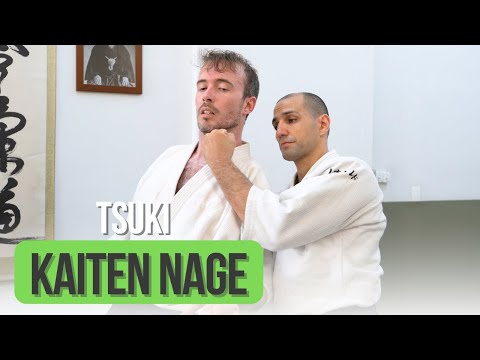
Tsuki Kaiten Nage
0
Kaiten Nage·Leonardo Sodre
Kaiten Nage é uma técnica de Aikido, mas também é encontrada em formas similares no Sumô. É uma técnica básica, que pode…
Перевод: rotary throw / wheel throw
Kaiten Nage (rotary throw) is one of the canonical aikido throws — a spiral throw in which the aikidoka guides the opponent's head down toward the ground while the opponent's arm is extended overhead, producing a wheel-like rotation of the opponent over their own bowed back. [1],[2] The throw is named for its kaiten (rotation) motion: the opponent rotates around their own spine like a wheel, with the thrower's hand on the back of their neck pressing forward and down while the other hand extends the opponent's arm forward and up. [1],[3] Kaiten nage is most often executed from shomen-uchi (overhead strike) or katate-dori (single wrist grab) entries. [2],[4] Two main forms exist: uchi-kaiten-nage (inside rotation, the throw begins inside the opponent's centreline) and soto-kaiten-nage (outside rotation, the throw begins outside the opponent's arm). [3],[4] In Aikikai pedagogy, kaiten nage is typically taught from 4th-3rd kyu (intermediate beginner level) because it requires a complete entry plus a clean two-handed off-balance — not a beginner skill. [1],[2]
Kaiten nage was systematised by Morihei Ueshiba and his senior students during the 1930s-1950s, derived from rotary principles found in Daito-ryu aiki-jujutsu under Sokaku Takeda. [1],[2] The throw appears in nearly every aikido curriculum from at least Kisshomaru Ueshiba's 1957 Aikido onward. [2] Saito's Iwama-ryu codification in the 1970s formalised both uchi and soto variants explicitly. [3],[4]
Kaiten nage is one of the most demonstrable aikido throws in cooperative practice — the rotary motion is visually striking and reliable when uke commits to a strike or grab. [1] In non-cooperative contexts the throw is harder to land because the entry requires uke to extend their arm or commit to a strike; non-committing opponents can refuse the entry. [2] The throw appears in Tomiki / Shodokan competitive randori and is occasionally seen in MMA in modified form (especially as a counter to overhand strikes). [3]
Изображений для этой техники пока нет.
Войдите, чтобы предложить изображение.
Kaiten Nage é uma técnica de Aikido, mas também é encontrada em formas similares no Sumô. É uma técnica básica, que pode…
Учебных курсов по этой технике пока нет.
Войдите, чтобы предложить курс.
Риск травмы для человека, к которому применяется техника
High — the rotation puts significant pressure on the opponent's neck and shoulder; insufficient ukemi (the receiver must learn the rotary breakfall) creates real injury risk. The uke must roll forward and over their own arm; failure to rotate cleanly can stress the cervical spine
Уровень мастерства, необходимый для надёжного выполнения техники
Разрешена ли техника по основным соревновательным правилам
Aikido (Kisshomaru Ueshiba, 1957)
Description sources — [1] The Spirit of Aikido (K. Ueshiba); [2] Aikido (K. Ueshiba 1957); [3] Total Aikido (Shioda); [4] Traditional Aikido Vol 1 (Saito)
Lineage sources — [1] Daito-ryu Aikijujutsu Conversations (Pranin); [2] Aikido (K. Ueshiba 1957); [3] Traditional Aikido (Saito); [4] Total Aikido (Shioda)
Effectiveness sources — [1] Aikikai pedagogy; [2] modern critique (Aikido Journal); [3] Tomiki/Shodokan competition records
Aikido technique naming conventions
Standard Japanese martial arts terminology (kanji/hiragana)
Established Japanese martial arts naming convention — native Japanese term (和語/漢語)
Description sources — [1] The Spirit of Aikido (K. Ueshiba); [2] Aikido (K. Ueshiba 1957); [3] Total Aikido (Shioda); [4] Traditional Aikido Vol 1 (Saito)
Lineage sources — [1] Daito-ryu Aikijujutsu Conversations (Pranin); [2] Aikido (K. Ueshiba 1957); [3] Traditional Aikido (Saito); [4] Total Aikido (Shioda)
Effectiveness sources — [1] Aikikai pedagogy; [2] modern critique (Aikido Journal); [3] Tomiki/Shodokan competition records
shoulder mobility, hip rotation, balance through the throw, sensitivity in two-hand contact
deltoids and lats (extending arm), hip rotators (centre lead), core (rotation control)
Kaiten Nage (rotary throw) — opponent rotates around their own spine like a wheel. Two main forms: uchi-kaiten-nage (inside rotation) and soto-kaiten-nage (outside rotation). Requires committed entry and the receiver to know rotary ukemi (front roll-out from bowed posture).
Kaiten Nage (rotary throw) is one of the canonical aikido throws — a spiral throw in which the aikidoka guides the opponent's head down toward the ground while the opponent's arm is extended overhead, producing a wheel-like rotation of the opponent over their own bowed back. The throw is named for its kaiten (rotation) motion: the opponent rotates around their own spine like a wheel, with the thrower's hand on the back of their neck pressing forward and down while the other hand extends the opponent's arm forward and up.
Kaiten nage was systematised by Morihei Ueshiba and his senior students during the 1930s-1950s, derived from rotary principles found in Daito-ryu aiki-jujutsu under Sokaku Takeda. The throw appears in nearly every aikido curriculum from at least Kisshomaru Ueshiba's 1957 Aikido onward.
IBJJF: разрешён — Legal as throw; ADCC: разрешён — Legal; Unified MMA: разрешён — Legal as standing throw
Оценка опасности 5/10. Moderate-high — the rotation puts significant pressure on the opponent's neck and shoulder; insufficient ukemi (the receiver must learn the rotary breakfall) creates real injury risk. The uke must roll forward and over their own arm; failure to rotate cleanly can stress the cervical spine
Стандартная цепочка подготовки: Receive Strike (Shomen-uchi) or Wrist Grab → Step Off-line → Catch Uke's Wrist or Striking Hand → Extend Uke's Arm Overhead → Press Uke's Head Forward and Down → Project Through Rotation → Recover Centre.
Стандартные контрприёмы: Refuse the strike commitment — uke must throw a real strike for kaiten nage to find purchase / Stiff-arm or block the off-line step before the rotation forms / Drop the centre of gravity to refuse the bow-down vector / Counter throw (kaeshi-waza) — at advanced level, aikidoka practice counter-throws to kaiten nage.
Распространённые варианты: Uchi-kaiten-nage (Inside rotation, throw begins inside opponent's centreline); Soto-kaiten-nage (Outside rotation, throw begins outside opponent's arm); Suwari-waza kaiten-nage (Kneeling form (formal training)); Hanmi-handachi (Thrower kneeling, uke standing); Yoshinkan compact form (Linear, tighter rotation favoured in Yoshinkan curriculum).
Appears in Tomiki / Shodokan toshu-randori. Modified variants seen in MMA as counters to overhand strikes.
Основные ошибки, на которые стоит обратить внимание: Pressing the head down without extending the arm — this produces a face-first slam, not a rotary throw, and is danger… / Pulling the arm without bowing the head — this produces a sloppy off-balance with no projection / Stopping mid-rotation — the rotation must continue until uke is committed forward; halting mid-throw lets uke recover / Trying to muscle the throw — kaiten nage is leverage-based; if force is required, the entry was wrong.
Kaiten Nage также известен как Kaiten-nage, Kaiten Nage, Rotary Throw, Wheel Throw, 回転投.