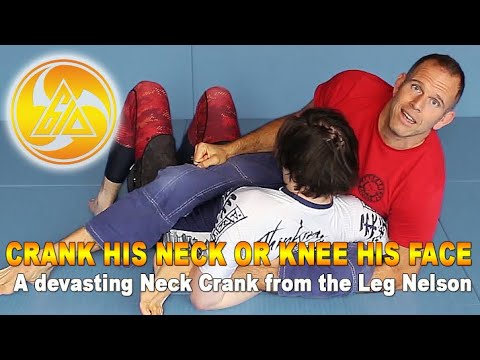
Crank his neck or knee his face - A devasting Neck Crank from the Leg Nelson
0
Jaw Pry Face Crank·EffortlessJiuJitsu
In this video BJJ Blackbelt Björn Friedrich shows a very effective combination of Leg Nelson and a powerful Neck Crank. …
Перевод: Jaw Prying / Wrenching
The jaw pry face crank from rear mount uses the fingers or hands to pry the opponent's jaw open and to the side, creating cervical rotation stress and intense mandibular pain. [1] From rear mount, the attacker hooks the fingers under the chin or around the jawline and pulls upward and to one side, forcing the cervical spine into combined extension and lateral rotation. [1],[2] The jaw serves as a lever arm — applying force at the jaw creates a long moment arm that transmits torque to the cervical vertebrae. [2] This technique is legal in most grappling rulesets but is considered a crank rather than a choke, and many practitioners tap due to pain rather than loss of consciousness risk. [2],[3]
Jaw manipulation techniques appear in traditional Japanese jujutsu and European catch wrestling as methods of forcing an opponent's neck into vulnerable positions. [1] The rear mount application became a recognised competition technique in MMA and no-gi grappling where neck cranks are permitted. [2],[3]
The jaw pry uses the fingers or hand under the chin to create a cervical extension crank by prying the head backward. [1]
Jaw pry techniques appear in self-defence systems and catch wrestling. [1]
Jaw pry face cranks are legal in MMA competition. [1]
Изображений для этой техники пока нет.
Войдите, чтобы предложить изображение.
In this video BJJ Blackbelt Björn Friedrich shows a very effective combination of Leg Nelson and a powerful Neck Crank. …
Учебных курсов по этой технике пока нет.
Войдите, чтобы предложить курс.
Риск травмы для человека, к которому применяется техника
Face cranks use the jaw or orbital ridge as a lever to torque the cervical spine
Уровень мастерства, необходимый для надёжного выполнения техники
Разрешена ли техника по основным соревновательным правилам
Koryu Jujutsu — Tenjin Shin'yo-ryu, Takenouchi-ryu densho
Japanese terminology sourced from Koryu Jujutsu — Tenjin Shin'yo-ryu, Takenouchi-ryu densho
Classical schools: Tenjin Shin'yo-ryu, Takenouchi-ryu, etc.
Standard Japanese martial arts terminology (kanji/hiragana)
Established Japanese martial arts naming convention — native Japanese term (和語/漢語)
Japanese terminology sourced from Koryu Jujutsu — Tenjin Shin'yo-ryu, Takenouchi-ryu densho
grip or squeeze strength, positional control
strong upper body for sustained compression
forearms, biceps, pectorals, core stabilisers
The jaw pry face crank is extremely dangerous—applying full power can cause serious injury requiring surgery. According to EffortlessJiuJitsu, you should always practice with control and care, remembering that you only have one spine and want to train jiu jitsu for a long time.
EffortlessJiuJitsu explains that the technique uses body mechanics and hip drive—similar to a deadlift motion—which generates one of the strongest forces the human body can produce, applied directly against the fragile spine.
Once the position is properly set with both arms trapped and the opponent lifted and positioned correctly, they have very limited escape options, according to EffortlessJiuJitsu.
EffortlessJiuJitsu recommends learning defensive knowledge of this technique so you won't be caught off guard if someone else uses it against you.
The jaw pry face crank from rear mount uses the fingers or hands to pry the opponent's jaw open and to the side, creating cervical rotation stress and intense mandibular pain. From rear mount, the attacker hooks the fingers under the chin or around the jawline and pulls upward and to one side, forcing the cervical spine into combined extension and lateral rotation.
Jaw manipulation techniques appear in traditional Japanese jujutsu and European catch wrestling as methods of forcing an opponent's neck into vulnerable positions. The rear mount application became a recognised competition technique in MMA and no-gi grappling where neck cranks are permitted.
IBJJF: запрещён — Neck cranks and spinal locks prohibited at all belt levels; IJF: запрещён — Neck cranks prohibited; ADCC: разрешён — Legal; Unified MMA: разрешён — Legal — choke submissions are among the most common finishes in MMA; FIAS Sport Sambo: запрещён — All chokes prohibited in Sport Sambo; FIAS Combat Sambo: разрешён — Legal
Оценка опасности 8/10. Face cranks use the jaw or orbital ridge as a lever to torque the cervical spine
Стандартная цепочка подготовки: Achieve Controlling Position → Isolate the Neck → Set the Grip → Apply Pressure.
Стандартные контрприёмы: Tuck Chin — protect the neck by lowering the chin to prevent the choke from sinking / Two-on-One Grip Fight — use both hands to strip the choking grip before it locks / Turn Into — rotate toward the choking arm to relieve carotid pressure / Posture Up — straighten the spine and create distance to break the choking angle.
Распространённые варианты: Standard grip variation (primary hand configuration for maximum choking pressure); Gi variation (uses the lapel or collar as an anchor for additional fric…); No-gi variation (adapted grip and positioning for submission grappling wit…); Transition finish (applied during a positional change to catch the opponent …).
Jaw pry face cranks are legal in MMA competition.
Основные ошибки, на которые стоит обратить внимание: Using the jaw pry as a violent wrench — the pry should be progressive; sudden jaw manipulation risks TMJ injury and f… / Inserting fingers into the eyes or nose — target only the jaw; fingers in the face are illegal in all competitions an… / Relying solely on the jaw pry without transitioning to a choke — the pry opens the chin; immediately follow with the … / Using the jaw pry from a position without back control — the pry requires stability; from inferior positions, the opp….
Jaw Pry Face Crank также известен как Ago Kujiki, Jaw Pry, Mandible Crank, Jaw-Lever Face Crank.