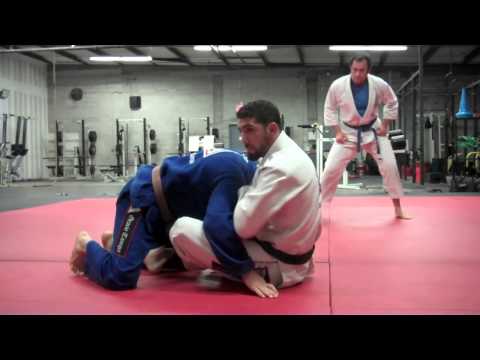
Standard Loop Choke

Разновидность

Перевод: Loop Choke (katakana loanword)

Дистанция и классификация

Категория
Удар и защитаЗамкиБлижний бойБой против нескольких
Дистанция
БлижняяСредняяДальняя
Целевая зона
Верхняя частьСредняя частьНижняя часть

Обзор

The standard loop choke from guard is a gi strangulation where the attacker feeds one hand deep into the opponent's collar, loops it around the back of the neck, and uses the closed guard to trap the opponent's posture while the lapel tightens around the throat. [1] The 'loop' refers to the circular path the gi collar travels — starting at the far collar, wrapping behind the neck, and returning to create a noose-like compression. [1],[2] The attacker typically initiates the choke when the opponent drops their head while attempting to pass, allowing the collar hand to swoop around the neck in a single fluid motion. [2] The closed guard ensures the opponent cannot posture away from the tightening loop. [2],[3]

Также известна как
Classic Loop Choke[1]Standard Lapel Loop[2]
Используется в

История и происхождение

The loop choke was popularised by BJJ competitor Leo Vieira in the early 2000s, who demonstrated its effectiveness at the highest levels of international competition. [1] The technique quickly spread through the BJJ community and became a staple attack from guard and half guard positions. [2],[3]

Страна происхождения· показано в случайном порядке

  • БразилияБразильское джиу-джитсу, Сабмишн-грэпплинг, ММА
  • ЯпонияБразильское джиу-джитсу, Дзюдо, Сабмишн-грэпплинг
  • СШАСабмишн-грэпплинг, ММА
  • РоссияСамбо

Эффективность

The standard loop choke is the fundamental collar-loop strangle, executed with a quick grab-and-pull motion. [1]

Родословная

The standard loop choke was codified as a competition technique in modern gi BJJ. [1]

Соревновательные результаты

The standard loop choke is one of the more commonly finished collar chokes at IBJJF competition. [1]

Изображения

Изображений для этой техники пока нет.

Войдите, чтобы предложить изображение.

Биомеханический механизм

Primary ActionCross-collar or lapel-driven compression of the carotid arteries using gi material as a friction anchor
Joints InvolvedCervical spine (flexion or lateral bend), wrists and forearms (grip and rotation)
Force VectorOpposing forearm rotation creates a scissors effect across both sides of the neck
Gi FactorLapel fabric increases friction and distributes force over a wider surface area, making the choke harder to escape

Позиция и вход

From back control with seatbeltEstablish hooks or body triangle, slide choking arm under the chin, connect hands and squeeze
From turtle top (back take)Break down the turtle, insert hooks, secure seatbelt grip, slide to back control and apply the choke
From standing back clinchSecure rear body lock, drag opponent to the mat while inserting hooks, transition to choking position

Варианты

Standard grip variationprimary hand configuration for maximum choking pressure
Gi variationuses the lapel or collar as an anchor for additional friction and control
No-gi variationadapted grip and positioning for submission grappling without the gi
Transition finishapplied during a positional change to catch the opponent off-guard

Видео

Best Loop Choke Technique (top and bottom)

0
Standard Loop Choke·Matt Arroyo Jiu Jitsu

http://www.MattArroyo.com Matt Arroyo teaches the loop choke from top and from bottom at Gracie Tampa South MMA. These

1 video

Изучить технику

Учебных курсов по этой технике пока нет.

Войдите, чтобы предложить курс.

Оценки

Уровень опасности

Риск травмы для человека, к которому применяется техника

8
Очень высокий8/10

The standard loop choke is the most common variant, typically applied during guard passing

Сложность

Уровень мастерства, необходимый для надёжного выполнения техники

Продвинутый
Допустимость на соревнованиях

Разрешена ли техника по основным соревновательным правилам

Запрещено
FIAS Sport Sambo — All chokes prohibited in Sport Sambo
FIAS International Sambo Competition RulesPDF
Ограничено
no-gi competition only — technique requires gi
ADCC Rules Update, April 2025PDF
technique requires gi — not applicable in MMA
Unified Rules of MMA, August 2025PDF
Разрешено
IBJJF — Legal at all belt levels, gi and no-gi — chokes a...
IBJJF Rules Book v6.0, June 2024PDF
FIAS Combat Sambo — Legal
FIAS Combat Sambo RulesPDF

Заметки по тренировке

The standard loop choke is the fundamental version of the loop choke applied from guard when the opponent initiates a guard pass or drives forward — the collar grip and forearm encircle the neck as the attacker falls to the side (Camarillo, Submit Everyone, 2008)
Setup from closed or butterfly guard: establish a deep cross-collar grip with four fingers inside the far lapel, then wait for the opponent to drive forward or attempt a pass
As the opponent commits forward: sweep the gripping arm's forearm around the back of their head while maintaining the collar grip — their head is now caught in the loop between your forearm and the collar
The fall: drop to the collar-grip side while pulling the opponent's head down — gravity and your body weight tighten the loop around the neck
The standard version emphasises the guard-to-submission transition: no sweep or positional change is needed — the choke is the direct attack from guard
The collar grip depth determines the choke quality: the deeper the grip, the tighter the loop — shallow grips create uncomfortable pressure but not a submission
Timing is the primary skill: the loop must close as the opponent drives forward — too early and they haven't committed, too late and they've passed the optimal angle

Типичные ошибки

!Initiating the loop while the opponent is sitting back — the standard loop requires forward pressure; against a retreating opponent, the loop opens rather than tightens
!Falling to the wrong side — fall to the collar-grip side; falling opposite opens the loop
!Keeping the legs closed in guard during the finish — open the guard and fall to the side; closed guard restricts the lateral movement needed
!Not pulling the head down with the looping arm — the forearm must actively pull the head into the loop; a passive arm allows the opponent to posture
!Attempting with a thumb-in collar grip — four fingers inside provides the depth and anchor; thumb-in grips are shallower and weaker
!Not following the opponent if they try to stack — if they drive up, maintain the grip and roll underneath; the loop can finish from various angles
!Treating the loop choke as a desperation move — it is a systematic technique that requires deliberate setup and timing, not a hail-Mary grab

Связанные техники

Контрприёмы

Цепочка подготовки

1Achieve Controlling Positionsecure the position from which the choke is applied
2Isolate the Neckclear defending hands and establish access to the throat
3Set the Griplock the choking configuration (arm, lapel, or leg placement)
4Apply Pressuresqueeze to compress the carotid arteries for the finish

Источники и ссылки

Основной источник

柔術B (jiujitsu-b.com) choke technique summary

Major Japanese BJJ publication — comprehensive technique lists

2ДругоеJapanese Combat Sports Katakana Convention

Standard katakana transliteration of Western martial arts terminology (外来語) — used in Japanese MMA, boxing, and BJJ communities

3Цитата柔術B (jiujitsu-b.com) choke technique summary

Japanese terminology sourced from 柔術B (jiujitsu-b.com) choke technique summary

Сообщество

Атлетизм

Requires

grip or squeeze strength, positional control

Favours

strong upper body for sustained compression

Key muscles

forearms, biceps, pectorals, core stabilisers

Часто задаваемые вопросы

Where exactly should my wrist contact the neck when setting up the loop choke?

According to Matt Arroyo, you want to curl your wrist so it touches the neck, with your knuckle (rather than your thumb) making contact at the throat—this positioning is critical for proper setup.

How do I finish the loop choke once I have my opponent on their side?

Matt Arroyo explains that you keep your grip on the leg, position your shoulder on their head, then drop your shoulder under theirs while pushing into their shoulder to complete the choke.

What's the key to baiting my opponent into the choke position?

Matt Arroyo emphasizes making it look like you want to wrestle rather than choke—push into your opponent so they naturally come back, then smack their head down and lift your body high to get their head under your armpit.

What should I avoid when dropping my shoulder to prevent my opponent escaping?

Matt Arroyo stresses that your shoulder must hit over the opponent's arm and over their head—if you leave their face, they will pop their head out and escape.

Как работает Standard Loop Choke?

The standard loop choke from guard is a gi strangulation where the attacker feeds one hand deep into the opponent's collar, loops it around the back of the neck, and uses the closed guard to trap the opponent's posture while the lapel tightens around the throat. The 'loop' refers to the circular path the gi collar travels — starting at the far collar, wrapping behind the neck, and returning to create a noose-like compression.

Откуда происходит Standard Loop Choke?

The loop choke was popularised by BJJ competitor Leo Vieira in the early 2000s, who demonstrated its effectiveness at the highest levels of international competition. The technique quickly spread through the BJJ community and became a staple attack from guard and half guard positions.

Разрешён ли Standard Loop Choke на соревнованиях?

IBJJF: разрешён — Legal at all belt levels, gi and no-gi — chokes are the safest submission cat…; IJF: разрешён — Legal (shime-waza) — strangulation techniques are one of three permitted subm…; ADCC: ограничен — N/A (no-gi competition only — technique requires gi); Unified MMA: ограничен — N/A (technique requires gi — not applicable in MMA); FIAS Sport Sambo: запрещён — All chokes prohibited in Sport Sambo; FIAS Combat Sambo: разрешён — Legal

Насколько опасен Standard Loop Choke?

Оценка опасности 8/10. The standard loop choke is the most common variant, typically applied during guard passing

Как подготовить Standard Loop Choke?

Стандартная цепочка подготовки: Achieve Controlling Position → Isolate the Neck → Set the Grip → Apply Pressure.

Как защититься от Standard Loop Choke?

Стандартные контрприёмы: Tuck Chin — protect the neck by lowering the chin to prevent the choke from sinking / Two-on-One Grip Fight — use both hands to strip the choking grip before it locks / Turn Into — rotate toward the choking arm to relieve carotid pressure / Posture Up — straighten the spine and create distance to break the choking angle.

Какие есть варианты Standard Loop Choke?

Распространённые варианты: Standard grip variation (primary hand configuration for maximum choking pressure); Gi variation (uses the lapel or collar as an anchor for additional fric…); No-gi variation (adapted grip and positioning for submission grappling wit…); Transition finish (applied during a positional change to catch the opponent …).

Насколько эффективен Standard Loop Choke на соревнованиях?

The standard loop choke is one of the more commonly finished collar chokes at IBJJF competition.

Какие типичные ошибки при выполнении Standard Loop Choke?

Основные ошибки, на которые стоит обратить внимание: Initiating the loop while the opponent is sitting back — the standard loop requires forward pressure; against a retre… / Falling to the wrong side — fall to the collar-grip side; falling opposite opens the loop / Keeping the legs closed in guard during the finish — open the guard and fall to the side; closed guard restricts the … / Not pulling the head down with the looping arm — the forearm must actively pull the head into the loop; a passive arm….

Какие ещё названия есть у Standard Loop Choke?

Standard Loop Choke также известен как Rūpu Chōku, Classic Loop Choke, Standard Lapel Loop.