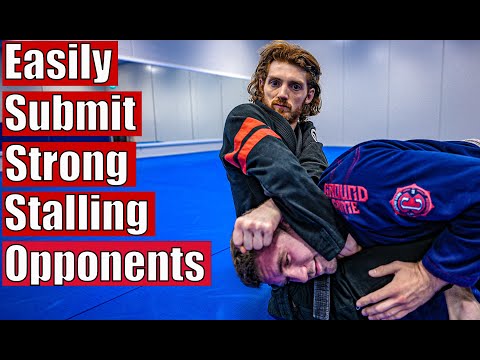
The Easiest Way to Submit Strong Stalling Opponents
0
Loop Choke·JonThomasBJJ
This video I go through a simple system to create offense vs a strong stalling opponent. The key to attacking a stalling…
Перевод: Loop Choke (katakana loanword)
The loop choke is executed by feeding the opponent's collar around their neck from underneath — typically from half guard, butterfly guard, or during a sprawl — creating a looping noose that constricts as the attacker pulls the collar tail while controlling the head. [1],[2] The attacker grips deep into the collar, loops the fabric over and around the opponent's head, and then closes the loop by pulling down while driving their forearm into the throat or carotid. [1] The loop choke is effective during transitions when the opponent shoots for a takedown or passes guard. [1],[3]
The loop choke gained prominence in BJJ competition through practitioners like Leo Vieira and other butterfly guard specialists who used it as a counter-attack during guard passing exchanges. [1],[2] While the basic collar-loop mechanic has parallels in judo's nami-jūji-jime, the specific loop-around-the-head application was systematized in Brazilian Jiu-Jitsu during the late 1990s and 2000s. [1],[3]
The loop choke uses a collar grip looped around the opponent's neck to create a quick strangle, often catching opponents during guard passing attempts. [1]
The loop choke was popularised in BJJ competition as a surprise submission during transitions. [1]
Loop chokes are a common competition submission in gi BJJ, frequently catching passers off-guard. [1]
Изображений для этой техники пока нет.
Войдите, чтобы предложить изображение.
This video I go through a simple system to create offense vs a strong stalling opponent. The key to attacking a stalling…
LOOP CHOKE BY THOMAS LISBOA - BJJ Techniques // In this BJJ Techniques video, Thomas Lisboa demonstrates hot to do the…
HEISTING LOOP CHOKE Tutorial https://bjjfanatics.com Nicholas Meregali teaches how to do the Heisting Loop Choke in thi…
The loop choke is a collar-based strangulation that leverages positional control and timing to trap an opponent's neck using the attacker's arm and forearm. JonThomasBJJ emphasizes the technique from a collar-sleeve grip while controlling the opponent's posture with foot placement on the hip and bicep, initiating the choke by dipping the wrist forward to create a pocket for the neck, then threading the top arm over and through underneath the forearm before securing the leg over the back to prevent escape. BJJ Fanatics' Thomas Lisboa stresses that the loop choke requires a loose collar grip rather than a deep one, and is most effective from closed guard where leg positioning prevents the opponent from spinning away—a primary defense in open guard. He highlights the importance of opening the guard, posting the opponent's hand down, sitting up, and angling the hips to generate pressure on the neck. Nicholas Meregali (BJJ Fanatics) teaches the loop choke from high-stem position, where the attacker uses a foot placement between the opponent's legs to maintain connection and prevent escape. Meregali emphasizes bringing the elbow up first before the hand when executing the technical stand-up, keeping the grip tight with three fingers, and sliding the knee toward the opponent to force a sprawl that creates submission opportunities or facilitates leg wrapping. All three instructors agree the technique requires precise timing, proper arm positioning, and controlling the opponent's ability to rotate, though they present different contextual setups: JonThomasBJJ from collar-sleeve with foot control, Lisboa from closed guard, and Meregali from standing positions.
Сформировано на основе 3 инструкторов
Учебных курсов по этой технике пока нет.
Войдите, чтобы предложить курс.
Риск травмы для человека, к которому применяется техника
Loop choke tightens as the opponent moves forward, making it a strong counter to passing
Уровень мастерства, необходимый для надёжного выполнения техники
Разрешена ли техника по основным соревновательным правилам
柔術B (jiujitsu-b.com) choke technique summary
Major Japanese BJJ publication — comprehensive technique lists
Standard katakana transliteration of Western martial arts terminology (外来語) — used in Japanese MMA, boxing, and BJJ communities
Japanese terminology sourced from 柔術B (jiujitsu-b.com) choke technique summary
grip or squeeze strength, positional control
strong upper body for sustained compression
forearms, biceps, pectorals, core stabilisers
Каждое движение в любом боевом искусстве обладает рядом универсальных свойств. Комбинируйте параметры ниже, чтобы найти нужный инструмент или сравнить аналоги из разных стилей.
The loop choke from guard is applied when the bottom player threads one hand behind the opponent's neck and grips their own collar or the opponent's collar, creating a loop of fabric around the neck that compresses the carotid arteries. [1,2] As the opponent attempts to pass or posture, the guard player tightens the loop by pulling the collar hand toward their own chest while using the legs to control distance and hip angle. [1] The choke tightens progressively as the opponent moves forward, making it an effective counter to guard passing attempts. [1,2]
The loop choke from mount is applied by threading one hand behind the opponent's neck and gripping the collar to form a loop of fabric while in the mounted position. [1] The attacker uses the mount's weight advantage to keep the opponent flat while pulling the collar grip tight, compressing the carotid arteries through the looped fabric. [1,2] This variation can be set up when the opponent turns to their side to escape mount, exposing the space behind the neck needed to thread the loop grip. [1,2]
According to Thomas Lisboa, many people struggle with the loop choke because they try it only once or twice and give up, but the technique requires consistent practice to understand the correct positioning. Additionally, Lisboa emphasizes that you need a loose grip on the collar—if your grip is too deep, you won't be able to apply the choke effectively.
Thomas Lisboa explains that in open guard, a main defense to the loop choke is for your opponent to spin to the side and escape, but in closed guard your legs prevent them from turning, making the choke far more effective.
Thomas Lisboa teaches that you cannot rely on squeezing alone to finish—instead, you must stay tight with both hands, bring your wrist in close, and angle your body properly to make your opponent tap. The finish requires controlling posture and positioning, not just grip strength.
According to Jon Thomas, when a strong opponent pulls their elbow tight to defend, they must lower their posture to do so, which makes the loop choke very easy to set up by dipping your wrist forward to create a pocket for their neck.
The loop choke is executed by feeding the opponent's collar around their neck from underneath — typically from half guard, butterfly guard, or during a sprawl — creating a looping noose that constricts as the attacker pulls the collar tail while controlling the head. The attacker grips deep into the collar, loops the fabric over and around the opponent's head, and then closes the loop by pulling down while driving their forearm into the throat or carotid.
The loop choke gained prominence in BJJ competition through practitioners like Leo Vieira and other butterfly guard specialists who used it as a counter-attack during guard passing exchanges. While the basic collar-loop mechanic has parallels in judo's nami-jūji-jime, the specific loop-around-the-head application was systematized in Brazilian Jiu-Jitsu during the late 1990s and 2000s.
IBJJF: разрешён — Legal at all belt levels, gi and no-gi — chokes are the safest submission cat…; IJF: разрешён — Legal (shime-waza) — strangulation techniques are one of three permitted subm…; ADCC: ограничен — N/A (no-gi competition only — technique requires gi); Unified MMA: ограничен — N/A (technique requires gi — not applicable in MMA); FIAS Sport Sambo: запрещён — All chokes prohibited in Sport Sambo; FIAS Combat Sambo: разрешён — Legal
Оценка опасности 8/10. Loop choke tightens as the opponent moves forward, making it a strong counter to passing
Стандартная цепочка подготовки: Achieve Controlling Position → Isolate the Neck → Set the Grip → Apply Pressure.
Стандартные контрприёмы: Tuck Chin — protect the neck by lowering the chin to prevent the choke from sinking / Two-on-One Grip Fight — use both hands to strip the choking grip before it locks / Turn Into — rotate toward the choking arm to relieve carotid pressure / Posture Up — straighten the spine and create distance to break the choking angle.
Распространённые варианты: Standard grip variation (primary hand configuration for maximum choking pressure); Gi variation (uses the lapel or collar as an anchor for additional fric…); No-gi variation (adapted grip and positioning for submission grappling wit…); Transition finish (applied during a positional change to catch the opponent …).
Loop chokes are a common competition submission in gi BJJ, frequently catching passers off-guard.
Основные ошибки, на которые стоит обратить внимание: Attempting without a deep collar grip — the grip must be past the centre line for the loop to reach around the head / Waiting for the opponent to stop moving — the loop choke works on forward motion; initiate when the opponent drives i… / Looping the arm over the head instead of around it — the forearm must sweep behind the head, catching it in the crook… / Not falling to the side — the loop choke finishes by falling to the collar-grip side; staying upright doesn't generat….
Loop Choke также известен как Rūpu Chōku, Loop Lapel Choke, Head-Loop Strangle, Lapel Loop.