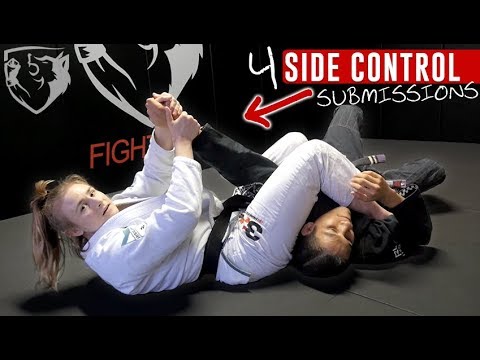
4 BJJ Submissions From Side Control
0
Side Control·fightTIPS
BJJ Coach Erin Herle is back with Vince 'The Anomaly' to show you 4 submissions from a very dominant side control positi…
Перевод: side control
The Side Control family covers the dominant top position where the controlling fighter lies perpendicular to the bottom fighter, chest-to-chest, having passed the guard to achieve a lateral pin. [1] Side control is one of the most important positions in grappling because it is the most commonly achieved dominant position after passing the guard, and it provides a stable platform for attacks while the bottom fighter has limited options. [1],[2] This family covers standard side control, kesa gatame (scarf hold), and twister side control, each offering different control mechanics and submission opportunities. [2],[3]
Side control is one of the primary dominant positions in grappling, providing the top fighter with strong pinning control and access to submissions, transitions to mount, and knee-on-belly. [1] Ribeiro describes side control as the consolidation position after a guard pass, from which the top player should advance to mount or back. [2] Side control scores three points in IBJJF competition (as part of a guard pass). [3]
Side control is a fundamental dominant position in BJJ, judo, and MMA. [1]
Изображений для этой техники пока нет.
Войдите, чтобы предложить изображение.
BJJ Coach Erin Herle is back with Vince 'The Anomaly' to show you 4 submissions from a very dominant side control positi…
Учебных курсов по этой технике пока нет.
Войдите, чтобы предложить курс.
Риск травмы для человека, к которому применяется техника
Top positions enable pressure and striking; rib compression risk under heavy pressure
Уровень мастерства, необходимый для надёжного выполнения техники
Разрешена ли техника по основным соревновательным правилам
Jiu-Jitsu University (Saulo Ribeiro, 2008)
Alias sources — [1] IBJJF Rules and Regulations [2] Mastering Jujitsu (Gracie & Danaher, 2003) [3] Kodokan Judo (Kano, 1986) [4] IBJJF Rules and Regulations
Effectiveness sources — [1] Mastering Jujitsu (Gracie & Danaher, 2003) [2] Jiu-Jitsu University (Ribeiro, 2008) [3] IBJJF Rules and Regulations
Standard Japanese martial arts terminology (kanji/hiragana)
Established Japanese martial arts naming convention — native Japanese term (和語/漢語)
Alias sources — [1] IBJJF Rules and Regulations [2] Mastering Jujitsu (Gracie & Danaher, 2003) [3] Kodokan Judo (Kano, 1986) [4] IBJJF Rules and Regulations
Effectiveness sources — [1] Mastering Jujitsu (Gracie & Danaher, 2003) [2] Jiu-Jitsu University (Ribeiro, 2008) [3] IBJJF Rules and Regulations
hip flexibility, active legs, grip management
long legs for distance control and guard retention
hip flexors, adductors, quadriceps, core, grip
Каждое движение в любом боевом искусстве обладает рядом универсальных свойств. Комбинируйте параметры ниже, чтобы найти нужный инструмент или сравнить аналоги из разных стилей.
The Kesa Gatame subfamily covers the scarf hold variation of side control, where the controlling fighter wraps one arm around the opponent's head and the other controls the near arm, with the hips turned to face the opponent's head. [1] Kesa gatame is one of the most traditional pinning positions in judo, providing extremely strong pinning pressure through the hip-and-shoulder weight distribution. [1,2] The position has several variations including standard kesa, modified kesa (kuzure-kesa-gatame), and reverse kesa, each with different control and attack options. [2,3]
The Standard Side Control subfamily covers the basic lateral side control position where the top fighter lies perpendicular to the bottom fighter, using chest pressure and arm controls to maintain the pin. [1] Standard side control is the most commonly achieved and maintained top position in grappling, serving as the primary position after guard passing and the transition point to mount, knee-on-belly, and north-south. [1,2] Variations include chest-to-chest, crossface, and underhook side control, each using different upper body control mechanics. [2,3]
The Twister Side Control subfamily covers the side control variation specific to the 10th Planet Jiu-Jitsu system, where the top fighter sets up the twister submission (a spinal lock) from a modified side control position. [1] Twister side control involves a specific body positioning and grip that enables the twister finish — a rotational submission that attacks the spine. [1,2] The position is unique to the 10th Planet system and requires specific set-up sequences from standard side control. [2,3]
Uki Gatame is a judo hold-down where the attacker controls the opponent from a floating position — lying across the opponent's chest without heavy body contact, using arm and leg control to maintain the pin. [1] Unlike the heavy pressure of Kesa Gatame, Uki Gatame uses skeletal alignment and positioning to maintain control with minimal energy expenditure. [1]
Side control (yoko-shiho-gatame in judo, cross-side in wrestling) is the primary controlling position after passing the guard. It scores 3 points in IBJJF competition as a guard pass. (IBJJF Rules v6.0; Ribeiro, Jiu-Jitsu University)
If your opponent's elbow gets to the mat, they can shrimp out and bring their knee in to create space, undoing all your work to establish the position. According to fightTIPS, you should keep their elbow up and stay on your toes ready to move.
Pull your opponent up so your elbow is on top of your thigh with your legs spread open, trapping their arm. This keeps them from escaping while you maintain a solid side control position, as explained in fightTIPS.
Keep your foot flexed and shaped around your opponent's hip—this is the most important part for maintaining pressure. If they move at all, you move with them; if they don't move, your foot is posted as a base for control.
Don't try to stay too rigid; if your opponent turns and you move with them, you can open up submission opportunities like the arm bar or guillotine. According to fightTIPS, staying too tight when they turn can result in you getting swept to the bottom.
The Side Control family covers the dominant top position where the controlling fighter lies perpendicular to the bottom fighter, chest-to-chest, having passed the guard to achieve a lateral pin. Side control is one of the most important positions in grappling because it is the most commonly achieved dominant position after passing the guard, and it provides a stable platform for attacks while the bottom fighter has limited options.
Side control is one of the foundational pinning positions in both judo (yoko-shiho-gatame/lateral four-corner hold) and wrestling. BJJ expanded the side control system with additional variations and a comprehensive submission curriculum from the position.
IBJJF: разрешён — Legal, mount scores 4 points — highest-scoring position; IJF: разрешён — Legal, osaekomi (pin) — 10-19 seconds scores waza-ari, 20 seconds scores ippon; ADCC: разрешён — Legal, mount scores 2 points; Unified MMA: разрешён — Legal dominant position; UWW: разрешён — Legal, back exposure scores points, pin ends match by fall; FIAS Sport Sambo: разрешён — Legal, pin scores points
Оценка опасности 3/10. Moderate — top positions enable pressure and striking; rib compression risk under heavy pressure
Стандартная цепочка подготовки: Achieve Guard Contact → Control Grips → Manage Distance → Threaten Submissions/Sweeps.
Стандартные контрприёмы: Guard Pass — systematically work to clear the legs and establish a dominant position / Leg Pin — control one or both legs to neutralize guard retention / Pressure Passing — use heavy chest pressure to flatten and immobilize the guard player.
Распространённые варианты: Standard guard (primary leg and grip configuration for control and attack…); Offensive guard (configured for sweeps and submissions); Defensive guard (prioritising distance management and preventing passes); Transition guard (moving between guard types to adjust to the opponent's pa…).
Side control is a fundamental dominant position in BJJ, judo, and MMA.
Основные ошибки, на которые стоит обратить внимание: Lying on top of the opponent without pressure — sink the hips and drive the chest into them / Not using the crossface — the crossface is the primary control; without it, the opponent can turn in and escape / Keeping the hips too high — low hips prevent the opponent from creating space underneath / Staying in side control without advancing — advance to mount, knee on belly, or attack submissions.
Side Control также известен как Yoko-shiho-gatame, Side Mount, Cross Body, Yoko Shiho Gatame, 100 Kilos.