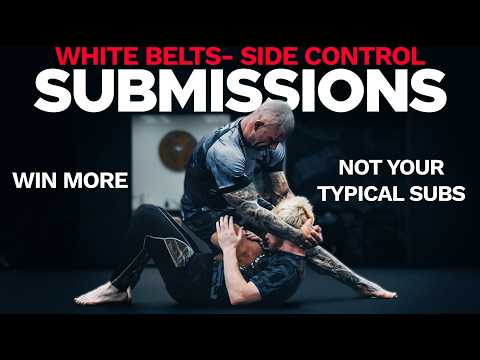
3 Easy Side Control Submissions
0
Standard Side Control·Will Brooks Official
Dominate from side control with these three submission options: a choke, an armbar, and one absolutely mean crushing fin…
Перевод: standard side control
The Standard Side Control subfamily covers the basic lateral side control position where the top fighter lies perpendicular to the bottom fighter, using chest pressure and arm controls to maintain the pin. [1] Standard side control is the most commonly achieved and maintained top position in grappling, serving as the primary position after guard passing and the transition point to mount, knee-on-belly, and north-south. [1],[2] Variations include chest-to-chest, crossface, and underhook side control, each using different upper body control mechanics. [2],[3]
Side control is one of the most commonly achieved dominant positions in BJJ and MMA competition. [1]
Изображений для этой техники пока нет.
Войдите, чтобы предложить изображение.
Dominate from side control with these three submission options: a choke, an armbar, and one absolutely mean crushing fin…
Учебных курсов по этой технике пока нет.
Войдите, чтобы предложить курс.
Риск травмы для человека, к которому применяется техника
Top positions enable pressure and striking; rib compression risk under heavy pressure
Уровень мастерства, необходимый для надёжного выполнения техники
Разрешена ли техника по основным соревновательным правилам
Jiu-Jitsu University (Saulo Ribeiro, 2008)
Alias sources — [1] Kodokan Judo (Kano, 1986) [2] Jiu-Jitsu University (Ribeiro, 2008) [3] Mastering Jujitsu (Gracie & Danaher, 2003) [4] Mastering Jujitsu (Gracie & Danaher, 2003)
Effectiveness sources — [1] Mastering Jujitsu (Gracie & Danaher, 2003) [2] Jiu-Jitsu University (Ribeiro, 2008)
Mixed Japanese-Western terminology — combines traditional Japanese terms with katakana loanwords
Alias sources — [1] Kodokan Judo (Kano, 1986) [2] Jiu-Jitsu University (Ribeiro, 2008) [3] Mastering Jujitsu (Gracie & Danaher, 2003) [4] Mastering Jujitsu (Gracie & Danaher, 2003)
Effectiveness sources — [1] Mastering Jujitsu (Gracie & Danaher, 2003) [2] Jiu-Jitsu University (Ribeiro, 2008)
hip flexibility, active legs, grip management
long legs for distance control and guard retention
hip flexors, adductors, quadriceps, core, grip
Каждое движение в любом боевом искусстве обладает рядом универсальных свойств. Комбинируйте параметры ниже, чтобы найти нужный инструмент или сравнить аналоги из разных стилей.
The Chest-To-Chest Side Control emphasises maximum chest pressure against the bottom fighter's chest, using bodyweight compression as the primary control mechanism while the arms control the head and far hip. [1] The chest-to-chest configuration provides the strongest pinning pressure and is the most difficult side control to escape because the top fighter's weight is directly on the bottom fighter's breathing. [1,2] It is the default side control control position taught in most BJJ academies. [2,3]
The Crossface Side Control uses a crossface — driving the forearm across the bottom fighter's face from jaw to shoulder — as the primary upper body control from side control. [1] The crossface turns the bottom fighter's head away, which limits their ability to turn into the top fighter, create frames, or set up escape sequences. [1,2] Crossface side control is one of the most effective side control configurations because the head control restricts the bottom fighter's options dramatically. [2,3]
The Underhook Side Control uses an underhook on the far arm as the primary upper body control, with the other arm controlling the head or near hip. [1] The underhook provides strong control of the bottom fighter's upper body while leaving the head relatively free, which creates different tactical dynamics than crossface side control. [1,2] The underhook side control is particularly effective for transitioning to mount, as the underhook facilitates stepping over to mount position. [2,3]
According to Will Brooks, you want to avoid placing your knee directly on the opponent's hips since the pelvis is strong and won't restrict breathing effectively. Instead, target the diaphragm area higher up on the torso.
Will Brooks notes that you'll see the opponent's face turn bright red and veins pop out—this is your landmark that you're doing it right. Hold the position for a couple seconds, as it typically takes time rather than being an instant tap.
Will Brooks explains that after establishing an underhook and applying downward pressure through the elbow, step wide and place your free hand on the mat behind your opponent's back, then step over their head while spinning off your back leg and keeping your hips close to their body.
The Standard Side Control subfamily covers the basic lateral side control position where the top fighter lies perpendicular to the bottom fighter, using chest pressure and arm controls to maintain the pin. Standard side control is the most commonly achieved and maintained top position in grappling, serving as the primary position after guard passing and the transition point to mount, knee-on-belly, and north-south.
Standard side control derives from judo's yoko-shiho-gatame (lateral four-corner hold) and is one of the most fundamental positions in all grappling systems. BJJ developed an extensive curriculum of attacks and transitions from the position.
IBJJF: разрешён — Legal, mount scores 4 points — highest-scoring position; IJF: разрешён — Legal, osaekomi (pin) — 10-19 seconds scores waza-ari, 20 seconds scores ippon; ADCC: разрешён — Legal, mount scores 2 points; Unified MMA: разрешён — Legal dominant position; UWW: разрешён — Legal, back exposure scores points, pin ends match by fall; FIAS Sport Sambo: разрешён — Legal, pin scores points
Оценка опасности 3/10. Moderate — top positions enable pressure and striking; rib compression risk under heavy pressure
Стандартная цепочка подготовки: Achieve Guard Contact → Control Grips → Manage Distance → Threaten Submissions/Sweeps.
Стандартные контрприёмы: Guard Pass — systematically work to clear the legs and establish a dominant position / Leg Pin — control one or both legs to neutralize guard retention / Pressure Passing — use heavy chest pressure to flatten and immobilize the guard player.
Распространённые варианты: Standard guard (primary leg and grip configuration for control and attack…); Offensive guard (configured for sweeps and submissions); Defensive guard (prioritising distance management and preventing passes); Transition guard (moving between guard types to adjust to the opponent's pa…).
Side control is one of the most commonly achieved dominant positions in BJJ and MMA competition.
Основные ошибки, на которые стоит обратить внимание: Settling into one side control configuration permanently — alternate between different arm positions and pressures / Not following the opponent's escape attempts — when they shrimp, adjust; when they bridge, resettle / Keeping both arms on one side — one arm crossfaces, the other controls the far side / Allowing the opponent to get both arms inside — at least one arm should be controlled from standard side control.
Standard Side Control также известен как Sutandādo Yoko-shiho-gatame, Cross Side, Hundred Kilos, Side Mount, Yoko Shiho Gatame (横四方固め).