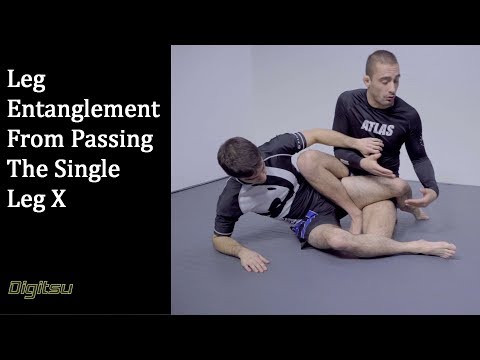
Leg Entanglement From Passing The Single Leg X
0
Leg Entanglement·Digitsu
Jason Rau: Dynamic No-Gi Passing and Attacking
Not yet documented
The Leg Entanglement (Ashi Garami) family covers the system of leg-on-leg control positions that serve as the platform for all modern leg lock attacks — the positional hierarchy that revolutionised submission grappling in the 2010s. [1] Ashi garami (足絡み, 'leg entanglement') positions control the opponent's leg by entangling it with both of the attacker's legs, isolating the target leg and preventing escape while creating the specific angles needed for heel hooks, kneebars, toe holds, and ankle locks. [1],[2] The four primary ashi garami positions — inside sankaku (inside triangle, the most dominant), outside ashi (standard ashi garami), 50/50 (symmetrical entanglement), and cross ashi (cross body leg entanglement) — each provide different control levels and submission options, forming a positional hierarchy parallel to the traditional mount/side control/back control hierarchy. [2],[3] John Danaher's systematisation of ashi garami positions as a coherent positional system is considered one of the most important technical innovations in modern grappling history. [3]
While leg entanglements existed in catch wrestling, sambo, and earlier BJJ, they were not systematised as a positional hierarchy until John Danaher developed the ashi garami system in the 2010s. [1] Dean Lister advocated for leg lock importance before Danaher, famously telling a young Gordon Ryan 'why would you ignore 50% of the body?' [1],[2] The Danaher Death Squad (Eddie Cummings, Garry Tonon, Gordon Ryan, Nicky Ryan) proved the system's effectiveness by dominating EBI tournaments from 2014 onward, and Gordon Ryan's ADCC dominance (2019, 2022) cemented ashi garami as an essential grappling skill set. [2],[3]
Ashi garami is the most effective positional system for leg lock submissions. The inside heel hook from inside sankaku is the highest-percentage submission in no-gi competition at the elite level. [1] Gordon Ryan's competitive record demonstrates that the ashi garami system can defeat the world's best grapplers. [2],[3]
Изображений для этой техники пока нет.
Войдите, чтобы предложить изображение.
Jason Rau: Dynamic No-Gi Passing and Attacking
Учебных курсов по этой технике пока нет.
Войдите, чтобы предложить курс.
Риск травмы для человека, к которому применяется техника
Leg entanglements enable heel hooks, which can destroy the knee's ligaments (ACL, MCL, meniscus) with minimal pain warning before catastrophic failure; the danger makes proper training methodology essential
Уровень мастерства, необходимый для надёжного выполнения техники
Разрешена ли техника по основным соревновательным правилам
Leg Lock Anthology (John Danaher, BJJ Fanatics instructional)
Description sources — [1] Danaher's Leg Lock Anthology system [2] Dean Lister's advocacy and Danaher Death Squad history [3] Gordon Ryan ADCC competition record
Standard katakana transliteration of Western martial arts terminology (外来語) — used in Japanese MMA, boxing, and BJJ communities
Description sources — [1] Danaher's Leg Lock Anthology system [2] Dean Lister's advocacy and Danaher Death Squad history [3] Gordon Ryan ADCC competition record
leg dexterity (entangling), hip control (maintaining position), grip strength (securing the heel)
long legs (easier to entangle), flexible hips, strong adductors (squeezing)
adductors (squeezing the entanglement), hip flexors (positioning), forearms (heel grip), core (adjusting body angle)
Каждое движение в любом боевом искусстве обладает рядом универсальных свойств. Комбинируйте параметры ниже, чтобы найти нужный инструмент или сравнить аналоги из разных стилей.
The Inside Heel Hook Entry covers the specific pathways used to enter inside sankaku (saddle) ashi garami for the inside heel hook — the most dangerous submission in modern grappling. [1] Entries include transitions from outside ashi, inversions from guard, Imanari rolls from standing, and backsteps from passing positions. [1,2]
Inside Sankaku (also called the Saddle, Honey Hole, or Game Over position) is the most dominant leg entanglement position in modern grappling — a configuration where the attacker's legs form a triangle around the opponent's thigh from the inside, with the outside knee controlling the hip line, creating the optimal angle for the inside heel hook, the most devastating submission in grappling. [1] Inside sankaku is to the leg lock game what mount is to the positional game: the apex of the hierarchy, the position from which the highest-percentage finishes occur, and the position every leg lock player aspires to achieve. [1,2] The position was systematised by John Danaher and demonstrated by his students (Eddie Cummings, Gordon Ryan, Garry Tonon) who proved that inside sankaku with proper heel control produces finishes at the highest levels of no-gi competition. [2,3] Once inside sankaku is established with the heel secured, escape is extremely difficult because the triangled legs prevent the opponent from extracting their leg, and the inside heel hook attacks the knee ligaments (ACL, MCL) with minimal pain warning before catastrophic failure. [3]
The Knee Knot is a leg entanglement position where the attacker's legs create a complex knot-like configuration around the opponent's knee — a controlling position primarily used for kneebar attacks and as a transitional position within the ashi garami system. [1] The knee knot provides strong control of the opponent's knee joint, preventing them from straightening or bending the leg to escape. [1,2]
The Reaping Heel Hook covers heel hook attacks applied with a 'reaping' leg configuration — where the attacker's outside leg crosses over the opponent's hip line, creating additional rotational control that amplifies the heel hook's force. [1] 'Reaping' (placing the leg across the opponent's centre line in leg entanglements) is specifically banned in IBJJF competition due to the increased knee injury risk but is legal and commonly used in ADCC, EBI, and MMA. [1,2]
The leg entanglement system was systematized by John Danaher and his students (Gordon Ryan, Garry Tonon, Eddie Cummings) at the Rensenzo Gracie Academy blue basement. Their dominance at EBI and ADCC from 2015–2019 revolutionized leg lock grappling. (Danaher, Enter the System series)
According to Digitsu, putting too much weight on the leg being attacked is critical to avoid—if you drive into your opponent with a weighted leg, they can simply bump you over and you'll already be off-balance and falling.
Keep your second leg back at all times. If your opponent gets hold of it, pummle your toes out through the space between their elbow and ribs by putting your weight on that leg momentarily, circling your toes out, and stepping away.
Step straight up to the ceiling rather than taking a looping step, so your foot clears the opponent's leg. As you step back, weave your leg inside and position your foot near your partner's hip to maintain control.
Keep your foot on the mat at all times—as long as your heel stays down, you won't get heeled. If your opponent manages to turn you across and expose your heel, use both hands with a thumb grip to secure their shin and prevent the reap.
The Leg Entanglement (Ashi Garami) family covers the system of leg-on-leg control positions that serve as the platform for all modern leg lock attacks — the positional hierarchy that revolutionised submission grappling in the 2010s. Ashi garami (足絡み, 'leg entanglement') positions control the opponent's leg by entangling it with both of the attacker's legs, isolating the target leg and preventing escape while creating the specific angles needed for heel hooks, kneebars, toe holds, and ankle locks.
While leg entanglements existed in catch wrestling, sambo, and earlier BJJ, they were not systematised as a positional hierarchy until John Danaher developed the ashi garami system in the 2010s. Dean Lister advocated for leg lock importance before Danaher, famously telling a young Gordon Ryan 'why would you ignore 50% of the body?
IBJJF: разрешён — Legal — guard is fundamental to BJJ, sweeps from guard score 2 points; IJF: ограничен — Guard pulling penalized as non-combativity — groundwork from guard permitted …; ADCC: разрешён — Legal, guard pull penalized -1 point in points portion; Unified MMA: разрешён — Legal — no penalty for playing guard; FIAS Sport Sambo: разрешён — Legal
Оценка опасности 9/10. Very high — leg entanglements enable heel hooks, which can destroy the knee's ligaments (ACL, MCL, meniscus) with minimal pain warning before catastrophic failure; the danger makes proper training methodology essential
Стандартная цепочка подготовки: Enter Guard Position → Thread Legs → Establish Ashi Garami → Control Hip Line → Secure the Heel/Foot → Apply Submission.
Стандартные контрприёмы: Boot (heel slip) — pointing toes to prevent heel hook grip / Hip Escape — clearing the hips past the knee line / Leg Pummeling — fighting with legs to disentangle / Rolling — rolling with the heel hook rotation.
Распространённые варианты: Inside sankaku (saddle/inside heel hook position) (the most dominant entanglement; legs triangled with outsi…); Outside ashi (standard ashi garami) (the basic entanglement; legs wrapped around one leg with …); 50/50 (symmetrical entanglement where both fighters have equal l…); Cross ashi (cross body) (the legs cross the opponent's body; creates a different h…); Backside 50/50 (a variation with the attacker's back facing the opponent); Game over position (Gordon Ryan's term) (inside sankaku with additional arm control [2]); Honey hole (Eddie Cummings' term for inside sankaku).
Ashi garami leg locks are the most common submission finish at ADCC and EBI. Gordon Ryan won 2 ADCC absolute titles using the system.
Основные ошибки, на которые стоит обратить внимание: Attacking submissions without positional control — reaching for the heel without first establishing proper ashi garam… / Not controlling the hip line — the knees must squeeze around the thigh; loose knees allow the opponent to extract the… / Applying heel hooks at full speed in training — this will injure training partners and is the most dangerous mistake … / Crossing the knees incorrectly — in most ashi garami positions, the inside leg (closest to the opponent's hip) should….
Leg Entanglement также известен как Ashi Garami, Leg Lock Position, Leg Knot, 50/50, Inside Ashi.