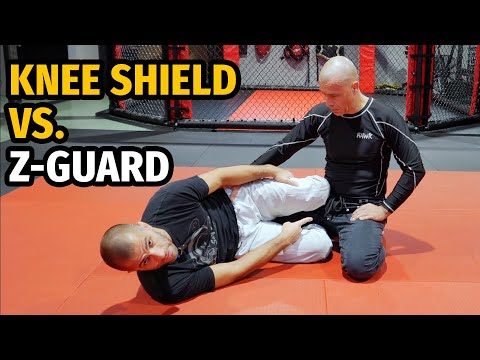
Z-Guard VS. Knee Shield Half Guard
0
Knee Knot·MMA Leech
What are the main differences between Z-Guard and Knee Shield Half Guard? In this video I explain how to set up your Z-G…
Not yet documented
The Knee Knot is a leg entanglement position where the attacker's legs create a complex knot-like configuration around the opponent's knee — a controlling position primarily used for kneebar attacks and as a transitional position within the ashi garami system. [1] The knee knot provides strong control of the opponent's knee joint, preventing them from straightening or bending the leg to escape. [1],[2]
Developed within the modern BJJ competition framework. [1]
Used in IBJJF, ADCC, and/or EBI competition. [1]
Изображений для этой техники пока нет.
Войдите, чтобы предложить изображение.
What are the main differences between Z-Guard and Knee Shield Half Guard? In this video I explain how to set up your Z-G…
Учебных курсов по этой технике пока нет.
Войдите, чтобы предложить курс.
Риск травмы для человека, к которому применяется техника
Varies based on the submissions accessible from this position
Уровень мастерства, необходимый для надёжного выполнения техники
Разрешена ли техника по основным соревновательным правилам
Jiu-Jitsu University (Saulo Ribeiro, 2008)
Description sources — [1] Modern BJJ positional development [2] Competition evolution
Standard katakana transliteration of Western martial arts terminology (外来語) — used in Japanese MMA, boxing, and BJJ communities
Description sources — [1] Modern BJJ positional development [2] Competition evolution
positional awareness, body control, specific attribute for this position
core, hip flexors, legs
Каждое движение в любом боевом искусстве обладает рядом универсальных свойств. Комбинируйте параметры ниже, чтобы найти нужный инструмент или сравнить аналоги из разных стилей.
The knee knot is a leg entanglement that controls the opponent's knee from inside — used to set up kneebars and calf slicers. Part of the modern leg lock system systematized by Danaher. (Danaher, Enter the System; leg lock instructionals)
In knee shield, you trap your opponent's leg with a hook. In Z-guard, you position your top shin on top of the opponent's thigh rather than hooking, which allows you to keep your knees separated and connect your feet together by shooting your bottom leg deeper.
Keeping your knees apart by positioning your top shin on the opponent's thigh prevents them from smashing your knees together and weakening your position. With separated knees, you can lock your feet together and defend against mill kicks more effectively.
Curl your back heel toward your butt with your bottom leg and push your top leg against the opponent's hip to make them sit on their heel. This engaged position makes it very difficult for them to stand up or start passing.
The Knee Knot is a leg entanglement position where the attacker's legs create a complex knot-like configuration around the opponent's knee — a controlling position primarily used for kneebar attacks and as a transitional position within the ashi garami system. The knee knot provides strong control of the opponent's knee joint, preventing them from straightening or bending the leg to escape.
This position developed within the modern BJJ/grappling positional framework as the art evolved.
IBJJF: разрешён — Legal — guard is fundamental to BJJ, sweeps from guard score 2 points; IJF: ограничен — Guard pulling penalized as non-combativity — groundwork from guard permitted …; ADCC: разрешён — Legal, guard pull penalized -1 point in points portion; Unified MMA: разрешён — Legal — no penalty for playing guard; FIAS Sport Sambo: разрешён — Legal
Оценка опасности 5/10. Moderate — varies based on the submissions accessible from this position
Стандартная цепочка подготовки: Establish Entry Position → Transition to This Position → Consolidate Control → Attack or Transition → Maintain or Advance.
Стандартные контрприёмы: Positional escape / Prevention (not allowing the position to be established) / Transition to a more advantageous position.
Распространённые варианты: Standard execution (the fundamental version); Modified variation (adapted for specific scenarios); Transitional version (used as a waypoint between positions).
Used in IBJJF, ADCC, and/or EBI competition.
Основные ошибки, на которые стоит обратить внимание: Entering without proper control / Not understanding the position's purpose / Staying too long without attacking / Not chaining with transitions to other positions.
Knee Knot также известен как Knee Bar Position, Knee Entanglement.