Jiu-Jitsu Escapes | Hail Mary Submission Escapes
0
Submission Defence·Knight Jiu-Jitsu
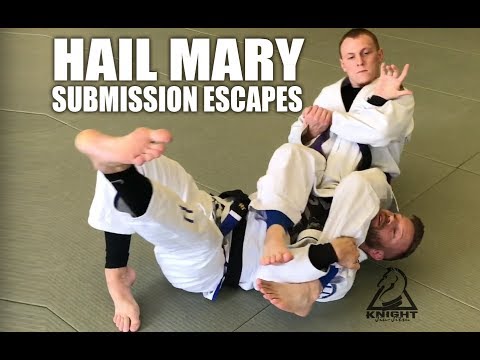
I am a big believer in backup plans at all stages. These are some very late considerations for escapes I refer to as Hai…
Перевод: submission defence
The Submission Defence group encompasses all defensive techniques used to prevent, escape from, or neutralise submission attempts including chokes, joint locks, compressions, and cranks. [1] Submission defence is a critical skill in Brazilian Jiu-Jitsu, MMA, and all grappling arts because a single successful submission ends the contest — therefore, the ability to defend submissions is often the difference between victory and defeat. [1],[2] This group is organised by the type of submission being defended against: choke defence, armlock defence, leglock defence, compression lock defence, crank/twist defence, and grip breaking techniques. [2],[3] Effective submission defence combines technical knowledge (understanding the mechanics of each submission to know where safety lies), positional awareness (knowing when a submission threat exists), and timing (defending before the submission is fully secured). [3]
Submission defence techniques have been developed alongside submission attacks throughout the history of grappling arts. [1] Japanese jujutsu systems included systematic escape training (fusegi) as part of their curriculum, and judo's ne-waza (ground work) developed specific defensive responses to each submission category. [2] Brazilian Jiu-Jitsu greatly expanded the submission defence curriculum as the art's competitive evolution produced increasingly sophisticated submission attacks that demanded equally sophisticated defences. [2],[3]
Submission defence is a core component of BJJ and MMA training. [1]
Submission defence is critical in BJJ and MMA competition. [1]
Изображений для этой техники пока нет.
Войдите, чтобы предложить изображение.
I am a big believer in backup plans at all stages. These are some very late considerations for escapes I refer to as Hai…
This video I breakdown a counter to the shoulder lock from a side headlock or kesa gatame/scarf hold. Check out the det…
Учебных курсов по этой технике пока нет.
Войдите, чтобы предложить курс.
Риск травмы для человека, к которому применяется техника
Submission defence involves resisting joint locks/chokes; risk of injury if defence fails or is delayed
Уровень мастерства, необходимый для надёжного выполнения техники
Разрешена ли техника по основным соревновательным правилам
Kodokan Judo (Jigoro Kano, 1986)
Alias sources — [1] Jiu-Jitsu University (Ribeiro, 2008) [2] Mastering Jujitsu (Gracie & Danaher, 2003) [3] Jiu-Jitsu University (Ribeiro, 2008)
Effectiveness sources — [1] Mastering Jujitsu (Gracie & Danaher, 2003) [2] Jiu-Jitsu University (Ribeiro, 2008)
Standard katakana transliteration of Western martial arts terminology (外来語) — used in Japanese MMA, boxing, and BJJ communities
Alias sources — [1] Jiu-Jitsu University (Ribeiro, 2008) [2] Mastering Jujitsu (Gracie & Danaher, 2003) [3] Jiu-Jitsu University (Ribeiro, 2008)
Effectiveness sources — [1] Mastering Jujitsu (Gracie & Danaher, 2003) [2] Jiu-Jitsu University (Ribeiro, 2008)
grip fighting technique, forearm endurance, timing
strong hands and forearms, quick stripping motions
forearm flexors/extensors, wrist rotators, biceps
Каждое движение в любом боевом искусстве обладает рядом универсальных свойств. Комбинируйте параметры ниже, чтобы найти нужный инструмент или сравнить аналоги из разных стилей.
The Armlock Defence family covers all defensive techniques used to prevent or escape from arm-based joint locks including armbars, kimuras, americanas, and wrist locks. [1] Armlock defence operates on the principle of preventing the opponent from isolating the arm and extending or rotating it past its anatomical limit. [1,2] The primary defensive strategies are grip fighting (preventing the opponent from controlling the arm), stacking (driving weight forward to relieve extension pressure), and the hitchhiker escape (rotating out of the armbar's fulcrum). [2,3]
The Choke Defence family covers all defensive techniques used to prevent or escape from choking attacks including blood chokes (strangulations that compress the carotid arteries), air chokes (compressions of the trachea), and gi-based collar chokes. [1] Choke defence is the most urgent submission defence because chokes can render a person unconscious in as little as 3-5 seconds once fully secured, making early defence critical. [1,2] The primary defensive strategies are chin tucking (preventing access to the neck), hand fighting (preventing the opponent from securing grips), and posture control (maintaining alignment that prevents choke application). [2,3]
The Compression Lock Defence family covers defensive techniques against compression locks (also called muscle crushes or slicers), where the attacker applies pressure across a muscle belly using a bone as a fulcrum. [1] Compression lock defence focuses on preventing the attacker from establishing the fulcrum position and relieving the compressive pressure before tissue damage occurs. [1,2] This family includes arm compression defence (against bicep slicers) and leg compression defence (against calf slicers), each requiring specific defensive mechanics based on the anatomy being attacked. [2,3]
The Crank-Twist Defence family covers defensive techniques against spinal manipulation submissions including neck cranks, can openers, twisters, and spinal locks. [1] Crank defence focuses on preventing the opponent from isolating a section of the spine and applying rotational or compressive force that exceeds the vertebral joints' range of motion. [1,2] These submissions are among the most dangerous because they target the spine and neck — areas where injury can have severe consequences — making early and decisive defence critically important. [2,3]
The Grip Breaking family covers defensive techniques focused on breaking or stripping the opponent's grips to prevent submission setups, guard controls, and positional dominance. [1] Grip breaking is a proactive defensive approach that addresses submissions at their earliest stage — before the submission is applied, and even before the opponent achieves the position for a submission attempt. [1,2] By denying the opponent the grips they need, the defender prevents entire chains of attacks from being initiated. [2,3]
The Leglock Defence family covers all defensive techniques against leg-based submissions including heel hooks, kneebars, toe holds, and ankle locks. [1] Leglock defence has become one of the most critical areas of submission defence in modern grappling due to the explosive growth of leg lock offence in competitive BJJ and MMA. [1,2] The primary defensive strategies are the boot (hiding the foot to prevent grip), hip pressure (driving the hips toward the opponent to relieve rotational force), and leg pummelling (freeing the legs from entanglement). [2,3]
Submission defense encompasses all techniques for preventing or escaping submissions — grip fighting, posture, frame placement, and specific escape sequences for each submission type. The fundamental principle: defend the position, not the submission. If you lose the position (back control, mount), submissions will follow. (Ribeiro, Jiu-Jitsu University; Danaher system)
Knight Jiu-Jitsu explains that it's counterintuitive, but you should defend the non-choking hand to prevent the opponent from creating a sliding collar, wing, or bow and arrow choke variation. By keeping that second hand away and turning toward the non-choking side, you can face the choke and improve your escape position.
Knight Jiu-Jitsu recommends placing your hand on the inside of the opponent's knee, covering their grip hand to prevent a hand switch, then pushing their hips through while pulling the knee to the ground. Once you get to your feet, turn the corner and apply oblique pressure to the knee rather than driving straight, similar to a Hindu push-up motion.
Coach Brian recommends locking their hands and pulling your head in while putting weight on your chest, then turning away and walking toward your knees. The key is to turn your back to your opponent—which is counterintuitive—rather than facing them, as this creates leverage to escape the submission.
Knight Jiu-Jitsu advises against using these late-game escapes as your primary functional defense, as they work best only when you're already in a very bad position.
The Submission Defence group encompasses all defensive techniques used to prevent, escape from, or neutralise submission attempts including chokes, joint locks, compressions, and cranks. Submission defence is a critical skill in Brazilian Jiu-Jitsu, MMA, and all grappling arts because a single successful submission ends the contest — therefore, the ability to defend submissions is often the difference between victory and defeat.
Submission defence techniques have been developed alongside submission attacks throughout the history of grappling arts. Japanese jujutsu systems included systematic escape training (fusegi) as part of their curriculum, and judo's ne-waza (ground work) developed specific defensive responses to each submission category.
Unified MMA: разрешён — Legal defensive technique; IBJJF: разрешён — Legal — defensive techniques are fundamental to grappling; IJF: разрешён — Legal defensive action; ADCC: разрешён — Legal; UWW: разрешён — Legal defensive technique; FIAS Sport Sambo: разрешён — Legal
Оценка опасности 3/10. Moderate — submission defence involves resisting joint locks/chokes; risk of injury if defence fails or is delayed
Стандартная цепочка подготовки: Anticipate the Attack → Execute Defence → Recover Stance → Counter or Disengage.
Стандартные контрприёмы: Timing — attack when the defence is recovering or between movements / Feint — use deception to create openings in the defensive structure / Angle Change — attack from an unexpected angle that the defence does not cover.
Распространённые варианты: Standard defence (primary defensive technique from the most common position); Reactive defence (triggered by the opponent's attack, minimal movement for …); Proactive defence (anticipating the attack and positioning to neutralise it …); Counter defence (using the defensive movement to create an immediate count…).
Submission defence is critical in BJJ and MMA competition.
Основные ошибки, на которые стоит обратить внимание: Waiting until the submission is fully locked to begin defending — fight the grips and setup early / Using strength alone to resist submissions — technical defence is sustainable; muscling out works once then you're ex… / Panicking when caught in a submission — panic wastes energy and leads to poor decisions; stay calm and apply technique / Defending the wrong aspect of the submission — understand what each submission attacks and defend the critical element.
Submission Defence также известен как Sabumisshon Difensu, Sub Defence, Anti-Submission, Submission Prevention.