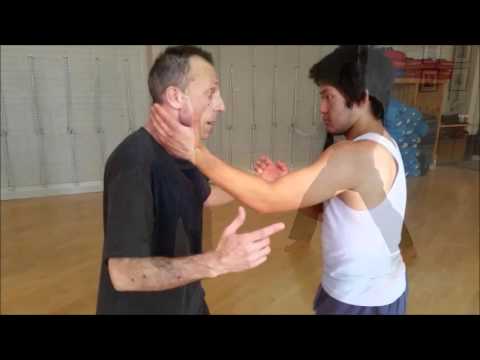
Twist step to repulse monkey - defence against clinch
0
Crank-Twist Defence·Dan Djurdjevic - The Way of Least Resistance
A discussion of how the twist step leading into repulse monkey in the Chen Pan Ling taijiquan form is an excellent defen…
Перевод: crank/twist defence
The Crank-Twist Defence family covers defensive techniques against spinal manipulation submissions including neck cranks, can openers, twisters, and spinal locks. [1] Crank defence focuses on preventing the opponent from isolating a section of the spine and applying rotational or compressive force that exceeds the vertebral joints' range of motion. [1],[2] These submissions are among the most dangerous because they target the spine and neck — areas where injury can have severe consequences — making early and decisive defence critically important. [2],[3]
Defences against spinal manipulation have been part of grappling training since the earliest development of neck crank and spinal lock techniques. [1] The increased prevalence of neck cranks and twisting submissions in modern competition has led to more systematic defensive training for these attacks. [2],[3]
Crank and twist defences prevent neck cranks and spinal twist submissions. [1]
Developed in BJJ and MMA as these submissions became more common. [1]
Used in BJJ and MMA competition. [1]
Изображений для этой техники пока нет.
Войдите, чтобы предложить изображение.
A discussion of how the twist step leading into repulse monkey in the Chen Pan Ling taijiquan form is an excellent defen…
Учебных курсов по этой технике пока нет.
Войдите, чтобы предложить курс.
Риск травмы для человека, к которому применяется техника
Submission defence involves resisting joint locks/chokes; risk of injury if defence fails or is delayed
Уровень мастерства, необходимый для надёжного выполнения техники
Разрешена ли техника по основным соревновательным правилам
Boxing (Edwin Haislet, 1940)
Alias sources — [1] Enter the System (Danaher, 2018) [2] Jiu-Jitsu University (Ribeiro, 2008) [3] Mastering Jujitsu (Gracie & Danaher, 2003)
Effectiveness sources — [1] Mastering Jujitsu (Gracie & Danaher, 2003)
Mixed Japanese-Western terminology — combines traditional Japanese terms with katakana loanwords
Alias sources — [1] Enter the System (Danaher, 2018) [2] Jiu-Jitsu University (Ribeiro, 2008) [3] Mastering Jujitsu (Gracie & Danaher, 2003)
Effectiveness sources — [1] Mastering Jujitsu (Gracie & Danaher, 2003)
reaction speed, structural body mechanics, defensive awareness
quick reflexes and conditioned defensive surfaces
varies — forearms (blocking), legs (movement), core (stability)
Каждое движение в любом боевом искусстве обладает рядом универсальных свойств. Комбинируйте параметры ниже, чтобы найти нужный инструмент или сравнить аналоги из разных стилей.
The Neck Crank Defence subfamily covers defences against submissions that apply rotational or lateral bending force to the cervical spine, including can openers, neck crank variations, and face locks. [1] Neck crank defence prioritises aligning the spine and preventing the opponent from creating the angle needed to apply twisting or bending force to the neck. [1,2] The defender works to tuck the chin, align the spine with the torso, and strip the opponent's grip before the cranking force can build to dangerous levels. [2,3]
The Spinal Twist Defence subfamily covers defences against submissions that apply rotational force to the thoracic or lumbar spine, such as the twister, banana split, and similar techniques that rotate the torso relative to the hips. [1] Spinal twist defence focuses on preventing the opponent from isolating and controlling both the upper and lower body independently, which is the prerequisite for applying rotational force to the spine. [1,2] The defender works to keep the hips and shoulders aligned, preventing the opponent from creating the separation needed for the twist. [2,3]
Neck crank and spinal twist defenses prioritize keeping the chin tucked and the spine aligned. Against the twister, defending the far-side underhook prevents the attacker from establishing the spinal rotation. Against can openers, posture and frame prevent the head from being pulled down. (BJJ instructionals; Danaher, Enter the System)
Push on the opponent's bicep rather than their elbow, as Dan Djurdjevic explains: pushing on the bicep is more effective, whereas pushing on the elbow is weak.
Keep your head away from the opponent's control—don't allow your head to be pulled into a bad position, as this is the worst outcome in the exchange.
If it's too late to drop back cleanly, collapse the distance and pull your weight onto your back leg while lifting your leg to break the opponent's grip.
The Crank-Twist Defence family covers defensive techniques against spinal manipulation submissions including neck cranks, can openers, twisters, and spinal locks. Crank defence focuses on preventing the opponent from isolating a section of the spine and applying rotational or compressive force that exceeds the vertebral joints' range of motion.
Defences against spinal manipulation have been part of grappling training since the earliest development of neck crank and spinal lock techniques. The increased prevalence of neck cranks and twisting submissions in modern competition has led to more systematic defensive training for these attacks.
Unified MMA: разрешён — Legal defensive technique; IBJJF: разрешён — Legal — defensive techniques are fundamental to grappling; IJF: разрешён — Legal defensive action; ADCC: разрешён — Legal; UWW: разрешён — Legal defensive technique; FIAS Sport Sambo: разрешён — Legal
Оценка опасности 3/10. Moderate — submission defence involves resisting joint locks/chokes; risk of injury if defence fails or is delayed
Стандартная цепочка подготовки: Anticipate the Attack → Execute Defence → Recover Stance → Counter or Disengage.
Стандартные контрприёмы: Timing — attack when the defence is recovering or between movements / Feint — use deception to create openings in the defensive structure / Angle Change — attack from an unexpected angle that the defence does not cover.
Распространённые варианты: Standard defence (primary defensive technique from the most common position); Reactive defence (triggered by the opponent's attack, minimal movement for …); Proactive defence (anticipating the attack and positioning to neutralise it …); Counter defence (using the defensive movement to create an immediate count…).
Used in BJJ and MMA competition.
Основные ошибки, на которые стоит обратить внимание: Resisting the crank by pushing in the opposite direction — this creates a two-way force on the spine, increasing inju… / Not recognizing crank setups from common positions like front headlock and crucifix / Treating neck cranks as minor submissions — cervical spine injuries can be catastrophic / Ignoring neck strengthening in training — a strong neck resists cranking force better and buys time for escape.
Crank-Twist Defence также известен как Hineri-waza Difensu, Crank Defence, Spine Lock Defence, Twist Defence.