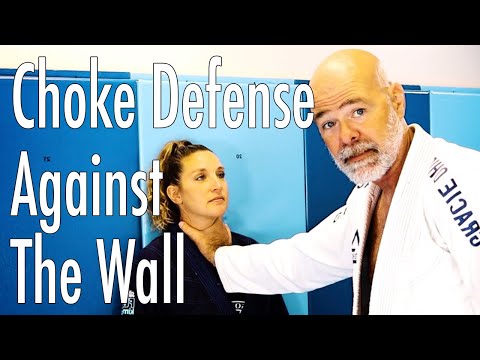
Choke Defense Against the Wall
0
Choke Defence·Gracie Ohio Jiu-Jitsu Academy
We share some defenses to some common attacks in self defense when you are stuck in a confined area and someone tries to…
Перевод: choke defence
The Choke Defence family covers all defensive techniques used to prevent or escape from choking attacks including blood chokes (strangulations that compress the carotid arteries), air chokes (compressions of the trachea), and gi-based collar chokes. [1] Choke defence is the most urgent submission defence because chokes can render a person unconscious in as little as 3-5 seconds once fully secured, making early defence critical. [1],[2] The primary defensive strategies are chin tucking (preventing access to the neck), hand fighting (preventing the opponent from securing grips), and posture control (maintaining alignment that prevents choke application). [2],[3]
Choke defences have been taught alongside choking techniques since the earliest martial arts systems, with Japanese jujutsu and judo including specific defensive responses (fusegi) for each choking method. [1] The urgency of choke defence — due to the rapid onset of unconsciousness — has made it one of the most emphasised defensive categories in competitive grappling. [2],[3]
Choke defence was developed alongside choke systems in judo and BJJ. [1]
Choke defence is critical in MMA and BJJ. [1]
Изображений для этой техники пока нет.
Войдите, чтобы предложить изображение.
We share some defenses to some common attacks in self defense when you are stuck in a confined area and someone tries to…
Учебных курсов по этой технике пока нет.
Войдите, чтобы предложить курс.
Риск травмы для человека, к которому применяется техника
Submission defence involves resisting joint locks/chokes; risk of injury if defence fails or is delayed
Уровень мастерства, необходимый для надёжного выполнения техники
Разрешена ли техника по основным соревновательным правилам
Boxing (Edwin Haislet, 1940)
Alias sources — [1] Jiu-Jitsu University (Ribeiro, 2008) [2] Mastering Jujitsu (Gracie & Danaher, 2003) [3] Jiu-Jitsu University (Ribeiro, 2008)
Effectiveness sources — [1] Mastering Jujitsu (Gracie & Danaher, 2003) [2] Jiu-Jitsu University (Ribeiro, 2008)
Mixed Japanese-Western terminology — combines traditional Japanese terms with katakana loanwords
Alias sources — [1] Jiu-Jitsu University (Ribeiro, 2008) [2] Mastering Jujitsu (Gracie & Danaher, 2003) [3] Jiu-Jitsu University (Ribeiro, 2008)
Effectiveness sources — [1] Mastering Jujitsu (Gracie & Danaher, 2003) [2] Jiu-Jitsu University (Ribeiro, 2008)
grip fighting technique, forearm endurance, timing
strong hands and forearms, quick stripping motions
forearm flexors/extensors, wrist rotators, biceps
Каждое движение в любом боевом искусстве обладает рядом универсальных свойств. Комбинируйте параметры ниже, чтобы найти нужный инструмент или сравнить аналоги из разных стилей.
The Chin Tuck Defence subfamily covers the defensive technique of pulling the chin tight to the chest, creating a barrier of bone and muscle that prevents the opponent from accessing the neck for choking attacks. [1] The chin tuck works by eliminating the space between the chin and chest that the attacker needs to thread their arm or forearm across the throat. [1,2] While the chin tuck is effective as an initial defence, it is considered a temporary measure — skilled attackers can work around the chin tuck by prying the chin up or attacking from alternative angles. [2,3]
The Hand Fighting Defence subfamily covers choke defensive techniques that focus on controlling the opponent's hands and grips to prevent them from securing the choking position. [1] Hand fighting is the most active and proactive form of choke defence — rather than passively blocking access to the neck, the defender actively fights the opponent's hands to strip grips, prevent cross-collar entries, and block the arm from threading under the chin. [1,2] Effective hand fighting defence requires constant tactile awareness and the ability to prioritise which hand to fight based on the choke being attempted. [2,3]
The Posture Defence subfamily covers choke defensive techniques that use body positioning and postural alignment to prevent the opponent from applying choking pressure. [1] Posture defence addresses the root cause of many chokes — broken posture — by maintaining or recovering an upright, aligned body position that makes choke application difficult. [1,2] In closed guard, maintaining an upright posture with the head high and spine straight prevents most cross-collar and guillotine attacks. [2,3]
Choke defense is the most time-critical defense in grappling — a fully locked blood choke causes unconsciousness in 5-10 seconds. The two-on-one grip fight (both hands fighting the choking hand) must begin BEFORE the choke is locked. Once both hands are connected behind the head, escape probability drops dramatically. (Ribeiro, Jiu-Jitsu University; Danaher, Back Attacks)
In real self-defense situations, you may be pushed or knocked against a wall, so it's critical to train this scenario in a controlled environment with proper padding to stay safe while learning to respond effectively.
Reach up with both hands to find and grab one or more of your attacker's fingers—it doesn't matter if you grab one or two fingers, whatever you can get a hold of, pull it out.
Once you pull a finger out, bring your second hand underneath and create a c-grip, rotating your hand over the attacker's grip to get more leverage and peel their hand away.
The Choke Defence family covers all defensive techniques used to prevent or escape from choking attacks including blood chokes (strangulations that compress the carotid arteries), air chokes (compressions of the trachea), and gi-based collar chokes. Choke defence is the most urgent submission defence because chokes can render a person unconscious in as little as 3-5 seconds once fully secured, making early defence critical.
Choke defences have been taught alongside choking techniques since the earliest martial arts systems, with Japanese jujutsu and judo including specific defensive responses (fusegi) for each choking method. The urgency of choke defence — due to the rapid onset of unconsciousness — has made it one of the most emphasised defensive categories in competitive grappling.
Unified MMA: разрешён — Legal defensive technique; IBJJF: разрешён — Legal — defensive techniques are fundamental to grappling; IJF: разрешён — Legal defensive action; ADCC: разрешён — Legal; UWW: разрешён — Legal defensive technique; FIAS Sport Sambo: разрешён — Legal
Оценка опасности 3/10. Moderate — submission defence involves resisting joint locks/chokes; risk of injury if defence fails or is delayed
Стандартная цепочка подготовки: Anticipate the Attack → Execute Defence → Recover Stance → Counter or Disengage.
Стандартные контрприёмы: Timing — attack when the defence is recovering or between movements / Feint — use deception to create openings in the defensive structure / Angle Change — attack from an unexpected angle that the defence does not cover.
Распространённые варианты: Standard defence (primary defensive technique from the most common position); Reactive defence (triggered by the opponent's attack, minimal movement for …); Proactive defence (anticipating the attack and positioning to neutralise it …); Counter defence (using the defensive movement to create an immediate count…).
Choke defence is critical in MMA and BJJ.
Основные ошибки, на которые стоит обратить внимание: Defending chokes too late — once the choke is fully locked and the squeeze begins, escape is nearly impossible; fight… / Using chin tuck as your only defence — the chin tuck buys time but doesn't escape the choke; you must combine it with… / Trying to pull the opponent's hands apart with strength — technical grip breaks (peeling the wrist, two-on-one) work … / Panicking when choked and using explosive, uncontrolled movement — panic wastes energy and often makes the choke tighter.
Choke Defence также известен как Shime-waza Difensu, Strangle Defence, Neck Defence, Anti-Choke.