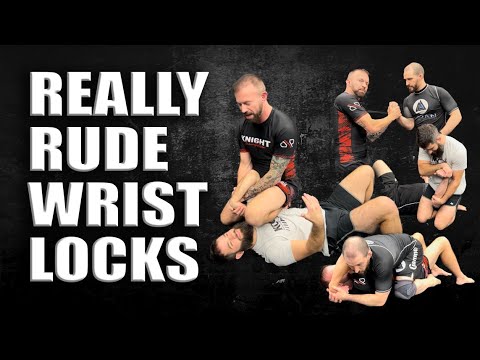
Really Rude Wrist Locks for Submission Grappling
0
Гусешия врат от охрана·Knight Jiu-Jitsu
Wrist locks are With some help from my good friends Shelby Young of Balance Point BJJ in Milford, NH and Aaron Jannetti …
Translation: гусешия врат от охрана
The gooseneck lock derives from traditional jujutsu and aikido wrist manipulation techniques, particularly the kote-gaeshi family, and also appears in Chinese chin na as a core finger-and-wrist control method. [1],[2] Its application from guard represents a modern BJJ adaptation of standing traditional techniques to ground fighting positions. [1] The guard-based gooseneck became a supplementary weapon for guard players seeking joint locks beyond the standard armbar and kimura. [1],[2]
The gooseneck from guard applies wrist lock pressure from the bottom guard position, catching opponents who post their hands. [1]
Guard wrist locks were developed in BJJ as opportunistic submissions against opponents who post their hands to posture up. [1]
Guard wrist locks are used as surprise submissions at brown/black belt IBJJF competition. [1]
No images yet for this technique.
Sign in to suggest an image.
Wrist locks are With some help from my good friends Shelby Young of Balance Point BJJ in Milford, NH and Aaron Jannetti …
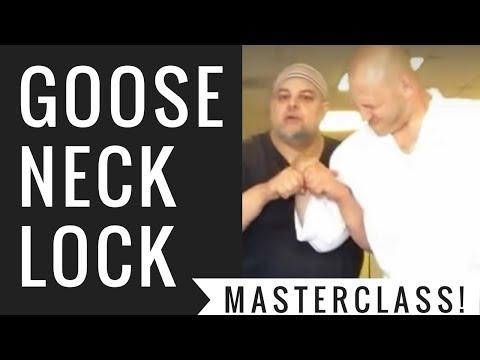
The gooseneck lock is an extremely important joint lock for all security, bouncers and cops to know. But it's also a tri…
Follow Cheat Code Jiu Jitsu on social media: https://www.facebook.com/Cheat-Code-Jiu-Jitsu-2479604595490997 https://www.…
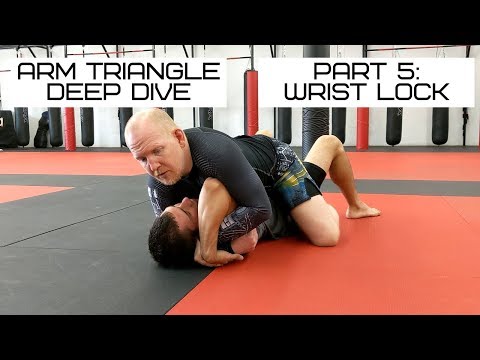
The gooseneck wrist lock is a flexion-based wrist submission characterized by hyperflexion of the opponent's wrist joint, applied with two essential points of control: pressure on the back of the hand and control of the elbow to prevent escape. Cheat Code Jiu Jitsu emphasizes the technique's simplicity and danger, noting that pain escalates rapidly from zero to sixty, requiring careful application to avoid injury. Within the arm triangle setup from guard, the inverted gooseneck variant emerges when the opponent's arm dangles while defending; the attacker weaves the hand to catch the opponent's palm between pinky and wrist, then pulls it down with the knuckles against the mat, applying downward elbow pressure to hyperlex the wrist—a position notably different from the standard gooseneck where pressure applies to the hand itself. Knight Jiu-Jitsu discusses wrist lock mechanics in various contexts, including from standing collar-tie positions and mount position defenses, emphasizing grip placement between knuckles and blade of the hand rather than fingers or wrist top for maximum leverage. Hammerhead Martial Arts presents the gooseneck as a self-defense and professional security tool, detailing hand chops, finger-splitting (two-and-two preferred over thumb-and-three), and thumb placement in the wrist crease as a fulcrum; the technique requires dynamic movement and body weight application rather than static holding. All three instructors agree on the submission's effectiveness and the wrist's vulnerability, though they emphasize different entry contexts: Cheat Code from arm-triangle setups, Knight from multiple positions including omoplata and standing, and Hammerhead from combative striking scenarios.
Synthesized from 3 instructors
No instructional courses yet for this technique.
Sign in to suggest a course.
Risk of injury to the person this technique is applied to
Wrist lock variant targeting carpal and radioulnar joints through forced deviation or torsion
Skill level needed to execute this technique reliably
Whether this technique is allowed under major competition rule sets
Japanese martial arts/BJJ community
Japanese martial arts/BJJ community
Standard katakana transliteration of Western martial arts terminology (外来語) — used in Japanese MMA, boxing, and BJJ communities
Japanese terminology sourced from Japanese martial arts/BJJ community
fine motor control, grip sensitivity, quick hand transitions
dexterous hands with strong fingers
forearm flexors and extensors, intrinsic hand muscles
You should switch hands because your opponent can reach across and peel your fingers back if you don't. Hammerhead Martial Arts emphasizes that switching hands prevents your opponent from breaking your grip by peeling your fingers.
You must move your opponent, not stand still. Hammerhead Martial Arts stresses that if you stay stationary with the lock, your opponent can still slam you in the face even while in pain—you need to push your chest forward and walk them where you want them to go.
Yes, you need some sort of distraction to put on a joint lock. Hammerhead Martial Arts notes that you can use various methods like an uppercut, a knee strike to the thigh, or other distractions to set up the technique effectively.
If your opponent is stiff and strong and resists the wrist bend, Hammerhead Martial Arts indicates this is a common defensive response, especially from people who have experienced the lock before, but the transcript does not provide a specific counter-technique for this scenario.
Заключването на китката тип „гусешия врат
The gooseneck lock derives from traditional jujutsu and aikido wrist manipulation techniques, particularly the kote-gaeshi family, and also appears in Chinese chin na as a core finger-and-wrist control method. Its application from guard represents a modern BJJ adaptation of standing traditional techniques to ground fighting positions.
IBJJF: легална — Legal at all belt levels; IJF: забранена — Only elbow joint locks (kansetsu-waza) permitted in judo — all other joint lo…; ADCC: легална — Legal — all submissions legal in ADCC; Unified MMA: легална — Legal submission technique; FIAS Sport Sambo: легална — Legal; FIAS Combat Sambo: легална — Legal
Оценка на опасност 5/10. Wrist lock variant targeting carpal and radioulnar joints through forced deviation or torsion
Стандартната верига за подготовка: Establish Position → Create the Threat → Secure the Hold → Finish.
Стандартните контри включват: Early Recognition — identify the submission attempt early and begin defence immediately / Posture and Base — maintain strong posture and base to prevent submission setups / Grip Fight — deny the attacker their preferred gripping configuration.
Чести варианти: Standard wrist lock (kote gaeshi) (two-handed rotational lock on the wrist); Gooseneck wrist lock (flexion lock bending the wrist down toward the forearm); Standing wrist lock (applied during grip fighting or a standing exchange); Ground wrist lock (catching the opponent's posted hand from mount, side cont…).
Guard wrist locks are used as surprise submissions at brown/black belt IBJJF competition.
Основни грешки, за които да внимавате: Attempting without weight on the hand — the opponent must be pushing through the hand; if no weight is committed, the… / Opening the guard to apply the lock — maintain closed guard while applying; opening the guard sacrifices control / Not capturing the hand fully — both hands must control the opponent's hand; a partial grip allows escape / Releasing when the opponent starts to escape — maintain the grip even if the wrist lock fails; the hand control creat….
Гусешия врат от охрана е известна също като Gādo kara Gūsu Nekku, Гусешия врат от охрана, Заключване на китката — лебедова шия от охрана.