The Mechanics of Rear Gooseneck (final cut)
0
Gooseneck·David Blanc·Added by Admin
The Rear Gooseneck is easily the most powerful wristlock I've ever encountered in all of my years of martial arts. This…
Translation: Kote Gaeshi Style
The flexion gooseneck wrist lock bends the wrist forward (toward the inner forearm) while curling the fingers backward, creating a gooseneck shape in the flexion direction. [1],[2] The attacker grips the opponent's fingers and palm, pushes the wrist into flexion, and curls the fingers back toward the back of the hand. [1],[3] The combined wrist flexion and finger extension creates compound joint stress that is extremely painful. [1] This is commonly used in self-defense, law enforcement wrist control, and as a submission from various grappling positions. [1],[4]
Gooseneck flexion locks appear in aikido, traditional jujutsu, and chin na as core wrist manipulation techniques. [1],[2],[3] The technique is widely used in police defensive tactics and security training for pain-compliant suspect control. [1] In BJJ, it is applied opportunistically when the opponent's wrist is exposed. [1],[4]
The gooseneck wrist lock flexes the wrist sharply toward the forearm, attacking the wrist joint and surrounding ligaments. [1]
Gooseneck locks appear in aikido (kote-gaeshi family), jūjutsu, and hapkido. [1]
Wrist locks are legal at brown and black belt in IBJJF and in MMA. They are used as surprise submissions at high-level competition. [1]
No images yet for this technique.
Sign in to suggest an image.
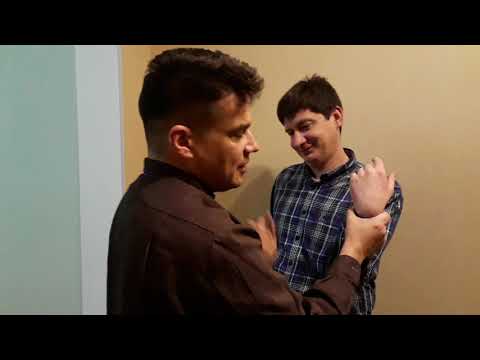
The Rear Gooseneck is easily the most powerful wristlock I've ever encountered in all of my years of martial arts. This…
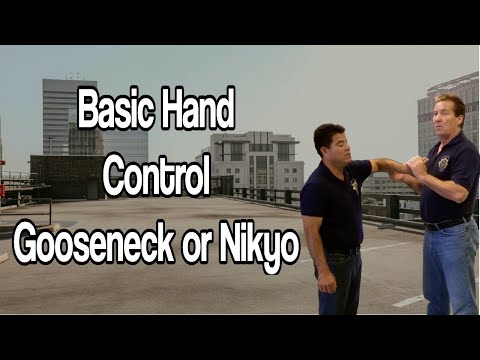
Gooseneck Wrist Lock (Nikyo): Ultimate Self-Defense Technique #aikido #hapkido #martialarts Advance your weapons defen…
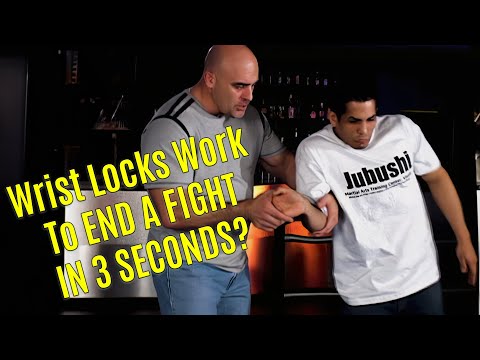
Get Your 15 FREE Brutally Effective... Combat-PROVEN "Fight-Enders" ► https://fightfast.com/yt/bfe Do Finger Locks and …
The gooseneck is a wrist-flexion lock that collapses the opponent's palm toward their forearm, creating a high-pain, low-strength submission applicable across multiple contexts. David Blanc emphasizes the mechanics of the rear gooseneck position: the attacker's head rests on the opponent's shoulder for protection while completely isolating the arm—the elbow blocked by the stomach, the forearm trapped by both arms, and lateral movement prevented. Blanc stresses that maintaining wrist collapse throughout the technique prevents escape, making it effective even against larger opponents; releasing pressure allows the defender to re-straighten the wrist and regain control. Weapons Defense Academy describes the fundamental principle: the hand becomes vertical (resembling a praying position), with the wrist serving as the fulcrum and the entire hand as the lever, applying downward pressure by pulling the hand toward the body while pushing the fingers downward. This instructor emphasizes that the direction of pressure is critical—downward is effective, lateral or upward movements fail. FightFast covers related finger and wrist techniques within a self-defense framework, including inverted wrist pressure where raising the pinky to the sky and pointing downward creates spinal misalignment. All three instructors agree on the technique's effectiveness regardless of size difference and its reliance on precise mechanical leverage rather than muscular strength. Blanc uniquely addresses ethical considerations in life-or-death scenarios versus controlled training or law-enforcement contexts.
Synthesized from 3 instructors
No instructional courses yet for this technique.
Sign in to suggest a course.
Risk of injury to the person this technique is applied to
Wrist lock variant targeting carpal and radioulnar joints through forced deviation or torsion
Skill level needed to execute this technique reliably
Whether this technique is allowed under major competition rule sets
Aikido / Daito-ryu — kote-gaeshi wrist position
Japanese terminology sourced from Aikido / Daito-ryu — kote-gaeshi wrist position
Aikido technique naming conventions
Standard Japanese martial arts terminology (kanji/hiragana)
Established Japanese martial arts naming convention — native Japanese term (和語/漢語)
Japanese terminology sourced from Aikido / Daito-ryu — kote-gaeshi wrist position
fine motor control, grip sensitivity, quick hand transitions
dexterous hands with strong fingers
forearm flexors and extensors, intrinsic hand muscles
Every move, in any martial art, shares a few universal traits. Mix and match below to pinpoint the right tool — or compare equivalents across styles.
According to Weapons Defense Academy, you want to keep your hand absolutely vertical, not at an angle. Think of it like a praying position—place the opponent's hands between your hands, then apply pressure by pulling their hand toward you while pushing their fingers toward their body.
David Blanc emphasizes that you must keep the opponent's elbow completely blocked—their arm has nowhere to go when the elbow is blocked by your stomach, their back blocks one side, and your forearm blocks the other. Maintaining constant pressure on the collapsed wrist prevents them from straightening it to escape.
The critical factor is keeping the opponent's wrist collapsed, according to David Blanc. Once the wrist is collapsed, you can apply significant pain with minimal strength; if you relax and the opponent straightens their wrist, you lose the advantage unless you're significantly stronger.
Weapons Defense Academy instructs to place your finger where the hand meets the wrist, pull inward with that finger while pushing down toward the opponent's body. Point your finger toward their body and push downward—pushing upward, sideways, or in other directions won't be effective.
The flexion gooseneck wrist lock bends the wrist forward (toward the inner forearm) while curling the fingers backward, creating a gooseneck shape in the flexion direction. The attacker grips the opponent's fingers and palm, pushes the wrist into flexion, and curls the fingers back toward the back of the hand.
Gooseneck flexion locks appear in aikido, traditional jujutsu, and chin na as core wrist manipulation techniques. The technique is widely used in police defensive tactics and security training for pain-compliant suspect control.
IBJJF: legal — Legal at all belt levels; IJF: banned — Only elbow joint locks (kansetsu-waza) permitted in judo — all other joint lo…; ADCC: legal — Legal — all submissions legal in ADCC; Unified MMA: legal — Legal submission technique; FIAS Sport Sambo: legal — Legal; FIAS Combat Sambo: legal — Legal
Danger rating 5/10. Wrist lock variant targeting carpal and radioulnar joints through forced deviation or torsion
The standard setup chain: Establish Position → Create the Threat → Secure the Hold → Finish.
Standard counters include: Early Recognition — identify the submission attempt early and begin defence immediately / Posture and Base — maintain strong posture and base to prevent submission setups / Grip Fight — deny the attacker their preferred gripping configuration.
Common variants: Standard wrist lock (kote gaeshi) (two-handed rotational lock on the wrist); Gooseneck wrist lock (flexion lock bending the wrist down toward the forearm); Standing wrist lock (applied during grip fighting or a standing exchange); Ground wrist lock (catching the opponent's posted hand from mount, side cont…).
Wrist locks are legal at brown and black belt in IBJJF and in MMA. They are used as surprise submissions at high-level competition.
Top errors to watch for: Not placing the thumb on the correct part of the hand — the thumb presses between the metacarpal bones on the back of… / Using only thumb pressure without finger pull — both forces are needed: thumb pushes back, fingers pull the palm forward / Applying on a fisted hand — the fist position protects the wrist; the gooseneck requires an open or partially open hand / Not controlling the forearm or elbow — without proximal control, the opponent retracts the entire arm.
The Gooseneck is also known as Kote Gaeshi Gata, Kote-gaeshi Lock, Gooseneck Wrist Lock, Swan Neck Lock.