Definition and Core Principle
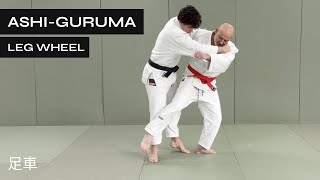
Ashi-guruma (足車, leg wheel) is a throwing technique in which the practitioner wheels the opponent over the extended leg rather than performing a sweep. Despite the name suggesting a leg technique, the throw is mechanically generated by the hands pulling and rotating the opponent's upper body, with the leg serving as a stationary pivot point.
Fundamental Posture and Foot Placement
The executing leg is placed across the opponent's body at the midpoint between ankle and knee, with the toes pointing straight ahead. The feet should be positioned so that the practitioner's toes are in close proximity to the opponent's toes—described as being "good neighbors"—which ensures optimal kuzushi (balance breaking) and throwing angle.
Upper Body Positioning and Shoulder Rotation
Severe rotation of the opponent's shoulders is critical to the technique's effectiveness. The tsurite (pulling hand) must follow the direction of hip rotation rather than move independently, and the hikite (pulling hand) draws to the hip bone while the opposite hand presses the collarbone before rotating with the hips.
Hip and Core Engagement
The koma-musubi (belt knot) serves as a gauge for proper hip rotation—if it remains stationary, the throw loses effectiveness. Energy is generated from the hara (lower abdomen), and turning the hips dramatically increases the power and control of the technique compared to techniques reliant on arm strength alone.
Execution and Hand Position
During the kake (finish), the stepping foot should remain stiff and stationary while the practitioner leans over the supporting side. The pulling hand wheels the opponent over the extended leg, with the right elbow held low throughout—allowing it to rise causes loss of kuzushi and diminishes throwing effectiveness.
Hand Mechanics and Directional Push
The initial contact from the tsurite performs a shotei zuki (palm heel push) that establishes a clear directional push before the rotation begins. This creates defined kuzushi, as opposed to an ambiguous hand motion that leaves the opponent uncertain which direction to fall, making resistance possible.
Distinction from Related Techniques
Ashi-guruma differs from yama-arashi in that yama-arashi engages more hip (koshi) mechanics and operates similarly to an uki-goshi with external leg blocking, rolling the opponent forward. In contrast, ashi-guruma relies on pure rotational mechanics from the hands and shoulders with minimal hip displacement.
Historical Context and Battlefield Application
Ashi-guruma originates from battlefield grappling scenarios where a defender could control both of an armed opponent's arms—such as when facing a spear-wielder (yari)—and then execute the throw through rotational control of the torso. The principle of using nose direction as a throwing target reflects the natural rotation inherent to the technique.
Ashi-Guruma Tips | Riki Judo Dojo
Key Takeaways
- •Definition and Core Principle
- •Fundamental Posture and Foot Placement
- •Upper Body Positioning and Shoulder Rotation
- •Hip and Core Engagement
Riki sensei explained ashi-guruma (足車 - foot/leg wheel) during judo class on 1-26-2023. 0:00 definition 0:18 te-waza or ashi-waza? 0:42 footwork 1:00 the target is between the ankle and knee 1:10 kuzushi details 1:49 turn your hips 2:26 how to finish 2:47 keep your elbow down 3:16 good neighbors 3:37 tsurite clarification 4:19 ashi-guruma vs. yama-arashi 4:27 jujitsu origins of ashi-guruma 4:57 the nose knows Riki sensei began Judo in Okinawa and is a Shichidan with over 56 years of study, practice, competition and teaching. He competed for 25 years at the local, national and international levels. A few of the great Judoka Riki sensei has studied and practiced with include: Kotani, Daigo, Ito, Inokuma, Okano, Kimura, Kaminaga and Nakatani. See Riki sensei teach every Monday, Wednesday, Thursday and Friday evening at 535 W. Iron Ave, Mesa, AZ 85210. Youth classes are 6 - 6:55 PM, adult classes are 7:00 - 8:30 PM. For more info, please visit rikidojousa.com The purpose of this YouTube channel is to pass on the original, traditional, authentic Kodokan Judo that Riki sensei loves so much. Riki sensei's students maintain this YouTube channel (and are responsible for any errors), but you can find more of his thoughts at the Riki Judo Dojo Facebook page: https://www.facebook.com/Riki-Judo-Dojo-USA-194351210607759 20
Frequently Asked Questions
What does this video teach about ashi guruma?
This video covers definition and core principle, fundamental posture and foot placement, upper body positioning and shoulder rotation. It provides detailed instruction from Riki Judo Dojo.
How long does it take to learn ashi guruma?
The basic mechanics can be understood in a single session, but developing reliable execution requires consistent drilling over weeks of practice. This 8-part breakdown helps structure your training by isolating each phase of the technique.
What are the key details for finishing ashi guruma?
Ashi-guruma differs from yama-arashi in that yama-arashi engages more hip (koshi) mechanics and operates similarly to an uki-goshi with external leg blocking, rolling the opponent forward. In contrast, ashi-guruma relies on pure rotational mechanics from the hands and shoulders with minimal hip displacement.