Technique Overview
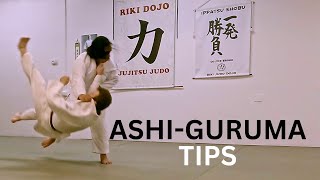
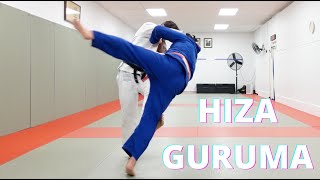
Ashi guruma (足車), translated as "leg wheel," is a throwing technique in judo that belongs to the family of hip throws alongside harai seoi nage, hoshi, and uchi mata. The technique is characterized by the absence of body contact with the opponent, distinguishing it from similar throws in the same technical family.
Distance and Positioning
The practitioner begins from a standard grip position under the opponent's elbow with a lapel grip, then steps away with the left foot to create distance. The optimal positioning places the practitioner approximately one and a half feet away from the opponent's toes, though this distance varies based on limb length and relative size of the participants.
Leg Placement and Contact
The practitioner extends their leg so that the back of the heel contacts the opponent's shin beneath the knee. Proper foot positioning requires pointing the toes downward, and the leg must not overextend beyond the shin contact point, as this would constitute a technically incorrect execution of the technique.
Kuzushi and Balance Breaking
The technique requires the practitioner to break the opponent's balance using hand action before executing the throw. The left hand comes up to assist in breaking balance while the right hand brings the opponent around, with the elbow kept down for proper chest control throughout the movement.
Rotational Mechanics
Unlike harai seoi nage where the shin is pushed backward, ashi guruma employs a corkscrew or twisting action of the entire body. The practitioner twists at the spine and neck, exaggerating the head rotation as if looking behind the partner, which generates the rotational force that executes the throw.
Execution Sequence
The throw sequence consists of stepping to create distance, breaking balance with hand action, placing the leg against the opponent's shin, and executing an explosive twisting motion through the torso and head. The leg remains off the ground throughout the twisting action, with the rotational dynamics of the spine being the primary force mechanism.
Critical Success Factor
The technique will not function effectively without proper balance breaking achieved through the hands prior to the leg and rotational execution. The initial hand action that creates forward momentum in the opponent is essential to the throw's success and must be established before the twisting action begins.
How to do Ashi Guruma in Judo and BJJ | Leg Wheel | 足車
Key Takeaways
- •Technique Overview
- •Distance and Positioning
- •Leg Placement and Contact
- •Kuzushi and Balance Breaking
Check out my online course 👇🏻 🔥https://sampsonjudo.thinkific.com Support the channel 👇🏻 🚀 Buy me a coffee: https://www.buymeacoffee.com/sampsonjudo ✈️ All proceeds go towards international trips for my students. ---------------------- www.Facebook.com/Sampsonjudo www.instagram.com/Sampsonjudo ---------------------- Stay connected with my club/federation: www.sobelljudoclub.com www.judoforall.org.uk ---------------------- Rashguards made in the UK: https://inner-chimp.co.uk/ Finger tape: https://amzn.to/2zbqvyh Mizuno Judogi: https://amzn.to/3gasbZz Pre-washed soft black belt: https://amzn.to/2XpNIEK My ultimate technique reference book: https://amzn.to/2LT46Zk Mind over muscle by Jigoro Kano: https://amzn.to/2zeDTSi
Frequently Asked Questions
What does this video teach about ashi guruma?
This video covers technique overview, distance and positioning, leg placement and contact. It provides detailed instruction from Sampson Judo.
How long does it take to learn ashi guruma?
The basic mechanics can be understood in a single session, but developing reliable execution requires consistent drilling over weeks of practice. This 7-part breakdown helps structure your training by isolating each phase of the technique.
What are the key details for finishing ashi guruma?
The throw sequence consists of stepping to create distance, breaking balance with hand action, placing the leg against the opponent's shin, and executing an explosive twisting motion through the torso and head. The leg remains off the ground throughout the twisting action, with the rotational dynamics of the spine being the primary force mechanism.