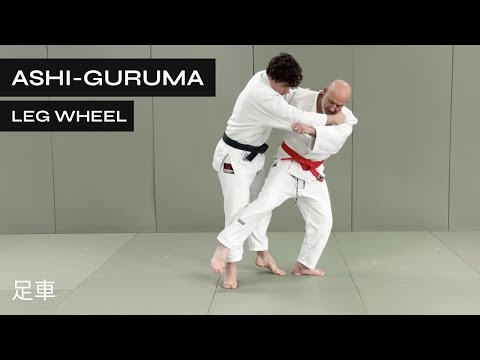
How to do Ashi Guruma in Judo and BJJ | Leg Wheel | 足車
0
Ashi Guruma·Sampson Judo
Check out my online course 👇🏻 🔥https://sampsonjudo.thinkific.com Support the channel 👇🏻 🚀 Buy me a coffee: https:…
Translation: leg wheel
Ashi Guruma is a judo foot technique where the attacker extends the leg across the opponent's thigh or shin and uses a rotational pull to wheel the opponent over the extended leg. [1] Similar to Hiza Guruma but with the blocking contact higher on the opponent's leg, creating a larger wheel radius and more dramatic throw. [1] Classified in the Gokyo no Waza. [1]
Classified in the Kodokan Judo syllabus. [1]
Kodokan judo lineage: Jigoro Kano (1860–1938) systematized this technique as part of the Kodokan judo curriculum. Transmitted through the Kodokan instructor system to judo federations worldwide. Adopted into BJJ through Mitsuyo Maeda → Carlos Gracie → the Gracie family lineage. [1]
Recognized Kodokan judo technique but rarely seen in modern IJF competition due to rule changes favoring forward-throwing techniques. Occasionally appears in kata demonstrations and regional tournaments. [1]
No images yet for this technique.
Sign in to suggest an image.
Check out my online course 👇🏻 🔥https://sampsonjudo.thinkific.com Support the channel 👇🏻 🚀 Buy me a coffee: https:…
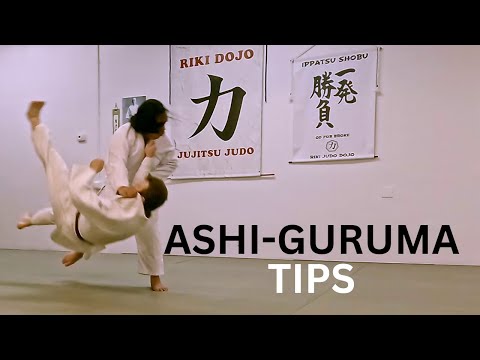
Riki sensei explained ashi-guruma (足車 - foot/leg wheel) during judo class on 1-26-2023. 0:00 definition 0:18 te-waza o…
No instructional courses yet for this technique.
Sign in to suggest a course.
Risk of injury to the person this technique is applied to
Larger rotation than Hiza Guruma.
Skill level needed to execute this technique reliably
Whether this technique is allowed under major competition rule sets
Kano, J. Kodokan Judo. Kodansha International.
[1] Kano, J. Kodokan Judo. Kodansha International.
Official Kodokan ground technique classification system
Standard Japanese martial arts terminology (kanji/hiragana)
Established Japanese martial arts naming convention — native Japanese term (和語/漢語)
[1] Kano, J. Kodokan Judo. Kodansha International.
flexibility for leg extension, strong core for rotation, balance during deep entry
hip flexors, quadriceps (extended leg), core obliques (rotation)
Ashi guruma (leg wheel) uses the leg as a fulcrum across the opponent's thigh while wheeling them over with upper body rotation. A foot technique (ashi-waza) in the Kodokan classification. (Kano, Kodokan Judo)
According to Riki Judo Dojo, you want to catch the leg midway between the ankle and the knee, and the leg stays there—it does not sweep.
Hip rotation is critical to the technique's effectiveness. Riki Judo Dojo emphasizes that your koma-musubi (hip position) must turn—if it stays in place, the technique is not effective, but when rotated it becomes very effective and generates the energy needed for the throw.
The pulling hand (hikite) comes to your hip bone while your other hand pushes on the opponent's collarbone, first pushing back then turning in the same direction as your hips to rotate them over your leg, according to Riki Judo Dojo.
Sampson Judo recommends you should be about a foot and a half away from your opponent—close enough that you're slightly in front of them to break their balance with gravity, but not so close that you break your own balance.
Ashi Guruma is a judo foot technique where the attacker extends the leg across the opponent's thigh or shin and uses a rotational pull to wheel the opponent over the extended leg. Similar to Hiza Guruma but with the blocking contact higher on the opponent's leg, creating a larger wheel radius and more dramatic throw.
Classified in the Kodokan Judo syllabus.
IJF Judo: Legal: legal — Kodokan classified technique; IBJJF: Legal {src:IBJJF Rules Book v6.0, June 2024|/sources/IBJJF: legal — Rules-v6.0-June-2024.pdf}; Unified MMA: Legal {src:Unified Rules of MMA, August 2025|/sources/Unified: legal — MMA-Rules-August-2025.pdf}; FIAS Sambo: Legal {src:FIAS International Sambo Competition Rules|/sources/FIAS: legal — Sambo-Rules.pdf}
Danger rating 6/10. High — larger rotation than Hiza Guruma.
The standard setup chain: Drive opponent forward → deep entry step → extend leg and wheel → Hiza Guruma attempt → opponent resists → transition to Ashi Guruma with higher contact → Pull opponent's head down → step across → Ashi Guruma.
Standard counters include: Step over the extended leg / Lower your center of gravity — harder to wheel over / Counter with Ura Nage — lift and throw backward.
Common variants: High Ashi Guruma (leg across the hip for maximum leverage); Low Ashi Guruma (leg across the shin); Spinning entry (full rotation into the technique).
Recognized Kodokan judo technique but rarely seen in modern IJF competition due to rule changes favoring forward-throwing techniques. Occasionally appears in kata demonstrations and regional tournaments.
Top errors to watch for: Not extending the leg fully — reduces the barrier effect / Entering too shallow — becomes a weak Hiza Guruma instead / Losing balance during the rotation — stay tight to the opponent / Telegraphing the deep entry step.
The Ashi Guruma is also known as Ashi Guruma, Ashi-Guruma, Leg Wheel Throw, Ashiguruma.