Manual Scope and Weapon Variations
The British Military Sabre manual covers three distinct weapons: broadsword, spagroom, and sabre. Cutting mechanics vary slightly between these weapons, particularly with the broadsword, requiring instructors to adapt their technical instruction accordingly.
Foundational Cutting Principle
The manual's first section teaches stationary rotational cutting before progressing to cuts combined with lunges. This foundational approach establishes proper wrist mechanics and body alignment before introducing footwork.
Cut 1 Execution from Outside Guard
Cut 1 begins from outside guard with a slight rotation to align the blade trajectory. The practitioner fully extends the arm while rotating until the back of the hand is visible, then sweeps the sword back into guard in a continuous motion.
Cut 2 Execution from Inside Guard
Cut 2 initiates from inside guard, with the practitioner aligning the cut toward the outside line before full arm extension. The point drops during execution, passing close to the right side of the head before recovering into outside guard.
Wrist and Finger Dexterity Requirements
Proper execution of sabre cuts requires supple, nimble fingers and a flexible grip. Open-hilted sabres allow greater finger dexterity compared to broadswords with guards, though broadsword practitioners must compensate with increased elbow movement.
Finger-Driven Cutting Mechanics
Cuts are generated primarily through wrist action with significant contribution from the fingers. The middle, ring, and pinky fingers release slightly to propel the sword forward, with the thumb optionally moving from a handshake grip to the back of the hilt during execution.
Cut Depth and Blade Weight Considerations
Lighter infantry-pattern blades require cuts executed to approximately the middle of the blade's length rather than full-depth cutting. Heavy cavalry sabres like the 1796 pattern demand fuller cuts but risk wrist injury with excessive extension.
Guard Integration and Recovery
Cuts must flow seamlessly into guard positions, with hand placement providing defensive coverage during execution. The momentum generated by the cutting motion facilitates the return to guard without requiring distinct stopping or resetting movements.
British Military Sabre Instruction - Cut 1 and 2
Key Takeaways
- •Manual Scope and Weapon Variations
- •Foundational Cutting Principle
- •Cut 1 Execution from Outside Guard
- •Cut 2 Execution from Inside Guard
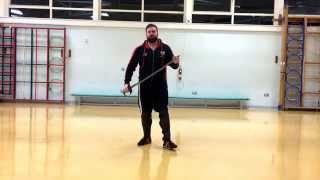
Here's another video in our Roworth's "Art of Defence on Foot" series this time going over cuts 1 and 2. It should cover the basics of these two cuts in the first section of cutting against the target. We'll see you next week for cuts 3 and 4.
Related Techniques
Frequently Asked Questions
What does this video teach about sabre cut?
This video covers manual scope and weapon variations, foundational cutting principle, cut 1 execution from outside guard. It provides detailed instruction from Espada Negra.
How long does it take to learn sabre cut?
The basic mechanics can be understood in a single session, but developing reliable execution requires consistent drilling over weeks of practice. This 8-part breakdown helps structure your training by isolating each phase of the technique.
What are the key details for finishing sabre cut?
Lighter infantry-pattern blades require cuts executed to approximately the middle of the blade's length rather than full-depth cutting. Heavy cavalry sabres like the 1796 pattern demand fuller cuts but risk wrist injury with excessive extension.