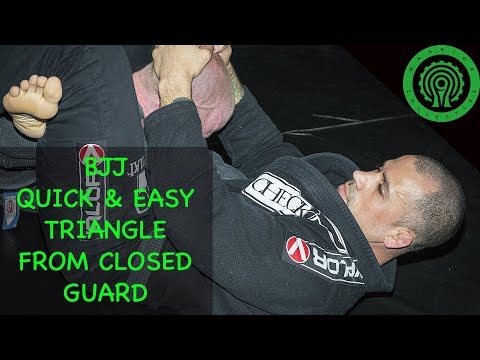
BJJ Quick and Easy Triangle from closed Guard Tutorial
0
Angle-Off Finish·Stuart Tomlinson
Leo Queiroz, Black Belt, renowned BJJ athlete and head coach of Checkmat Watford is here filmed by the Warrior Collectiv…
Translation: Angle-Off Finish (katakana loanword)
The angle-off finish for the triangle choke from closed guard involves the attacker cutting an angle by pivoting the hips perpendicular to the opponent's body after locking the triangle, maximising compression on the carotid arteries. [1] After locking the triangle with the legs, the attacker shifts the hips to one side — typically toward the trapped arm — creating a diagonal pressure angle that tightens the neck compression dramatically. [1],[2] The angle-off eliminates space within the triangle loop and aligns the attacker's leg and hip structure for optimal mechanical advantage. [2] This is widely taught as the essential finishing adjustment, as many triangles fail without the angle-off due to insufficient compression from a square-on position. [2],[3]
The angle-off finishing principle was systematised by BJJ competitors and instructors during the 2000s, with Ryan Hall's triangle instructional materials being particularly influential. [1] Understanding the angle-off transformed triangle choke success rates and became a fundamental teaching point in BJJ curricula worldwide. [2],[3]
The angle-off creates a superior finishing angle for triangle-type leg chokes; by changing the angle, the attacker eliminates the opponent's ability to posture and stack [1]
A refinement of the triangle choke popularized by Ryan Hall, who demonstrated the importance of angular cutting to maximize choking pressure [1]
Ryan Hall's triangle victories in UFC and submission grappling competition brought widespread attention to the angle-off principle; now considered fundamental to high-level triangle attacks [1]
No images yet for this technique.
Sign in to suggest an image.
Leo Queiroz, Black Belt, renowned BJJ athlete and head coach of Checkmat Watford is here filmed by the Warrior Collectiv…
No instructional courses yet for this technique.
Sign in to suggest a course.
Risk of injury to the person this technique is applied to
Triangle variants use the legs to compress the carotid arteries around the opponent's neck and arm
Skill level needed to execute this technique reliably
Whether this technique is allowed under major competition rule sets
Japanese BJJ community standard katakana transliteration
Japanese BJJ community standard katakana transliteration
Standard katakana transliteration of Western martial arts terminology (外来語) — used in Japanese MMA, boxing, and BJJ communities
Japanese terminology sourced from Japanese BJJ community standard katakana transliteration
hip flexibility, long legs relative to torso
longer limbs for easier figure-four lock around head and arm
hip adductors, hamstrings, quadriceps
The angle-off finish for the triangle choke from closed guard involves the attacker cutting an angle by pivoting the hips perpendicular to the opponent's body after locking the triangle, maximising compression on the carotid arteries. After locking the triangle with the legs, the attacker shifts the hips to one side — typically toward the trapped arm — creating a diagonal pressure angle that tightens the neck compression dramatically.
The angle-off finishing principle was systematised by BJJ competitors and instructors during the 2000s, with Ryan Hall's triangle instructional materials being particularly influential. Understanding the angle-off transformed triangle choke success rates and became a fundamental teaching point in BJJ curricula worldwide.
IBJJF: legal — Legal at all belt levels, gi and no-gi — chokes are the safest submission cat…; IJF: legal — Legal (shime-waza) — strangulation techniques are one of three permitted subm…; ADCC: legal — Legal; Unified MMA: legal — Legal — choke submissions are among the most common finishes in MMA; FIAS Sport Sambo: banned — All chokes prohibited in Sport Sambo; FIAS Combat Sambo: legal — Legal
Danger rating 8/10. Triangle variants use the legs to compress the carotid arteries around the opponent's neck and arm
The standard setup chain: Achieve Controlling Position → Isolate the Neck → Set the Grip → Apply Pressure.
Standard counters include: Tuck Chin — protect the neck by lowering the chin to prevent the choke from sinking / Two-on-One Grip Fight — use both hands to strip the choking grip before it locks / Turn Into — rotate toward the choking arm to relieve carotid pressure / Posture Up — straighten the spine and create distance to break the choking angle.
Common variants: Standard triangle (classic figure-four leg lock around the head and one arm …); Reverse triangle (legs locked from behind or inverted angle for different a…); Mounted triangle (applied from mount position with gravity assisting the sq…); No-arm triangle (both arms excluded, legs-only compression on the neck).
Ryan Hall's triangle victories in UFC and submission grappling competition brought widespread attention to the angle-off principle; now considered fundamental to high-level triangle attacks
Top errors to watch for: Not cutting the angle before squeezing — the angle must be established first; squeezing from a square position compre… / Pivoting to the wrong side — angle toward the trapped-arm side; pivoting opposite moves the shoulder away from the ar… / Not pivoting far enough — the body should be close to perpendicular (90 degrees); a slight angle is insufficient for … / Rushing the squeeze without completing the pivot — take the time to fully angle off before applying maximum compression.
The Angle-Off Finish is also known as Anguru Ofu Finisshu, Angle-Off Triangle, Cut-Angle Triangle Finish, Perpendicular Triangle.