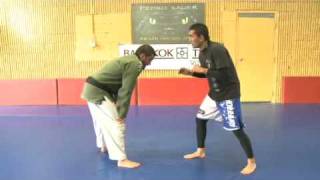
The Standard Run-The-Pipe Double: Entry Mechanics
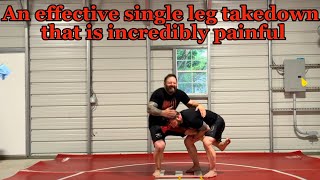
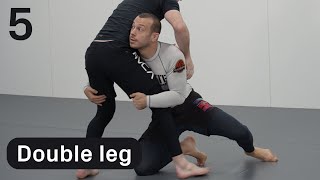
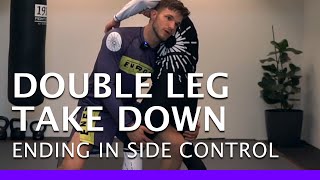
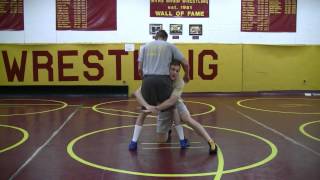
The instructor demonstrates the foundational entry to the run-the-pipe double leg takedown. From an underhook position, the practitioner executes a snatch signal before bringing the opponent's leg back. The critical timing occurs when weight distribution shifts—at this moment, the attacker transitions to the shallow side with a shoulder-driven motion to secure the takedown.
Weight Distribution and Transition Points
Proper execution requires sensitivity to the opponent's weight shift. Once the defender's weight moves back after the initial snatch, the attacker immediately drives through the shoulder for the underhook takedown. This seamless transition from leg control to shoulder pressure ensures completion of the technique with minimal resistance.
Knee-Touch Drill: Building Stance Foundation
The instructor introduces a partner drill where each participant attempts to touch their opponent's knee while defending their own. Participants must maintain an upright posture with eyes forward rather than looking down, keeping hands active for blocking and counterattacking. Below-the-knee contact does not score points, encouraging upper-body engagement and balance maintenance throughout the exchange.
Game Rules and Scoring Mechanics
Contact resets after each score, preventing consecutive point accumulation from a single position. If both practitioners score simultaneously, neither point counts—this rule encourages clean separation and forces re-engagement. The drill runs for one-minute intervals to build sustained focus and decision-making under fatigue.
Transitioning to Double-Leg Entries
The instructor emphasizes that the knee-touch drill serves as a foundation for advancing to double-underhook and double-leg attacks. Practitioners should avoid excessive hip-back movement, instead driving forward with the knees while strategically using hands and feet. This methodical progression prevents reckless entries and develops a nuanced understanding of pressure and positioning before executing full takedowns.
Single-Leg Stance Balance Work
Advanced drills progress to single-leg balance challenges where practitioners must defend while maintaining contact on only their left or right foot. This develops dynamic footwork, reactive base adjustments, and the ability to use leg hooks and sweeps as defensive counterattacks. The instructor stresses safety—practitioners should never compromise their position so severely that they land additional body parts to avoid point concession.
Strategic Hand and Foot Integration
Successful flow-state execution requires constant variation between hand-fighting pressure and foot-based attacks. Rather than relying on a single defensive strategy, practitioners must mix offensive and defensive tools to maintain control. This complexity within structured simplicity develops tactical thinking and prevents opponents from predicting patterns.
This is HOW you enter the FLO state
Key Takeaways
- •The Standard Run-The-Pipe Double: Entry Mechanics
- •Weight Distribution and Transition Points
- •Knee-Touch Drill: Building Stance Foundation
- •Game Rules and Scoring Mechanics
No surprise here. It's nothing but high level takedowns as athletes gather at Legion to learn the world's greatest takedowns from the one and only Justin 'JFLO' Flores! Timecodes: 0:00 - Intro 0:44 - Underhook to create takedowns 1:23 - Group takedown for takedown 1:58 - Knee tap game 4:00 - Battle for double underhooks 5:24 - Hop don't drop 7:12 - Exchange takedowns 8:15 - Flo down throwdown 8:55- Outro Legion American Jiu Jitsu is a professional academy that offers classes for ALL levels whether you've never trained a day in your life or you're a seasoned competitor! HEAD INSTRUCTOR: KEENAN CORNELIUS 5-week beginner course: Looking to get into jiu jitsu? We have our famous 5-week beginner course teaching brand new students the fundamentals of jiu jitsu! Kid's Program: Legion provides classes for kids from the ages 4-15 years old! No-Gi Program: Are you a no-gi addict? Us too! You can learn from our varies world class instructors Justin Flores, Miha Perhavec, Sloan Clymer and Mike Salazar Advanced Program: Head instructor is Andris Brunovskis and he'll keep you up to date and sharp on the latest techniques as he's a huge innovator of the sport! Looking to become an affiliate and learn how to successfully run a Jiu Jitsu academy? Follow this link! https://legionajj.com/ Follow our socials and keep up with our daily posts! https://www.instagram.com/legion_ajj/ https://www.tiktok.com/t/ZTdWPbSHy/ https://m.facebook.com/LegionSanDiegoAJJ/ WEBSITE: https://legionsandiego.com/
Frequently Asked Questions
What does this video teach about standard run-the-pipe double?
This video covers the standard run-the-pipe double: entry mechanics, weight distribution and transition points, knee-touch drill: building stance foundation. It provides detailed instruction from Legion AJJ.
How long does it take to learn standard run-the-pipe double?
The basic mechanics can be understood in a single session, but developing reliable execution requires consistent drilling over weeks of practice. This 7-part breakdown helps structure your training by isolating each phase of the technique.
What are the key details for finishing standard run-the-pipe double?
Advanced drills progress to single-leg balance challenges where practitioners must defend while maintaining contact on only their left or right foot. This develops dynamic footwork, reactive base adjustments, and the ability to use leg hooks and sweeps as defensive counterattacks. The instructor stresses safety—practitioners should never compromise their position so severely that they land additional body parts to avoid point concession.