Hip Frame Positioning and Transitions
When defending from mount, the practitioner establishes a hip frame by folding the opponent's arm to the inside with the elbow centered on the torso. This frame effectively creates distance, but transitioning to deep half guard requires repositioning the elbow inward to allow hip movement. The frame must be released and the shoulder driven into the space created by the opponent's leg.
Entry to Deep Half Guard
As the opponent crosses their legs, the defender frames the hip and initiates the transition by bumping forward and sliding the elbow to center—not across the body, as this exposes the back. Precise shoulder placement into the gap between the opponent's legs is critical. The defender then settles weight, shifts the hips, rotates toward the opponent's belly, secures the heel grip, and executes the sweep with controlled upward and rotational force.
Mechanical Similarity to Wrestling's Low Single
The waiter sweep functions identically to a low single takedown in wrestling mechanics. Both techniques involve controlling the outside of the ankle while driving the opponent's knee over the captured ankle angle. The key distinction in jiu-jitsu application is the bottom position—the practitioner uses leg pressure and hip drive rather than postural drive from a standing position.
Angle Precision and Sweep Mechanics
The sweep's success depends entirely on precise angle control at the ankle. If the knee is driven across the wrong angle, the opponent can simply balance and escape. The correct angle requires pushing the knee directly over the foot that has been controlled, creating an unstable fulcrum. The practitioner must experiment slowly to find the angle at which the opponent falls most naturally.
Foot Positioning Variations
Multiple foot positioning options exist within deep half guard, each serving different purposes based on the practitioner's body type and pressure preferences. Taller practitioners may create tension by extending the leg, while shorter athletes often prefer a compact ball position that generates momentum through hip drive. The choice of positioning should be determined by individual mechanics rather than a single prescribed method.
Base Control and Commitment
Before executing the sweep, the defender must check the opponent's base with subtle shoulder and hip movements, testing balance without committing. These micro-adjustments reveal how stable the opponent is and inform the timing of the full sweep. Once the opponent's weight is committed, the defender drives forward decisively.
Structural Arm Position During Execution
The defending arm must maintain an hooked structure at the elbow throughout the sweep, never straightening or losing the bend. This structural integrity prevents the opponent from straightening the leg and escaping back to deep half guard through pure strength. The arm functions as an immobile frame rather than a muscle, allowing the leg pressure and hip drive to generate the sweep.
Hip Movement and Directional Drive
As the defender transitions from under the opponent toward the sweep, both knees drive toward the face while the shoulder crunch initiates the rotational component. The practitioner moves diagonally toward the opponent's midsection—described as moving 'toward the grill'—which combines forward and rotational pressure for maximum effect. This compound movement creates the fall rather than any single isolated technique.
Creating Space for the Finish
The sweep's completion requires the defender to create a 'hole' for the opponent to fall into. This can be accomplished by driving the opponent sideways as they fall, or by opening the gap and attacking the legs after the initial tip. Without deliberately creating this falling space, the opponent will find balance and prevent the sweep from completing.
(HOW TO) Waiter Sweep from Deep Half Guard
Key Takeaways
- •Hip Frame Positioning and Transitions
- •Entry to Deep Half Guard
- •Mechanical Similarity to Wrestling's Low Single
- •Angle Precision and Sweep Mechanics
Bmac relates the Waiter Sweep to the Low Single and explains how they are mechanically the same. The full Deep Half instructional is available at the link below: https://bmac.mykajabi.com/offers/C2b6nbTh/checkout Join this channel to get access to Members Only Perks such as: - Weekly Live Classes - Members Only Chat - Exclusive Members Only Videos - Access to the PGF Archive - Custom Badges and Emojis and more! https://www.youtube.com/channel/UCr7VU0Cnef4AhQk7Pe_9nTA/join
Related Techniques
Frequently Asked Questions
What does this video teach about waiter deep half?
This video covers hip frame positioning and transitions, entry to deep half guard, mechanical similarity to wrestling's low single. It provides detailed instruction from Brandon Mccaghren.
How long does it take to learn waiter deep half?
The basic mechanics can be understood in a single session, but developing reliable execution requires consistent drilling over weeks of practice. This 9-part breakdown helps structure your training by isolating each phase of the technique.
What are the key details for finishing waiter deep half?
As the defender transitions from under the opponent toward the sweep, both knees drive toward the face while the shoulder crunch initiates the rotational component. The practitioner moves diagonally toward the opponent's midsection—described as moving 'toward the grill'—which combines forward and rotational pressure for maximum effect. This compound movement creates the fall rather than any single isolated technique.
Related videos
Back Takes from the Waiter Sweep Position (Deep Half Guard)
Tarik BJJ
This Guard is Ridiculously Strong - Waiter Guard Back Attack - BJJ Guards
Dubious Dom
DEEP Half Guard — Beginner's Guide
James Clingerman
Jiu-Jitsu Mini-Seminar on Deep Half Guard Techniques
Knight Jiu-Jitsu
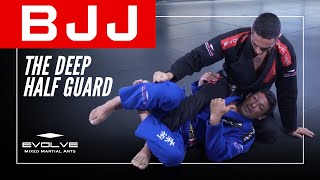
BJJ | An Introduction To The Deep Half Guard
Evolve Mixed Martial Arts