Understanding De Ashi Barai Terminology
De ashi barai translates to "advancing foot sweep," with "de" referring to the forward-moving foot, "ashi" meaning foot, and "harai" (or "barai") meaning to sweep. Despite being the most frequently used throw in judo, it remains underestimated due to its deceptively simple appearance. The technique is far more powerful and complex than casual practitioners realize.
The Critical Role of Hand Placement
The hikite (pulling hand) and tsunite (following hand) work in concert to control the opponent's posture and generate throwing power. Rather than simply pulling the opponent forward, the hands should drive downward and rotate to break their balance. Proper hand mechanics are essential to converting the foot sweep into a complete throw.
Maintaining Optimal Distance
Precise ma-i (distance between combatants) is critical for execution. Too close proximity prevents proper technique application, while excessive distance causes the sweep to miss its target. The practitioner must position themselves to strike the opponent's ankle bone effectively while maintaining control through their grip.
Leg Position and Power Generation
The sweeping leg must remain straight like a hockey stick to maximize power transfer. A bent knee dissipates energy and weakens the technique significantly. Proper posture and body angle are maintained by adjusting ma-i rather than compromising leg extension, which sacrifices the fundamental structure needed for effective throws.
Grip Security and Body Commitment
A secure grip on the sleeve (sodeh) and collar prevents loss of balance when executing the sweep with full body weight. Thumbs must be curled inward to grip muscle rather than left extended. The thrower must commit fully by leaning back and maintaining extension through the entire motion rather than hesitating after initial contact.
Explosive Follow-Through and Momentum
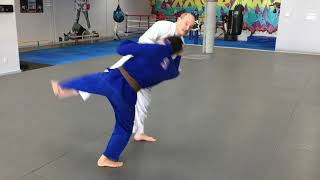
Practitioners must continue driving through the throw with maximum hip rotation and body engagement rather than stopping after the initial sweep contact. The combination of the downward hand motion, continuous leg sweep, and full-body rotation creates the power that distinguishes a successful throw from a failed attempt. Commitment to completion is the difference between an effective technique and minimal impact.
De Ashi Barai as a Combat-Effective Technique
De ashi barai is fundamentally a combative technique with devastating force, capable of causing knockouts when executed with proper intensity. The head contact during the sweep can deliver impact equivalent to a hook punch. Professor Kano modified traditional samurai methods for safer regular training, but the underlying effectiveness and danger of the technique remain unchanged in professional and law enforcement applications.
De-Ashi-Harai Tips | Riki Judo Dojo
Key Takeaways
- •Understanding De Ashi Barai Terminology
- •The Critical Role of Hand Placement
- •Maintaining Optimal Distance
- •Leg Position and Power Generation
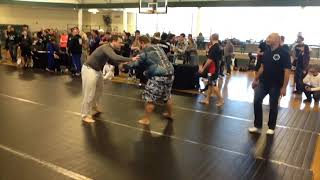
Riki sensei showed us the fundamental way of doing de-ashi-harai / de-ashi-barai (advancing foot sweep) during judo class on 9-20-2021. 0:00 Definition 0:27 Kuzushi 0:51 Distance 1:03 The target is the ankle bone 1:13 Keep your leg straight 1:35 Lean back 1:51 Grip details 2:56 Go for broke 3:24 Hook punch 3:44 Jujitsu origin 3:58 Atemi waza in judo Riki sensei began Judo in Okinawa and is a Shichidan with over 56 years of study, practice, competition and teaching. He competed for 25 years at the local, national and international levels. A few of the great Judoka Riki sensei has studied and practiced with include: Kotani, Daigo, Ito, Inokuma, Okano, Kimura, Kaminaga and Nakatani. See Riki sensei teach every Monday, Wednesday, Thursday and Friday evening at 535 W. Iron Ave, Mesa, AZ 85210. Youth classes are 6 - 6:55 PM, adult classes are 7:00 - 8:30 PM. For more info, please visit rikidojousa.com The purpose of this YouTube channel is to pass on the original, traditional, authentic Kodokan Judo that Riki sensei loves so much. Riki sensei's students maintain this YouTube channel (and are responsible for any errors), but you can find more of his thoughts at the Riki Judo Dojo Facebook page: https://www.facebook.com/Riki-Judo-Dojo-USA-194351210607759 15
Frequently Asked Questions
What does this video teach about standard de ashi barai?
This video covers understanding de ashi barai terminology, the critical role of hand placement, maintaining optimal distance. It provides detailed instruction from Riki Judo Dojo.
How long does it take to learn standard de ashi barai?
The basic mechanics can be understood in a single session, but developing reliable execution requires consistent drilling over weeks of practice. This 7-part breakdown helps structure your training by isolating each phase of the technique.
What are the key details for finishing standard de ashi barai?
Practitioners must continue driving through the throw with maximum hip rotation and body engagement rather than stopping after the initial sweep contact. The combination of the downward hand motion, continuous leg sweep, and full-body rotation creates the power that distinguishes a successful throw from a failed attempt. Commitment to completion is the difference between an effective technique and minimal impact.