Foundation: Two-on-One Grip Setup
The instructor establishes control from closed guard using a two-on-one grip: the right hand secures the collar while the left hand controls the wrist cuff. This grip configuration prevents the opponent from moving backward via collar control and forward via arm control, creating the ideal positioning for sweep execution.
Guard Unlock and Leg Positioning
When unlocking the guard, the practitioner avoids placing feet on the floor, instead maintaining pressure on the opponent while positioning the legs strategically. The front shin acts as a barrier against forward movement while the rear leg remains ready to either repost on the hip or drive the sweep.
Understanding Hiza Garuma: The Knee Wheel
Hiza Garuma, meaning 'knee wheel,' involves placing the sole of the foot directly on the opponent's knee rather than posting on the ground. This placement eliminates the opponent's base of support by elongating their leg, creating vulnerability to the sweep while the shin on their torso provides the counter-force needed for directional control.
Head Position and Upper Body Mechanics
The instructor emphasizes propping on the elbow while bringing the head to the same height as the opponent's head, as positioning the head too low allows the opponent to maintain weight distribution above. The pulling hand drives the opponent's head over the knee while the body turns toward the mat for balance, enabling the practitioner to rise into top position.
Execution from Closed Guard
From closed guard with the two-on-one grip established and body angled out, the practitioner places the left foot on the opponent's knee while keeping the right shin across their body. The practitioner then props on the elbow, drives with both hands, and pushes through the foot on the knee to complete the sweep into mounted position.
Troubleshooting Strong Opponent Resistance
When encountering significant resistance during the Hiza Garuma, the ineffective shin barrier becomes secondary. The practitioner converts the foot placement from a knee post into a hook on the opponent's inner leg, shifting the mechanics toward a Sumi Gaeshi-style sweep that uses leg elevation and a head post for additional leverage.
Sumi Gaeshi Transition: The Hook Variation
As a counter to strong posture, the right leg elevates and hooks the opponent's leg from the inside while the left foot posts on the floor. The practitioner places their head on the mat and drives through the leg hook, using both upper and lower body engagement to complete the sweep into top position.
Versatility and Application Context
Hiza Garuma functions as both a standalone sweep and as a progressive alternative to the scissor sweep when initial attempts encounter resistance. This technique proves particularly effective against opponents whose knees are grounded, offering multiple entry points and adjustment options based on defensive reactions.
Maximize Your Scissor Sweep: Hiza Garuma and Sumi Gaeshi to the Rescue (BJJ/Jiu-Jitsu)
Key Takeaways
- •Foundation: Two-on-One Grip Setup
- •Guard Unlock and Leg Positioning
- •Understanding Hiza Garuma: The Knee Wheel
- •Head Position and Upper Body Mechanics
Hiza garuma is most commonly seen as a high-amplitude takedown in judo, but we can make perfect use of it down on the ground as well. Here we’re going to use it to beef up the scissor sweep, a great technique which stops working for most people right around blue belt. Why hiza garuma? Well, one of the central problems with the scissor sweep is our partner’s ability to widen their base of support - the wider their knees are, the more difficult it is for us to offset their balance. When we elongate one of their legs with hiza garuma, we remove the source of that support, making it easy to wheel them over and put them on their back. Not only that, but when we add a sumi gaeshi hook, we can now generate a lifting force to move them over that blocked leg. Combining a block with a lift at the lower body and collar-sleeve control for a pull on the upper body and we have a powerful and effective scissor sweep variation. ⭐ ➡️ MY BIO (by J. Danaher): https://bit.ly/3gUMU5R === Like this video? Please subscribe! === ⬇️ CHECK OUT ⬇️ 🚨 INSTAGRAM: http://www.instagram.com/bzglick 🚨 FACEBOOK: http://www.facebook.com/bzglick 🥋 SHOYOROLL: https://shoyoroll.com/ 🙇🏻 BROOKLYN BJJ: https://www.brooklynbjj.com
Related Techniques
Frequently Asked Questions
What does this video teach about hiza-gatame?
This video covers foundation: two-on-one grip setup, guard unlock and leg positioning, understanding hiza garuma: the knee wheel. It provides detailed instruction from Brian Glick.
How long does it take to learn hiza-gatame?
The basic mechanics can be understood in a single session, but developing reliable execution requires consistent drilling over weeks of practice. This 8-part breakdown helps structure your training by isolating each phase of the technique.
What are the key details for finishing hiza-gatame?
As a counter to strong posture, the right leg elevates and hooks the opponent's leg from the inside while the left foot posts on the floor. The practitioner places their head on the mat and drives through the leg hook, using both upper and lower body engagement to complete the sweep into top position.
Related videos
Hiza Gatame
WINNING
Modified Hiza Gatame to Reverse Juji Gatame from Guard
Rob Jackson
Katame Waza || Grappling Techniques - 32 Holds, Strangles/Chokes and Armlocks
The Judo Way of Life
Waki Gatame - when and how to use it.
Robert Silas (Aiki_and_Jiu)
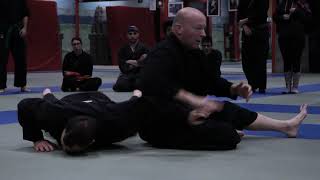
Waki Gatame into Ura Oni Kudaki - Yossi Sheriff in Madrid
AKBAN Ninjutsu – Yossi Sheriff