Introduction to Hiza-Gatame Transition
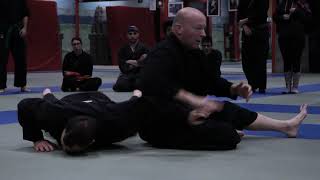
This instructional sequence demonstrates an efficient method to transition from Hiza-Gatame (knee lock) to Reverse Juji-Gatame (reverse cross armlock) when working from guard position. The technique emphasizes simplicity and reliability, enabling practitioners to control opponents of significantly greater size through proper mechanical advantage rather than strength.
Foundation and Control Principles
The demonstration establishes fundamental control mechanics that will be applied throughout the transition sequence. Understanding these base principles allows practitioners to execute the technique efficiently against larger or stronger opponents.
Step-by-Step Transition Sequence
The instructor systematically breaks down the movement from initial Hiza-Gatame position through the transition to Reverse Juji-Gatame. Each phase builds upon the previous positioning, maintaining control throughout the sequence.
Technical Summary and Route Overview
The instructional pathway presented offers one of several viable approaches to execute this transition effectively. While this map provides a clear progression from point A to point B, practitioners should recognize alternative routes and understand key checkpoints to maintain control if positioning becomes imprecise.
Recovery and Adaptation Strategies
Through repeated practice, practitioners develop the sensitivity to self-correct minor deviations in technique execution. This skill allows for smoother transitions even when initial positioning is not perfect, transforming potential errors into opportunities to maintain control and adjust positioning.
Hip Rotation and Body Mechanics
Proper hip rotation toward the opponent and synchronized body movement are critical final elements for completing the transition. This mechanical adjustment ensures maximal control and efficient power transfer during the final phases of the technique.
Modified Hiza Gatame to Reverse Juji Gatame from Guard
Key Takeaways
- •Introduction to Hiza-Gatame Transition
- •Foundation and Control Principles
- •Step-by-Step Transition Sequence
- •Technical Summary and Route Overview
One of many Attacks from Guard: Bottom; This is a straightforward approach that's relatively easy to recall and retain in a stressful situation. Adjusting the traditional knee arm lock by throwing the leg over to finish hiza gatame, roll into juji gatame, or a cross (so to speak) between those and ura jumonji gatame ude highigi. Keeping options open can often be useful. This is one option that preserves some others. It's not the form that's most often seen, and that's okay. If you're looking for a textbook approach, just be aware of that and consider it accordingly. There are more typical versions from this position in another video. We believe that any technique has multiple versions and can (and, based on primary principles, will) be expressed efficiently in different ways by different practitioners as well as varying based on the situation in which it's applied. It's an old-school approach because, well, we're an old school.
Related Techniques
Frequently Asked Questions
What does this video teach about hiza-gatame?
This video covers introduction to hiza-gatame transition, foundation and control principles, step-by-step transition sequence. It provides detailed instruction from Rob Jackson.
How long does it take to learn hiza-gatame?
The basic mechanics can be understood in a single session, but developing reliable execution requires consistent drilling over weeks of practice. This 6-part breakdown helps structure your training by isolating each phase of the technique.
What are the key details for finishing hiza-gatame?
Through repeated practice, practitioners develop the sensitivity to self-correct minor deviations in technique execution. This skill allows for smoother transitions even when initial positioning is not perfect, transforming potential errors into opportunities to maintain control and adjust positioning.
Related videos
Maximize Your Scissor Sweep: Hiza Garuma and Sumi Gaeshi to the Rescue (BJJ/Jiu-Jitsu)
Brian Glick
Hiza Gatame
WINNING
Katame Waza || Grappling Techniques - 32 Holds, Strangles/Chokes and Armlocks
The Judo Way of Life
Waki Gatame - when and how to use it.
Robert Silas (Aiki_and_Jiu)
Waki Gatame into Ura Oni Kudaki - Yossi Sheriff in Madrid
AKBAN Ninjutsu – Yossi Sheriff