Guard Break Setup
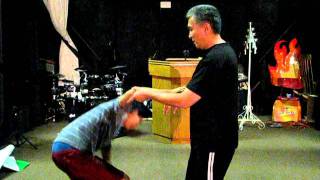
The instructor begins from a closed guard position where the top player feels controlled by the bottom player's legs. To escape, the top player can throw their hands forward, grab the opponent's head, and crank the neck to force the legs open. This basic guard break creates the entry point for subsequent leg lock attacks.
Hip Lock Entry Position
From the guard break, the top player slides between the opponent's legs while bending one knee. The attacker positions themselves with their hip turned in a specific configuration that allows pressure application to either the knee or hip joint. This positioning establishes the foundational hip lock setup.
Hip Lock Pressure and Escape
The hip lock applies pressure that creates discomfort in either the knee or hip until the opponent responds. The primary escape for the trapped player is to straighten their leg, which paradoxically gives the attacker access to a knee bar position instead.
Transitioning to Knee Bar
When the opponent escapes the hip lock by straightening their leg, the attacker can immediately transition to a knee bar by controlling the foot and stepping over. The attacker applies cranking pressure to the knee joint while maintaining control of the opponent's leg.
Controlling Foot Position
In the knee bar configuration, the attacker controls the blade of the foot and toes, sweeping the foot toward the opponent's belly button rather than pulling outward. This directional control is critical for proper lock execution and prevents the opponent from escaping by rotating their body.
Body Rotation and Lock Variations
If the opponent rotates their body to escape the knee bar, the attacker can transition to alternative leg lock options including calf crushes, heel hooks, or toe holds. Understanding body mechanics allows the attacker to exploit multiple submission pathways from the same fundamental position.
Knee Bar Mechanics
A proper knee bar locks the knee joint while the attacker pulls on the heel to apply pressure. The attacker can also apply additional force by sitting or dropping their weight directly on the opponent's knee to increase lock intensity.
Hip Lock as Submission Alternative
If the opponent's leg does not break from knee bar pressure, the attacker can transition back to hip lock by cranking the hip in a different direction. This cycling between hip lock and knee bar keeps the opponent under constant threat from multiple submission angles.
Progressive Pressure and Adaptation
As the opponent feels increasing pressure and distress, they naturally attempt to straighten their leg to escape, which creates new opportunities for the attacker. The instructor emphasizes that understanding how the body responds to pressure allows practitioners to seamlessly transition between multiple leg lock variations from the same entry position.
How To Execute Hip Lock
Key Takeaways
- •Guard Break Setup
- •Hip Lock Entry Position
- •Hip Lock Pressure and Escape
- •Transitioning to Knee Bar
The hip lock, also known as "hip crank" or "hip pinch," is a powerful submission technique in grappling sports like Brazilian Jiu-Jitsu (BJJ) and Catch Wrestling. It targets the hip joint and can cause significant discomfort, forcing your opponent to submit. The hip lock is a powerful technique that can be highly effective when executed correctly. Practice regularly to improve your proficiency and ensure you can perform the submission safely and effectively. http://www.ConwayToe2Toe.com
Related Techniques
Frequently Asked Questions
What does this video teach about hip lock?
This video covers guard break setup, hip lock entry position, hip lock pressure and escape. It provides detailed instruction from ConwayToe2Toe Jiu-Jitsu.
How long does it take to learn hip lock?
The basic mechanics can be understood in a single session, but developing reliable execution requires consistent drilling over weeks of practice. This 9-part breakdown helps structure your training by isolating each phase of the technique.
What are the key details for finishing hip lock?
If the opponent's leg does not break from knee bar pressure, the attacker can transition back to hip lock by cranking the hip in a different direction. This cycling between hip lock and knee bar keeps the opponent under constant threat from multiple submission angles.
Related videos
Small Hand Wrap Chin Na Wrist Locking
Gary Gee

Gooseneck Wrist Lock (Nikyo): Ultimate Self-Defense Technique #aikido #hapkido #martialarts
Weapons Defense Academy

10 Elbow Locks Every Martial Artist Must Know.
Straight Circle Martial Arts
10 Elbow Locks Every Martial Artist Must Know.
Straight Circle Martial Arts
10 Elbow Locks Every Martial Artist Must Know.
Straight Circle Martial Arts