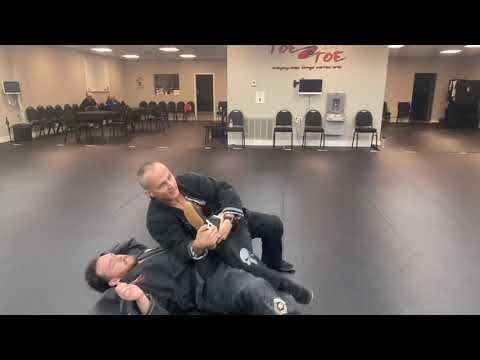
How To Execute Hip Lock
0
Hip Lock·ConwayToe2Toe Jiu-Jitsu
The hip lock, also known as "hip crank" or "hip pinch," is a powerful submission technique in grappling sports like Braz…
Translation: hip lock
Hip locks target the coxofemoral (hip) joint by forcing extreme abduction, adduction, or rotation of the femur within the hip socket. [1],[2] The hip is an inherently stable ball-and-socket joint with deep muscular support, making hip locks among the least common submissions in competition. Techniques include the electric chair (forcing hip abduction from lockdown half guard), hip compression locks from certain leg entanglements, and various hip-rotation attacks from back control or saddle positions. [3],[4] Hip locks are legal in most competition formats since they are not specifically prohibited, but their rarity reflects the difficulty of isolating and attacking such a well-protected joint.
Hip manipulation techniques appear in various grappling traditions, though they were rarely developed as primary submissions. [1] In catch wrestling, hip-stretching holds were used as part of ride-and-crank sequences. The electric chair — the most well-known modern hip lock — was popularized by Eddie Bravo within his 10th Planet Jiu-Jitsu system, developed from the lockdown half-guard position. [2],[3] In Daito-ryū Aiki-jūjutsu and certain koryu jujutsu schools, hip control techniques were studied as part of comprehensive joint manipulation curricula. [4]
Hip locks attack the hip joint through hyperextension or rotation, causing pain in the hip flexors and surrounding ligaments. [1]
Hip locks appear in catch wrestling and sambo, though they are less commonly trained than other joint locks. [1]
Hip locks occasionally appear in advanced submission grappling and MMA competition. [1]
No images yet for this technique.
Sign in to suggest an image.
The hip lock, also known as "hip crank" or "hip pinch," is a powerful submission technique in grappling sports like Braz…
No instructional courses yet for this technique.
Sign in to suggest a course.
Risk of injury to the person this technique is applied to
Hip locks are rare submissions that attack the hip joint through forced rotation or extension
Skill level needed to execute this technique reliably
Whether this technique is allowed under major competition rule sets
Kosen Judo / Shooto; Daito-ryu hip control
Japanese terminology sourced from Kosen Judo / Shooto; Daito-ryu hip control
Japanese MMA pioneer organization — technique terminology
Standard Japanese martial arts terminology (kanji/hiragana)
Established Japanese martial arts naming convention — native Japanese term (和語/漢語)
Japanese terminology sourced from Kosen Judo / Shooto; Daito-ryu hip control
grip strength, joint isolation ability, positional control
strong forearms and stable base
forearm flexors, core stabilisers, hip muscles for base
Hip locks (the 'banana split' and similar groin-stretching submissions) attack the hip joint through forced abduction. Legal in ADCC and some no-gi competitions but banned in IBJJF. The truck position and spladle are the primary hip lock entry positions. (ADCC Rules; IBJJF Rules v6.0)
From a basic guard break position, place the blade of your foot between your opponent's legs and bend your knee. Slide in as if going for a knee bar, then turn your hip to apply pressure that targets either the knee or hip joint.
If they straighten their leg to escape, it typically gives you access to either a knee bar or toe hold from the same position. ConwayToe2Toe Jiu-Jitsu notes that escaping the hip lock can also transition you into a knee block.
Sweep the blade of the foot toward your opponent's belly button rather than pulling it to the side. This proper mechanics positioning is key to maintaining control and maximizing the submission threat.
Hip locks target the coxofemoral (hip) joint by forcing extreme abduction, adduction, or rotation of the femur within the hip socket. The hip is an inherently stable ball-and-socket joint with deep muscular support, making hip locks among the least common submissions in competition.
Hip manipulation techniques appear in various grappling traditions, though they were rarely developed as primary submissions. In catch wrestling, hip-stretching holds were used as part of ride-and-crank sequences.
IBJJF: legal — Legal at all belt levels; IJF: banned — Only elbow joint locks (kansetsu-waza) permitted in judo — all other joint lo…; ADCC: legal — Legal — all submissions legal in ADCC; Unified MMA: legal — Legal submission technique; FIAS Sport Sambo: legal — Legal; FIAS Combat Sambo: legal — Legal
Danger rating 7/10. Hip locks are rare submissions that attack the hip joint through forced rotation or extension
The standard setup chain: Establish Position → Create the Threat → Secure the Hold → Finish.
Standard counters include: Early Recognition — identify the submission attempt early and begin defence immediately / Posture and Base — maintain strong posture and base to prevent submission setups / Grip Fight — deny the attacker their preferred gripping configuration.
Common variants: Standard variation (primary grip configuration and finishing angle); Gi variation (using the gi material for grip assistance and control); No-gi variation (adapted grips for submission grappling without the gi); Transition variation (applied during a positional change or scramble).
Hip locks occasionally appear in advanced submission grappling and MMA competition.
Top errors to watch for: Expecting hip locks to be as reliable as arm or leg locks — the hip joint is the strongest in the body; hip locks are… / Applying without controlling the torso — the opponent can rotate their entire body to relieve hip pressure if the tor… / Using hip locks as primary attacks — they work best as secondary threats within a system (e.g., electric chair create… / Applying aggressively in training — hip injuries are debilitating and slow to heal; apply hip locks with extra caution.
The Hip Lock is also known as Koken Kansetsu-waza, Hip Joint Lock, Koshi-kansetsu, Hip Submission.