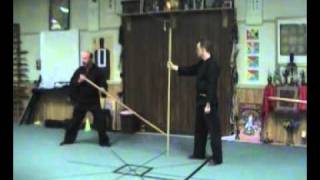
Feints with Quarterstaff: Cutting Mechanics
Quarterstaff feints employ similar principles to broadsword and smallsword techniques. When executing cutting feints, the practitioner feints over the opponent's weapon, disengaging over the blade to attack an alternate target, such as feinting to the outside and then cutting to the inside.
Weight Limitations and Double Feints
Double feints should be avoided with the quarterstaff due to the weapon's weight, unlike broadsword techniques where multiple successive feints are viable. This mechanical constraint shapes the tactical approach to deception with heavier polearms.
Thrusting Feints: Disengagement Under the Blade
When feinting with thrusts, the practitioner disengages under the opponent's blade rather than over it, mirroring smallsword methodology. If the opponent follows the feint, the attacker thrusts forward to score.
Inside-Cut Feints with Footwork
Starting from an inside-cut guard, the practitioner feints toward the opponent's outside, prompting a response, then pivots to strike the inside cut. Incorporating traverse footwork creates favorable angles and increases effectiveness.
Outside-Cut Feints and Target Flexibility
Outside-cut feints involve a step forward followed by a lateral movement and strike to the second target. This technique can target the head, arm, or hand; striking the hand places the opponent in a bind where the attacker maintains positional advantage.
Half-Step Advantage for Feinting
Employing a half-step grip shortens the effective weapon length, enabling faster and more efficient feints. This compressed distance reduces the time and space required to execute deceptive techniques.
Thrust Feints with Disengagement
The practitioner disengages under the opponent's thrust, fades the attack, then immediately thrusts to the opposite line. This rhythm—fade-respond-thrust—creates a continuous offensive cycle.
Guard Transitions After Feinted Thrusts
Following a successful thrust feint, the practitioner can transition into either inside or outside guard positions with minimal motion. Maintaining positional control after the feint ensures the defender cannot effectively counter.
Quarterstaff: Lesson 5
Key Takeaways
- •Feints with Quarterstaff: Cutting Mechanics
- •Weight Limitations and Double Feints
- •Thrusting Feints: Disengagement Under the Blade
- •Inside-Cut Feints with Footwork
Lesson 5 of our Quarterstaff guide is about Feints. Based on and inspired by Zachary Wylde, Donald McBane, Archibald MacGregor and others. Please train under the guidance of an experienced instructor, check your medical condition before you start training, stay safe, protect yourself and your training partners at all times. This is for information only, we do not take any responsiblity for any physical, mental or material harm. If you are interested in joining our free online apprenticeship program, check out for details at our homepage: https://cateransociety.wordpress.com/ Visit us on Facebook: https://www.facebook.com/DragonSysXIII/ If you find some value in our videos and want to support our work, maybe you like to become a Patron and get access to additional material: https://www.patreon.com/HighlandBroadsword Or you can do a one off donation on Paypal: https://www.paypal.com/cgi-bin/webscr?cmd=_s-xclick&hosted_button_id=AWP6X9XHCLPFL&source=url
Related Techniques
Frequently Asked Questions
What does this video teach about quarterstaff — hema?
This video covers feints with quarterstaff: cutting mechanics, weight limitations and double feints, thrusting feints: disengagement under the blade. It provides detailed instruction from Triskelion Combat.
How long does it take to learn quarterstaff — hema?
The basic mechanics can be understood in a single session, but developing reliable execution requires consistent drilling over weeks of practice. This 8-part breakdown helps structure your training by isolating each phase of the technique.
What are the key details for finishing quarterstaff — hema?
The practitioner disengages under the opponent's thrust, fades the attack, then immediately thrusts to the opposite line. This rhythm—fade-respond-thrust—creates a continuous offensive cycle.