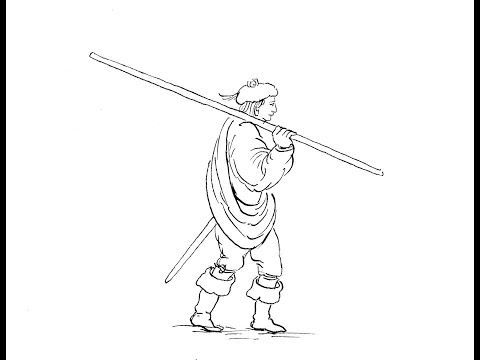
Quarterstaff: Lesson 5
0
Quarterstaff — HEMA·Triskelion Combat
Lesson 5 of our Quarterstaff guide is about Feints. Based on and inspired by Zachary Wylde, Donald McBane, Archibald Mac…
Translation: quarterstaff — HEMA
European quarterstaff fighting using a 6-8 foot hardwood staff, documented in English and German fight manuals from the medieval period onward.
The quarterstaff has been documented as a weapon of both commoners and gentlemen in England since at least the medieval period, with references appearing in 14th-century legal and literary sources. [1] George Silver's Paradoxes of Defence (1599) argued that the short staff was the most effective weapon of all, superior to the rapier then fashionable among the English gentry. [2] Joseph Swetnam's The Schoole of the Noble and Worthy Science of Defence (1617) provides further technical instruction in quarterstaff methods. [3] On the continent, Hans Talhoffer's fight manual (1467) includes staff techniques alongside sword and polearm methods. [1] The quarterstaff experienced a revival in Victorian England as a gentleman's exercise, documented in R.G. Allanson-Winn's Broad-Sword and Single-Stick (1898), and is now studied within the HEMA (Historical European Martial Arts) movement. [1]
The quarterstaff was widely recognised in medieval and Renaissance Europe as an exceptionally effective weapon, with George Silver declaring in Paradoxes of Defence (1599) that the short staff was superior to the sword in combat. [1] Its two-handed grip allows rapid transitions between thrusts and strikes, and the ability to slide the hands along the shaft enables variable-range fighting. [2]
Quarterstaff technique is documented in multiple European sources, including George Silver's Paradoxes of Defence (1599) and Joseph Swetnam's The Schoole of the Noble and Worthy Science of Defence (1617). [1]
Quarterstaff fighting is competed at HEMA tournaments, with English and German staff-fighting traditions reconstructed from historical sources. [1]
No images yet for this technique.
Sign in to suggest an image.
Lesson 5 of our Quarterstaff guide is about Feints. Based on and inspired by Zachary Wylde, Donald McBane, Archibald Mac…
No instructional courses yet for this technique.
Sign in to suggest a course.
Risk of injury to the person this technique is applied to
Staff/bo/jo weapons generate significant blunt force; fracture risk
Skill level needed to execute this technique reliably
Whether this technique is allowed under major competition rule sets
The Art of Combat (Joachim Meyer, 1570)
Alias sources — [1] MMA Instruction Manual (UFC, 2008) [2] MMA Instruction Manual (UFC, 2008) [3] MMA Instruction Manual (UFC, 2008)
Effectiveness sources — [1] Silver, G., Paradoxes of Defence (1599) [2] Anglo, S., The Martial Arts of Renaissance Europe (Yale University Press, 2000)
Standard katakana transliteration of Western martial arts terminology (外来語) — used in Japanese MMA, boxing, and BJJ communities
Alias sources — [1] MMA Instruction Manual (UFC, 2008) [2] MMA Instruction Manual (UFC, 2008) [3] MMA Instruction Manual (UFC, 2008)
Effectiveness sources — [1] Silver, G., Paradoxes of Defence (1599) [2] Anglo, S., The Martial Arts of Renaissance Europe (Yale University Press, 2000)
wrist snap speed, sliding grip coordination, hip rotation
long reach and strong wrists for staff manipulation
forearms, wrist rotators, core rotators, shoulders
Every move, in any martial art, shares a few universal traits. Mix and match below to pinpoint the right tool — or compare equivalents across styles.
The quarterstaff appears in 47 passages across 17 books. The simplest and most universally available weapon in history — a wooden pole 6-8 feet long. Documented in English martial arts manuals from the medieval period through the Renaissance. Silver's Paradoxes of Defence (1599) ranks the staff as the supreme weapon. (17 books; HEMA texts)
European quarterstaff fighting using a 6-8 foot hardwood staff, documented in English and German fight manuals from the medieval period onward.
The quarterstaff has been documented as a weapon of both commoners and gentlemen in England since at least the medieval period, with references appearing in 14th-century legal and literary sources. George Silver's Paradoxes of Defence (1599) argued that the short staff was the most effective weapon of all, superior to the rapier then fashionable among the English gentry.
Traditional martial arts: legal — Practiced in traditional kata/forms and weapon-specific competition under var…; IWUF: legal — Legal in wushu taolu if applicable; HEMA: legal — Legal in applicable historical weapon categories
Danger rating 7/10. Very High — staff/bo/jo weapons generate significant blunt force; fracture risk
The standard setup chain: Grip and Stance → Chamber → Strike → Recovery.
Standard counters include: Guard Position — return to a defensive ready stance / Distance Management — control the measure to avoid being in range / Counter-Attack — strike during the opponent's recovery or between movements.
Common variants: Overhead strike (bringing the staff down from above in a vertical arc); Lateral strike (horizontal sweep targeting the ribs or head); Thrust (straight thrust with the end of the staff); Butt-end strike (striking with the rear end of the staff at close range).
Quarterstaff fighting is competed at HEMA tournaments, with English and German staff-fighting traditions reconstructed from historical sources.
Top errors to watch for: Gripping the staff in the centre with both hands — the quarterstaff grip uses one hand at the butt and one at the qua… / Not using the sliding grip technique — the ability to extend and retract by sliding the butt hand is the quarterstaff… / Treating the quarterstaff as identical to the Japanese bo — different grip, different techniques, different tactical … / Not using thrusts — the quarterstaff thrust is devastating; Silver considered it the primary attack.
The Quarterstaff — HEMA is also known as Kwōtā Sutaffu, English Quarterstaff, European Staff, Short Staff — HEMA.