Setup and Positioning
The instructor establishes the basic position for the inside foot sweep, emphasizing the importance of the near leg placement in jiu-jitsu versus the far leg preference in wrestling. The distinction matters because jiu-jitsu opponents typically transition to guard position upon being swept, whereas wrestlers aim to keep opponents on their back.
Upper Body Control and Pressure
Proper upper body mechanics are critical to executing the sweep effectively. The instructor demonstrates that simply positioning the leg without maintaining downward pressure through the chest and arm placement will allow the opponent to stand up and escape the technique.
Leg Placement and Circling
Once upper body pressure is established, the attacker steps and grabs the opponent's leg while circling to maintain position. The key is to prevent the opponent from creating space by walking away, requiring the attacker to move laterally while keeping control.
Common Mistake: Quad-Stack Defense
The instructor identifies a frequent error where incomplete leg control allows the opponent to stack the attacker's hips and escape. Proper execution requires securing a seatbelt grip and controlling the far leg to maintain pressure and prevent the opponent from using a defensive stack.
Greco-Roman Variation
An alternative approach using Greco-Roman wrestling mechanics involves dropping to the knee and pulling the opponent down rather than executing a traditional foot sweep. This variation can result in the opponent being taken to their back but is less applicable to freestyle wrestling or no-gi grappling.
Extended Leg Pull Alternative
Another option involves keeping the opponent's leg elevated in the air while continuously pulling them forward. This variation creates mutual hopping between both athletes and serves primarily as a reset technique when both competitors are stuck in position.
Mechanics of the Pull
The pulling motion must occur over the attacker's hip to elevate the opponent's leg properly. Without this initial pull establishing the leg height, the technique devolves into a less effective position where the attacker lacks proper body weight leverage.
Leg Hook Finish and Positional Transition
Once the opponent is taken down, the attacker should work toward hooking a leg and establishing back control. The instructor notes that both of the opponent's legs being down creates an opportunity to transition to mount position, though the attacker must be careful not to settle into an undesirable half guard.
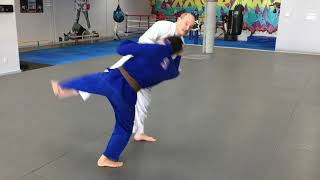
Inside Foot Sweep TAKEDOWN!
Key Takeaways
- •Setup and Positioning
- •Upper Body Control and Pressure
- •Leg Placement and Circling
- •Common Mistake: Quad-Stack Defense
This video Anton breaks down an inside foot sweep out of the clinch that can be used for wrestling, bjj, or mma. Check out the details and you are sure to find something useful! Enjoy! If you have any questions, comments, or suggestions, please comment below. More videos to come! Please like, share, and subscribe!! PLEASE Click this link to SUPPORT the TeachMeGrappling Channel!!! https://www.patreon.com/TeachMeGrappling or https://www.paypal.me/CoachBrianPeterson Your contribution is much appreciated and will help me continue to bring you content! 🙏 www.NextLevelGuy.com The NextLevelGuy Podcast with Coach Brian Peterson has been released!! Check it out!
Related Techniques
Frequently Asked Questions
What does this video teach about foot sweep?
This video covers setup and positioning, upper body control and pressure, leg placement and circling. It provides detailed instruction from TeachMeGrappling Coach Brian.
How long does it take to learn foot sweep?
The basic mechanics can be understood in a single session, but developing reliable execution requires consistent drilling over weeks of practice. This 8-part breakdown helps structure your training by isolating each phase of the technique.
What are the key details for finishing foot sweep?
The pulling motion must occur over the attacker's hip to elevate the opponent's leg properly. Without this initial pull establishing the leg height, the technique devolves into a less effective position where the attacker lacks proper body weight leverage.
Related videos
The Scissor Sweep Takedown MMA Surge, Episode 20
mahalodotcom
Outside Trip Double Leg Takedown - Wrestling for Jiu-Jitsu by Greg Hamilton BJJ
Renzo Gracie Jiu Jitsu DFW
AWESOME Inside Trip TAKEDOWN!!
TeachMeGrappling Coach Brian
KO UCHI GARI O SOTO GARI COMBINATION TECHNIQUE
welcomematstevescott
Integrated Attacks - Ko Soto Gari
Seiryoku Zenyo