Feinting and Information Gathering
The instructor emphasizes the importance of feinting to gather information about an opponent's tendencies and defensive responses. By feinting with the lead leg, lead hand, or both in combination, a fighter can provoke reactions that reveal the opponent's personality—such as their preferred counters or stress responses under pressure. This intelligence gathering forms the foundation for executing effective takedown entries.
Entry with One-Two and Single-Leg Setup
After feinting to read the opponent, the fighter steps in with a deliberate one-two combination while advancing the right leg forward and keeping the left hand high to defend against potential knees. Upon closing distance, the fighter secures a single-leg takedown position with the knee in the middle, then pummels the hand to the inside of the opponent's wrist to control the arm before transitioning to an underhook.
Underhook and Front Headlock Position
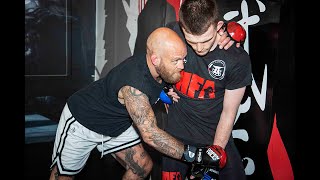
From the pummeled position, the fighter establishes an underhook with the head positioned on the same side, maintaining tight hip positioning. The fighter then secures a collar tie and drags the opponent forward into a front headlock position, which serves as the control mechanism for the subsequent takedown phase.
Clinch Control and Upper Body Strikes
Once in the front headlock, the fighter works upper cuts to the body and targets the liver with knees while systematically lowering the opponent's head below chin level. Throughout this phase, the fighter maintains control of the chin to keep the opponent in an uncomfortable and compromised position.
Breaking Down to Half Guard
The fighter slides into a rough position while maintaining chin control, then seats the opponent to their side by sliding the knee adjacent and posting to drag the hip to the mat. From here, the fighter transitions into half guard, establishing an A-shaped leg configuration and securing inside wrist control with the chin positioned above the shoulder.
Half Guard Refinement and Leg Configuration
To prevent the opponent from generating power through leg strength in half guard, the fighter retracts the heel toward the buttocks, creating an uncomfortable compression. The fighter can then sit on the knee and apply figure-four leg pressure, establishing a dominant control position suitable for ground-and-pound or submission attacks.
Front Headlock Exits and Neck Positioning
The instructor demonstrates two variations for exiting the front headlock position while minimizing neck strain. The first method involves pinning the head and pulling out, while the second method keeps the head low and uses an ankle grab to achieve a smoother transition. Both approaches lead to the same inside wrist and chin positioning for the final breakdown sequence.
Transition to Dominant Ground Position
From the controlled clinch position with inside wrist control and chin above shoulder, the fighter steps through to establish a stable top position. The fighter avoids top-heavy positioning by retracting the heel before applying figure-four leg pressure, completing the transition from standing takedown to a ground control position suitable for offensive operations.
Khabib Nurmagomedov Takedown Technique (Wall Wrestling)
Key Takeaways
- •Feinting and Information Gathering
- •Entry with One-Two and Single-Leg Setup
- •Underhook and Front Headlock Position
- •Clinch Control and Upper Body Strikes
This is a system used by Khabib Nurmagomedov. He often uses the upper body lock to setup his snap downs and front headlocks etc. Here's a technique (system) he uses in at least a few of his MMA fights. Very excited to see if Khabib can land this or a similar setup in his upcoming UFC fight against Tony Ferguson. Khabib Nurmagomedov Takedown Technique (Wall Wrestling) Subscribe: https://www.youtube.com/channel/UCd8S... Social Media: Website: https://www.thevikingacademy.com/ Email: [email protected] instagram: https://www.instagram.com/stevenstran... Facebook: https://www.facebook.com/thevikingaca... Twitter: https://twitter.com/vikingacademyny I hope you enjoy the video! #KhabibDagestan #MMA #SendMeLocation
Related Techniques
Frequently Asked Questions
What does this video teach about wall takedown?
This video covers feinting and information gathering, entry with one-two and single-leg setup, underhook and front headlock position. It provides detailed instruction from Steven Strangles People.
How long does it take to learn wall takedown?
The basic mechanics can be understood in a single session, but developing reliable execution requires consistent drilling over weeks of practice. This 8-part breakdown helps structure your training by isolating each phase of the technique.
What are the key details for finishing wall takedown?
The instructor demonstrates two variations for exiting the front headlock position while minimizing neck strain. The first method involves pinning the head and pulling out, while the second method keeps the head low and uses an ankle grab to achieve a smoother transition. Both approaches lead to the same inside wrist and chin positioning for the final breakdown sequence.
Related videos
MMA Takedown from the Clinch Tutorial
Stuart Tomlinson
The Easiest Street Takedown: Dirty Boxing to Single Leg (Cliff Odette)
Strip Mall Sensei
Single leg defense variation, against the cage ..
Lyubomir Kumbarov
Double Leg Off Cage With Striking Set Up
MMA COACH
MMA Training - Using the Body Lock to Throw & Suplex off the Cage Wall with Peter Irving
Stuart Tomlinson