Hip Positioning and Back Arch Development
The body lock's effectiveness depends on proper hip positioning placed directly underneath the opponent's center of gravity. Developing a strong back arch is essential, requiring dedicated conditioning work to maintain correct positioning without relying on upper body pulling.
Wall Walking Warm-Up Drill
The wall walking drill builds the necessary strength for body lock work by having the practitioner place hands on the cage and walk backward while maintaining hip contact. Practitioners should start conservatively, gradually increasing depth as their body adapts to the bridging position.
Partner Hip Drop Exercise
In partner drills, practitioners maintain hand grip while dropping their hips explosively, then recovering to standing. This develops the hip mobility and explosive power needed for takedown execution while requiring significant trust between partners.
Establishing Outside Foot Position
Proper foot placement against the cage is critical for body lock control. The practitioner must establish a strong outside foot position that prevents the opponent from creating space or executing escapes.
Forearm Grip and Rib Cage Compression
The grip configuration emphasizes using the sharp blade of the forearm to dig into the opponent's ribs, creating compression that prevents escape attempts. This hand position, with palm orientation specific to the attack side, makes it nearly impossible for the opponent to extract their elbow.
Hip Scoop and Elevation
As the takedown executes, the attacking wrestler steps around while scooping the opponent's hips upward and underneath their center. This positioning creates the mechanical advantage necessary for the suplex finish against the cage.
Grip Security and Forearm Pressure
The grip must transition so the sharp forearm edge digs deeply into the opponent's ribcage, creating a seal that prevents elbow extraction. This positioning makes resistance substantially more difficult and stabilizes the hold throughout the takedown sequence.
Finish and Suplex Execution
The complete takedown finishes with the opponent lifted off their feet and driven into the cage through suplex mechanics. The combination of hip elevation, rib cage compression, and explosive leg drive creates the finishing power for the technique.
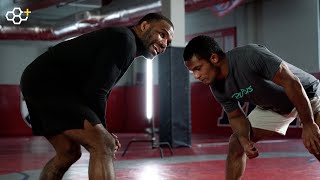
MMA Training - Using the Body Lock to Throw & Suplex off the Cage Wall with Peter Irving
Key Takeaways
- •Hip Positioning and Back Arch Development
- •Wall Walking Warm-Up Drill
- •Partner Hip Drop Exercise
- •Establishing Outside Foot Position
MMA training has to be very sports specific nowadays in order for the athlete or fighter to be successful at any level of competition. Using the cage wall then has never been a more vital skill. Download your copy today by clicking on the link below: https://www.warriorcollective.co.uk/shop/digital-download/mma-training-cage-craft-peter-irving/ This tutorial clip has been taken from the newest full length instructional volume to go up on the Warrior Marketplace. "MMA Training - Cage Craft for Dominating Fights" is from none other than renowned UK MMA fighter, BJJ black belt and head coach of Itaipava Jiu Jitsu Peter Irving. Here, alongside the equally brilliant duo of brothers Harry and George Hardwick, he goes over how he likes to build his fighters up to utilising arching throws or suplexes from the body lock against the cage wall in MMA. Peter Irving began training in 2001, fighting on small regional events, and made his professional MMA debut in 2003 on Cagewarriors 4. At the beginning of 2004 Pete made the move to Brazil, studying under Master Crezio de Souza, a legendary figure in Brazilian Jiu-Jitsu, Brazilian wrestling team member and pioneer of Vale-Tudo (anything goes) fighting. Whilst in Brazil Pete competed extensively in Gi and no-gi competition, fighting in the copa do Brasil and the Mundials. After dedicating two years completely to studying Brazilian Jiu-Jitsu and Judo, Pete returned to Muay Thai and Mixed Martial Arts in December 2005, becoming 2x Strike and Submit British MMA champion, and facing top European opposition to become 2x Strike and Submit European MMA champion and 3x Xth Legion European MMA champion, with wins over top American middleweight champion Reggie Cardiel, top Danish fighter Morten Djursaa, UFC fighter Reza Madadi, M-1 champion Daniel Weichel, Cagewarriors champion Ivan Musardo, TUF competitor Nordin Asrih, and Iceland’s Arni Isaakson Pete made the move to the K-1 rules style of Thaiboxing in 2012, capturing the UCMMA UK-1 Welterweight belt, the XFS super middleweight title and the ICO super middleweight British title under the tutelage of Semtex gym coaches Steve Gladstone and Kieran Keddle. Pete received his black belt in BJJ from World Champion Leo Negao and his black belt in Chinese boxing from his MMA coach and mentor Alan Orr in 2011. Peter is now a 3rd Degree Black Belt in CSL Chinese Boxing San Da under Alan Orr. This volume includes: Lines of Defence. A look at the layers of defence typically utilised by fighters defending takedowns in the centre of the cage. MMA Striking Defence. How to use traditional and MMA specific defences to nullify your opponents strikes. Wrestling Vs Striking. A multitude of different ways to counter your opponent when they look to attack via their most favoured strikes. Floor Control. How to land in dominate positions and control on the floor to continue causing damage via strikes or progress to submissions. The 50/50 tie. A complete framework for developing an understanding of the 50/50 over/under clinch position in the centre or against the cage wall Physical Controls. How to be physical above your weight class in order to control or reverse your opponent onto the cage wall. Using the Wall. An in-depth look at how to use the cage wall to pin, strike and takedown for maximum damage using the MMA rule set. Defending the Wall. A complete framework for how to defend takedown attempts and controls against the cage wall from the floor to standing. Reversing & Counters. How to reverse and submit fighters who are trying to pin you against the cage wall. Takedowns. A multitude of different takedown options from Peter’s complete system of using wrestling against the cage wall. Taking the Back. How to force the back take against the wall in order to set up both high impact throws and low energy takedowns. Body Lock. How to fight effectively for the body lock and then utilise a systematic tool kit of attacks once it has been taken. And more…. Thanks for watching, I hope you enjoyed watching this MMA video, please like, share and don't forget to SUBSCRIBE to Warrior Collective for more great videos each week!! WELCOME TO THE BEST ONLINE MARTIAL ARTS RESOURCE IN THE WORLD www.warriorcollective.co.uk JOIN THE WARRIOR COLLECTIVE COMMUNITY INSTAGRAM - https://www.instagram.com/warriorcollective/?hl=en FACEBOOK - https://www.facebook.com/warriorcolle... TWITTER - https://twitter.com/Warriorcollect WARRIOR COLLECTIVE COURSES - https://www.warriorcollective.co.uk/product-category/digital-download/ #mma #cagewall #warriorcollective
Related Techniques
Frequently Asked Questions
What does this video teach about body lock wall takedown?
This video covers hip positioning and back arch development, wall walking warm-up drill, partner hip drop exercise. It provides detailed instruction from Stuart Tomlinson.
How long does it take to learn body lock wall takedown?
The basic mechanics can be understood in a single session, but developing reliable execution requires consistent drilling over weeks of practice. This 8-part breakdown helps structure your training by isolating each phase of the technique.
What are the key details for finishing body lock wall takedown?
The grip must transition so the sharp forearm edge digs deeply into the opponent's ribcage, creating a seal that prevents elbow extraction. This positioning makes resistance substantially more difficult and stabilizes the hold throughout the takedown sequence.
Related videos
Single leg defense variation, against the cage ..
Lyubomir Kumbarov
Double Leg Off Cage With Striking Set Up
MMA COACH
Drake Ayala Single Leg Takedown | Technique Tuesday
FloWrestling
How to SHOOT the PERFECT Single Leg for Beginners!
TeachMeGrappling Coach Brian
Jordan Burroughs Blast Double Breakdown
RUDIS