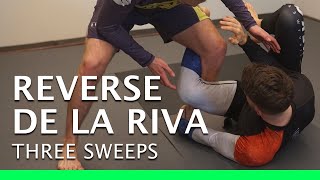
Introduction to De La Riva Guard
De La Riva guard, pioneered by Ricardo de la Riva, has become a dominant position in modern jiu-jitsu competition over the past two decades. While historically played for many years, de la Riva guard is primarily used in sport contexts and is most effective when the opponent is standing or grounded. This guard emphasizes off-balancing and creating multiple attacking opportunities from a single positional setup.
Establishing the Shallow Hook
The shallow de la Riva hook is established by placing one leg on the opponent's thigh while controlling the ankle on the same side. The practitioner simultaneously pushes away on the opponent's far thigh to create separation and control. This foundational position allows the guard player to manipulate the opponent's base and set up subsequent techniques.
Upper Body Control and Grip Sequence
After establishing the hook, the guard player sits up into a jackknife position to secure upper body control. Initial grip can be taken on the sleeve, but transitioning to a collar grip provides superior off-balancing leverage. With control of both the ankle and collar, the practitioner can effectively pull the opponent forward and off-balance them by driving their hands toward the floor.
Triangle Setup from Shallow Hook
When the opponent's arm passes under the guard player's arm during the off-balancing motion, a triangle opportunity emerges. The guard player steps their hips into the opponent's armpit and shifts weight to center their hips. From this position, a triangle choke or armbar can be cleanly executed with proper hip placement and control.
Armbar Finish from Arm-Over Position
If the opponent's arm passes over the guard player's arm instead, an alternative armbar path becomes available. The practitioner steps across the opponent's body and reaches over their arm at the wrist. The finish can occur belly-down or by allowing the opponent's resistance to create a roll, transitioning into a mounted armbar position.
Deep Hook Transition for Vertical Posture
When the opponent maintains an upright posture and resists off-balancing, transitioning to a deep hook becomes necessary. The guard player places their foot on the ground and reaches their hook leg deeply across the opponent's hip. This deep positioning immediately off-balances the opponent's hips, causing them to either fall or backstep and expose their back.
Back Take Sequence
Following the deep hook off-balance, the guard player secures the opponent's back by wrapping around their arm and hooking behind their knee. Control is maintained on the pants or belt while the guard player squares their hips and elevates the opponent. The practitioner then kicks their feet out perpendicular to complete the back take, controlling both hooks and the opponent's torso.
Baratoplata Back Take Introduction
The baratoplata is an advanced finishing technique that combines de la Riva positioning with a rolling back take mechanism. This technique searches for the back while utilizing a granby roll principle, requiring the practitioner to break the sleeve grip and transition to belt or pants control. Understanding the underlying mechanical structure makes this complex-appearing movement relatively simple to execute.
Scissor Lift and Belt Control
The baratoplata execution begins with establishing the deep hook and securing the opponent's belt or pants. As the guard player sits up, they pull the opponent over their shoulder, creating space to roll slightly back. This scissor-lift motion generates the momentum necessary to continue the rolling transition while maintaining positional control.
Finishing the Baratoplata
As the guard player rolls through, they remove the top leg while keeping the bottom hook engaged as the rear hook control. The practitioner climbs up the opponent's back by reaching and pulling simultaneously to establish chest-to-back contact. This seamless transition completes the back take from a guard position, combining multiple mechanical principles into a single fluid motion.
De la Riva Guard Basics & 4 Great Options
Key Takeaways
- •Introduction to De La Riva Guard
- •Establishing the Shallow Hook
- •Upper Body Control and Grip Sequence
- •Triangle Setup from Shallow Hook
This video shows the basics of de la Riva guard, one of the most useful and versatile guards in BJJ. From this position, you can sweep, submit, take the back in a variety of ways. I include some of my favorites, as well as what I consider to be some of the highest percentage techniques off this guard. Included in this video: • Basic DLR Setup • Triangle Choke • Rolling Arm Lock • Standard Back Take • Berimbolo to Back If you like this, please subscribe and consider signing up for exclusive, members only content by joining my channel as a paid member for a few bucks a month. Thank you everyone for watching!
Related Techniques
Frequently Asked Questions
What does this video teach about standard de la riva?
This video covers introduction to de la riva guard, establishing the shallow hook, upper body control and grip sequence. It provides detailed instruction from Knight Jiu-Jitsu.
How long does it take to learn standard de la riva?
The basic mechanics can be understood in a single session, but developing reliable execution requires consistent drilling over weeks of practice. This 10-part breakdown helps structure your training by isolating each phase of the technique.
What are the key details for finishing standard de la riva?
The baratoplata execution begins with establishing the deep hook and securing the opponent's belt or pants. As the guard player sits up, they pull the opponent over their shoulder, creating space to roll slightly back. This scissor-lift motion generates the momentum necessary to continue the rolling transition while maintaining positional control.