Reverse de la Riva
0
Reverse De La Riva·Energia Martial Arts·Added by Admin
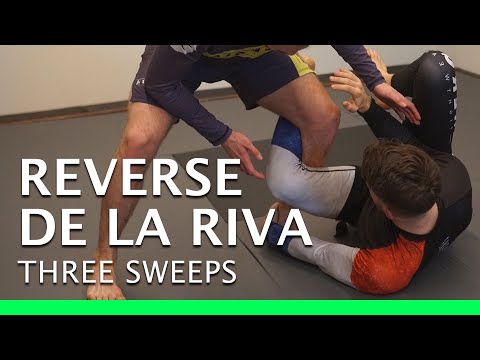
Reverse de la Riva Here we'll be showing you a basic setup, position and 3 different sweeps from the Reverse de la Riva …
Translation: reverse De La Riva
The Reverse De La Riva positions the guard player with the DLR hook wrapped around the opponent's lead leg from the inside rather than the outside, with the foot hooking behind the knee from the opposite direction. [1] The reverse DLR provides different sweeping angles than the standard DLR and is frequently used as a transitional position to berimbolo attacks, kiss of the dragon entries, and deep half guard. [1],[2] It is particularly effective against opponents who step their leg back to counter the standard DLR hook. [2],[3]
The reverse De La Riva guard is highly effective as a counter to knee-cut passes, using an inside hook on the lead leg to disrupt the pass and create back take opportunities. [1]
Reverse De La Riva guard is used in modern BJJ competition as a complement to the standard RDLR. [1]
No images yet for this technique.
Sign in to suggest an image.
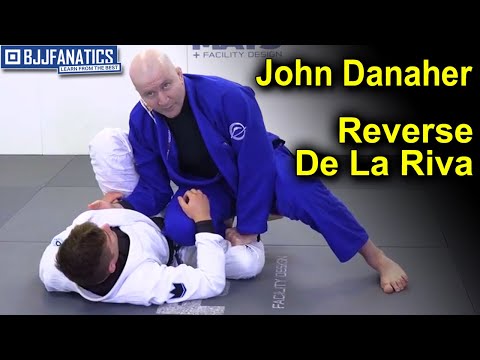
Reverse de la Riva Here we'll be showing you a basic setup, position and 3 different sweeps from the Reverse de la Riva …
REVERSE DE LA RIVA - BJJ Technique by John Danaher https://www.bjjfanatics.com In this BJJ Techniqes video, John Danahe…
This video Espen Mathiesen shows his basic foundations for controlling the reverse de la riva position. This is a powerf…
The Reverse De La Riva is a modern guard system where the inside leg hooks the opponent's outer thigh with a shoelace connection, functioning primarily as a defensive tool against knee slice passing. Energia Martial Arts emphasizes the guard's mechanical fundamentals: the bottom player uses hamstring pressure on the opponent's shin while controlling the heel, maintaining an on-side body position to eliminate gaps, and keeping the non-hooking foot in the opponent's armpit to prevent foot lock threats. The position branches into three sweep categories based on opponent reaction—disengaging (triggering a tripod sweep), full engagement with pressure (leading to a tumbling sweep), and angle-making (requiring a transition to X-guard). BJJ Fanatics and JonThomasBJJ approach the guard from the passer's perspective, focusing on removing the shoelace connection by establishing inside elbow or knee position below the opponent's knee, then moving into split squat or similar passing configurations. JonThomasBJJ introduces a strategic framework dividing the position into three levels: knee-on-ground (level one, emphasizing weight transfer and back-take attacks), heel-elevated drive (level two, using opponent momentum against them), and standing posture (level three, employing underhooks and leg attacks). All three instructors agree on the guard's critical utility within broader guard systems and its effectiveness when adapted to individual gripping styles (collar, spider, lasso). Energia Martial Arts and JonThomasBJJ emphasize reading opponent positioning and adjusting technique accordingly, while BJJ Fanatics stresses the consistent principle of inside position acquisition regardless of which limb accomplishes it.
Synthesized from 3 instructors
No instructional courses yet for this technique.
Sign in to suggest a course.
Risk of injury to the person this technique is applied to
Guard positions are defensive; injury risk comes from transitions, not the position itself
Skill level needed to execute this technique reliably
Whether this technique is allowed under major competition rule sets
Jiu-Jitsu University (Saulo Ribeiro, 2008)
Alias sources — [1] IBJJF Rules (2024) [2] Jiu-Jitsu University (Ribeiro, 2008) [3] Jiu-Jitsu University (Ribeiro, 2008)
Effectiveness sources — [1] The Guard (Moreira & Beneville, 2003)
Standard katakana transliteration of Western martial arts terminology (外来語) — used in Japanese MMA, boxing, and BJJ communities
Alias sources — [1] IBJJF Rules (2024) [2] Jiu-Jitsu University (Ribeiro, 2008) [3] Jiu-Jitsu University (Ribeiro, 2008)
Effectiveness sources — [1] The Guard (Moreira & Beneville, 2003)
hip flexibility, active legs, grip management
long legs for distance control and guard retention
hip flexors, adductors, quadriceps, core, grip
According to John Danaher, always pop the grip in the direction your opponent's thumb points—never try to go down, as that's the strongest direction of their grip. Breaking toward the thumb direction works every time.
John Danaher explains that you don't have to use your hand in the inside position—you can use almost anything, including your second knee, to achieve the same passing position effectively.
According to Energia Martial Arts, don't stay in Reverse De La Riva—switch to X Guard instead. Keep your knee high to prevent them from getting an angle and sprawling into half guard, then make the transition by lifting them up rather than pushing them to the side.
Energia Martial Arts emphasizes keeping your hand underneath the opponent's leg and maintaining constant tension—if you both let go and go for the top position, your opponent will likely win or you'll end up in a scramble.
The Reverse De La Riva positions the guard player with the DLR hook wrapped around the opponent's lead leg from the inside rather than the outside, with the foot hooking behind the knee from the opposite direction. The reverse DLR provides different sweeping angles than the standard DLR and is frequently used as a transitional position to berimbolo attacks, kiss of the dragon entries, and deep half guard.
The reverse De La Riva guard developed as a natural counter-position within the DLR guard system, gaining prominence as berimbolo and inverted guard play became dominant in lightweight BJJ competition. It is now a standard component of modern open guard systems.
IBJJF: legal — Legal — guard is fundamental to BJJ, sweeps from guard score 2 points; IJF: restricted — Guard pulling penalized as non-combativity — groundwork from guard permitted …; ADCC: legal — Legal, guard pull penalized -1 point in points portion; Unified MMA: legal — Legal — no penalty for playing guard; FIAS Sport Sambo: legal — Legal
Danger rating 2/10. Low — guard positions are defensive; injury risk comes from transitions, not the position itself
The standard setup chain: Achieve Guard Contact → Control Grips → Manage Distance → Threaten Submissions/Sweeps.
Standard counters include: Guard Pass — systematically work to clear the legs and establish a dominant position / Leg Pin — control one or both legs to neutralize guard retention / Pressure Passing — use heavy chest pressure to flatten and immobilize the guard player.
Common variants: Standard half guard (one leg trapped between both legs with an underhook); Deep half guard (fully under the opponent with the leg fully entangled); Lockdown half guard (figure-four leg lock on the trapped leg (10th Planet)); Z-guard (knee shield) (knee across the opponent's chest creating a frame).
Reverse De La Riva guard is used in modern BJJ competition as a complement to the standard RDLR.
Top errors to watch for: Using RDLR as a primary starting guard — it is a reactive guard best used to counter passes / Not maintaining the hook when the opponent tries to clear it — fight to keep the RDLR hook active / Playing RDLR without upper body grips — the hook alone is insufficient; add collar-sleeve or frame grips / Not inverting for the kiss of the dragon — the back-take from RDLR is the highest-percentage attack.
The Reverse De La Riva is also known as Ribāsu Dera Hība, Reverse DLR, RDLR, Berimbolo Guard.