Understanding The De La Riva X
0
Standard De La Riva·JonThomasBJJ
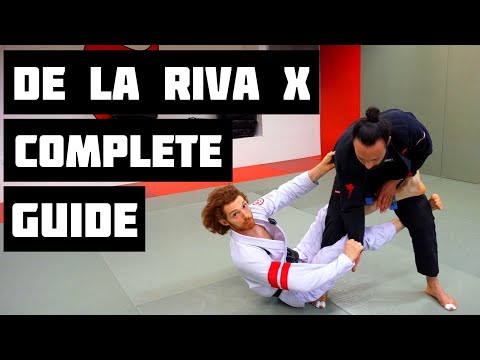
The De La Riva X is an extremely powerful guard system used at the top black belt level by the likes of Nicholas Meregal…
Translation: standard De La Riva
The Standard De La Riva establishes the classic DLR guard with the outside hook wrapped around the opponent's lead leg, foot behind the knee, near hand controlling the ankle, and the far hand gripping the collar or sleeve. [1] This is the base DLR guard configuration from which all DLR attacks originate — sweeps, berimbolo entries, back takes, and transitions to other guard positions. [1],[2] The standard DLR provides a comprehensive platform for both gi and no-gi guard play. [2],[3]
De La Riva guard is one of the most commonly played open guards in IBJJF competition. [1]
No images yet for this technique.
Sign in to suggest an image.
The De La Riva X is an extremely powerful guard system used at the top black belt level by the likes of Nicholas Meregal…
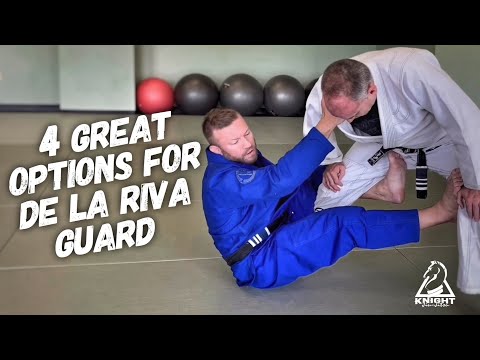
This video shows the basics of de la Riva guard, one of the most useful and versatile guards in BJJ. From this position,…
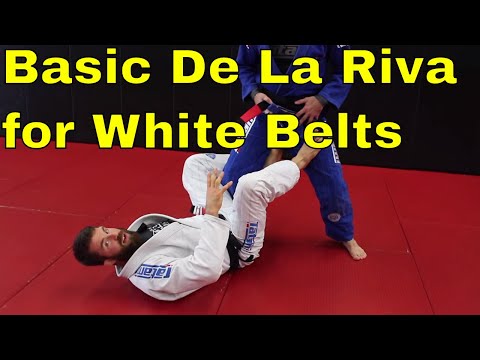
Today's question is from Andrew who requested a De La Riva Sweep. In this video I first talk about some basic ideas of…
The Standard De La Riva is a fundamental open-guard position that emphasizes controlled placement of one leg on an opponent's thigh or hip while maintaining grip control, typically from a standing or semi-standing context. Chewjitsu establishes the basic mechanics: the practitioner hooks the inside of the opponent's leg with the foot while controlling the ankle and heel, prevents knee-turning by maintaining heel position, and uses a cross-grip on the sleeve combined with same-side hip control for entry. Knight Jiu-Jitsu and JonThomasBJJ both stress the critical principle of creating distance between hips before attempting position refinement, with JonThomasBJJ emphasizing that greater distance allows easier leg lacing and that lateral body positioning increases reach. All three instructors agree on grip priorities—sleeve and collar grips are preferred for off-balancing—and highlight that control precedes technical execution. Chewjitsu presents the hook sweep as a primary finishing technique from the position, noting the danger of exposed ankles during the sweep exit and advocating for a combat-base recovery. Knight Jiu-Jitsu demonstrates multiple attacking pathways including triangles, armbars, and back takes via the Baratoplata motion, while JonThomasBJJ details deep-lace variations (De La Riva X) with options for sweeps, single-leg transitions, and back controls. All instructors consistently treat Standard De La Riva as a position requiring proper entry methodology, maintained tension throughout, and awareness of defensive counter-attacks before pursuing offensive techniques.
Synthesized from 3 instructors
No instructional courses yet for this technique.
Sign in to suggest a course.
Risk of injury to the person this technique is applied to
Guard positions are defensive; injury risk comes from transitions, not the position itself
Skill level needed to execute this technique reliably
Whether this technique is allowed under major competition rule sets
Jiu-Jitsu University (Saulo Ribeiro, 2008)
Alias sources — [1] IBJJF Rules (2024) [2] Jiu-Jitsu University (Ribeiro, 2008) [3] The Guard (Moreira & Beneville, 2003)
Effectiveness sources — [1] Jiu-Jitsu University (Ribeiro, 2008) [2] Mastering Jujitsu (Gracie & Danaher, 2003)
Standard katakana transliteration of Western martial arts terminology (外来語) — used in Japanese MMA, boxing, and BJJ communities
Alias sources — [1] IBJJF Rules (2024) [2] Jiu-Jitsu University (Ribeiro, 2008) [3] The Guard (Moreira & Beneville, 2003)
Effectiveness sources — [1] Jiu-Jitsu University (Ribeiro, 2008) [2] Mastering Jujitsu (Gracie & Danaher, 2003)
hip flexibility, active legs, grip management
long legs for distance control and guard retention
hip flexors, adductors, quadriceps, core, grip
When you're close to your opponent's hips, your leg gets jammed up and you need longer reach to lace effectively. Counter-intuitively, the further away you are, the easier it is to lace because your leg has to travel less distance.
Get on your side when lacing—this gives your leg more reach than staying flat. Creating distance and getting on your side are the two key mechanics to establish a strong lace.
Hit high on the hip; if you hit low, the lace is much easier for your opponent to slide off, and they may also be able to backstep toward a knee bar.
Immediately sit up and grab the armpit material on the same side—this prevents your opponent from pushing your feet down and escaping the position.
One of the easiest sweeps is to switch to a single leg grip, or you can grab the cross lapel high and use a technical stand-up to complete the sweep.
You don't need to rip the heel to the side aggressively; instead, maintain control so that if your opponent tries to turn their knee out, you can hold their foot in place to stop that movement.
The Standard De La Riva establishes the classic DLR guard with the outside hook wrapped around the opponent's lead leg, foot behind the knee, near hand controlling the ankle, and the far hand gripping the collar or sleeve. This is the base DLR guard configuration from which all DLR attacks originate — sweeps, berimbolo entries, back takes, and transitions to other guard positions.
The standard De La Riva guard is the foundational position developed by Ricardo De La Riva, representing one of the most influential guard innovations in BJJ history. It remains one of the most widely used and effective open guard positions in competition.
IBJJF: legal — Legal — guard is fundamental to BJJ, sweeps from guard score 2 points; IJF: restricted — Guard pulling penalized as non-combativity — groundwork from guard permitted …; ADCC: legal — Legal, guard pull penalized -1 point in points portion; Unified MMA: legal — Legal — no penalty for playing guard; FIAS Sport Sambo: legal — Legal
Danger rating 2/10. Low — guard positions are defensive; injury risk comes from transitions, not the position itself
The standard setup chain: Achieve Guard Contact → Control Grips → Manage Distance → Threaten Submissions/Sweeps.
Standard counters include: Guard Pass — systematically work to clear the legs and establish a dominant position / Leg Pin — control one or both legs to neutralize guard retention / Pressure Passing — use heavy chest pressure to flatten and immobilize the guard player.
Common variants: Spider guard (gripping both sleeves with feet on the biceps for distanc…); De la Riva guard (one hook behind the opponent's lead leg with opposite foo…); Lasso guard (lasso grip wrapping the leg around the opponent's arm); Collar-sleeve guard (controlling collar with one hand and sleeve with the othe…).
De La Riva guard is one of the most commonly played open guards in IBJJF competition.
Top errors to watch for: Hooking without the far-side grip — the opponent will simply step around the hook / Not controlling the near ankle — ankle control prevents retreat and maintains range / Placing the hook too deep (past the knee) — the instep should be on the inner thigh, not wrapped around the entire leg / Using a straight hook instead of an angled one — the hook should pull at a diagonal for maximum off-balancing.
The Standard De La Riva is also known as Sutandādo Dera Hība, Classic DLR, Standard De La Riva Hook, Full DLR.