Positioning the Bolt to the Wrench
When attempting a turtle sweep, the top player's extended weight distribution creates leverage that prevents the roll. The escape requires moving closer to the opponent's center of gravity by walking up on the head and compressing distance. The key principle is aligning one's spine parallel to the opponent's spine rather than perpendicular, conceptualized as bringing a bolt as close as possible to a wrench to neutralize mechanical advantage.
Hip Frame to Guard Entry
If a direct turnover fails, the near shoulder drops to the ground while the hip elevates and inserts between the escaper and the opponent. The hip is supported by the spine, which transfers weight through the shoulder and legs, creating a structural frame. Once stabilized, the bottom player drops the hip and brings the knees forward to establish guard, with the frame supported sequentially by hand, knee, and hip to prevent the opponent from circling the guard.
Spinal Lever Against Rear Body Lock
When an opponent applies a rear body lock while in kneeling turtle position, the spine functions as a mechanical lever. Since the opponent's weight concentrates on the upper body, the head can be lifted easily even if the hips cannot. The escaper lifts the head, builds to a knee, then stands up to break the grip and transition into an offensive position.
Hip Elevation Against Seatbelt Control
Against a seatbelt grip applied from turtle position, weight distribution favors the upper body while the hips remain relatively unloaded. The escaper lifts the hip rather than the head, walking around the opponent's hips to execute a dump. This reversal transfers the bottom player to top position, where they can unwind the grip and establish control.
Leg Lever from Bottom Sprawl Position
When caught underneath a sprawled opponent after a failed takedown attempt, the bottom player can create a mechanical advantage by controlling the opponent's leg. The escaper traps the knee and ankle with the heel, keeping the leg elevated and off the ground while driving the head forward. An opponent's grounded leg functions as a stabilizing frame, but an elevated leg becomes a lever that the bottom player can manipulate to transition to top position.
Executing the Elevated Leg Lever
To isolate the leg lever, the bottom player first traps the opponent's knee and encircles it with both hands. Falling to the side allows the heel to lift the ankle off the ground while pressure is maintained through head drive and forward push. Continuing this pressure uses the opponent's leg as a fulcrum to shift their weight and positioning, enabling the bottom player to potentially pass guard or advance position.
The 5 Best Ways To Escape The Turtle Position
Key Takeaways
- •Positioning the Bolt to the Wrench
- •Hip Frame to Guard Entry
- •Spinal Lever Against Rear Body Lock
- •Hip Elevation Against Seatbelt Control
Turtle Sweep. The longer the lever, the greater the torque. With my partner’s centre of gravity so far away from me, their body acts like a lever preventing me from turning them over. The key to making the Turtle Sweep work, is to get directly under their centre of gravity. Granby The Granby allows you to use your spine as a frame. A frame which goes from your hip to your shoulder. Standing up head first. In order for your partner to keep you down, they need to utilize your spine like a lever. Understanding that, if your partner is heavy on your hips; then, you can lift your head. Once you’ve stood up; then, you can fight fight and turn to face your partner. Standing up hips first. If your opponent is heavy on your shoulders; then, there’s nothing stopping you from lifting up your hips; since, your spine acts like a lever. Once your hips are up, look to underhook your partner, and drive into them so that you’re both standing up. Single Leg If your partner is directly in front of you, then you can grab one of their legs. In order to make their leg into a lever, their leg has to be completely off the ground. Use your hand to grab the toes of their right leg to keep their foot and their knee off the ground and look to stand up into a Single Leg Takedown.
Related Techniques
Frequently Asked Questions
What does this video teach about turtle escape?
This video covers positioning the bolt to the wrench, hip frame to guard entry, spinal lever against rear body lock. It provides detailed instruction from Ritchie Yip.
How long does it take to learn turtle escape?
The basic mechanics can be understood in a single session, but developing reliable execution requires consistent drilling over weeks of practice. This 6-part breakdown helps structure your training by isolating each phase of the technique.
What are the key details for finishing turtle escape?
When caught underneath a sprawled opponent after a failed takedown attempt, the bottom player can create a mechanical advantage by controlling the opponent's leg. The escaper traps the knee and ankle with the heel, keeping the leg elevated and off the ground while driving the head forward. An opponent's grounded leg functions as a stabilizing frame, but an elevated leg becomes a lever that the bottom player can manipulate to transition to top position.
Related videos
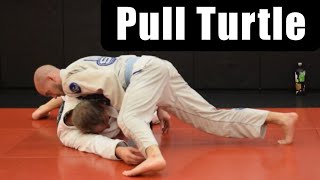
Pull Turtle To Escape
SBG PDX & Vancouver BJJ and MMA Videos

Beginners MUST KNOW This One!!: BABY-BOLO - Taking the Back from De La Riva
玉木強 / YOSHI JIU-JITSU TECH
Berimbolo | Z Lock & Triangle Lock | 4K
玉木強 / YOSHI JIU-JITSU TECH
10th Planet Counters: Einstein's Triangle Escape
Alder Hampel
2 Ways to Escape the Mount EVERY Time!
BIG OSS Jiu-Jitsu Channel