Turtle Position Origins
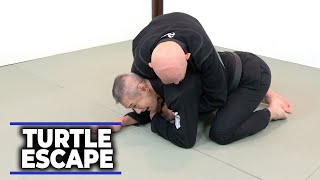
Turtle position arises in two primary scenarios: following a failed takedown attempt when the opponent sprawls, or during escapes from dominant positions like cross-side control. Understanding when turtle occurs helps practitioners recognize transition opportunities and develop appropriate responses.
Three Primary Bottom Escapes
When trapped on the bottom in jiu-jitsu, practitioners have three fundamental options: pull guard, transition to hands and knees (turtle), or attempt to roll the opponent. Rolling is considered unreliable against opponents with strong bases or significant size advantages, making guard pulling and turtle transitions the most dependable escape strategies.
Developing Dual Escape Capabilities
Effective bottom players must develop proficiency in both guard pulling and turtle transitions, as opponents can specifically shut down either escape. When opponents pin the shoulders to prevent turtle, guard pulling becomes necessary; conversely, when hip pressure blocks guard pulls, turtle transitions become essential. Building competency in both methods creates a flexible defensive game.
Preventing the Underhook
The critical principle for successfully transitioning to turtle position is denying the opponent an underhook. When defending against guard pass attempts, the bottom player should glue their forearm to their own thigh on the passing side while moving their hips away, making it mechanically difficult for the passer to secure the underhook or maintain pin pressure.
Hip Positioning and Escape Mechanics
As the opponent initiates their pass, the bottom player should immediately retreat their hips backward rather than driving forward into the opponent's weight. This defensive hip placement creates a strong angle that prevents the passer from flattening them out, setting up an efficient transition to hands and knees.
Threading the Needle to Belly-Down Position
Once in turtle position with proper hip spacing, the escaping player threads one foot underneath the other to achieve a belly-down orientation. This position allows the practitioner to maintain pressure and prepare for subsequent offensive movements while maintaining the structural integrity of their escape.
Head Positioning and Crossface Defense
Proper head positioning denies the opponent a crossface opportunity by connecting the head tightly to the defending arm in an iron pillow configuration. This defensive posture, maintained throughout the escape sequence, prevents the passer from controlling the head and using it as a lever to flatten the escaping player.
Timing the Explosive Movement
Rather than continuously driving forward against the opponent's weight, the bottom player should move themselves away gradually until they identify an opening, then execute the explosive transition to hands and knees. This timing-based approach is more efficient than attempting sustained muscular pressure against superior positioning.
Pull Turtle To Escape
Key Takeaways
- •Turtle Position Origins
- •Three Primary Bottom Escapes
- •Developing Dual Escape Capabilities
- •Preventing the Underhook
Try out SBG University for a month for free. Use the code: YOUTUBEFREE https://sbgu.samcart.com/referral/OD1DNOAi/vUiYFZg8SxVUHRex For more SBG International BJJ and MMA instructional videos check: www.sbguniversity.com Also, check the BJJ Q&A with founder of SBG Matt Thornton here: https://youtu.be/pghir7WyisY #bjj #brazilianjiujitsu #SBG
Related Techniques
Frequently Asked Questions
What does this video teach about turtle escape?
This video covers turtle position origins, three primary bottom escapes, developing dual escape capabilities. It provides detailed instruction from SBG PDX & Vancouver BJJ and MMA Videos.
How long does it take to learn turtle escape?
The basic mechanics can be understood in a single session, but developing reliable execution requires consistent drilling over weeks of practice. This 8-part breakdown helps structure your training by isolating each phase of the technique.
What are the key details for finishing turtle escape?
Proper head positioning denies the opponent a crossface opportunity by connecting the head tightly to the defending arm in an iron pillow configuration. This defensive posture, maintained throughout the escape sequence, prevents the passer from controlling the head and using it as a lever to flatten the escaping player.
Related videos
The 5 Best Ways To Escape The Turtle Position
Ritchie Yip
Beginners MUST KNOW This One!!: BABY-BOLO - Taking the Back from De La Riva
玉木強 / YOSHI JIU-JITSU TECH
Berimbolo | Z Lock & Triangle Lock | 4K
玉木強 / YOSHI JIU-JITSU TECH
10th Planet Counters: Einstein's Triangle Escape
Alder Hampel
2 Ways to Escape the Mount EVERY Time!
BIG OSS Jiu-Jitsu Channel