Limitations of Direct Pummeling
When an opponent maintains tight arm position with elbows down and armpits closed, direct pummeling and striking become ineffective. The instructor addresses the challenge of establishing an underhook against a defensively sound opponent, noting that techniques like uchi mata, o goshi, and inside trips all benefit from underhook control.
Collar Tie as Setup Tool
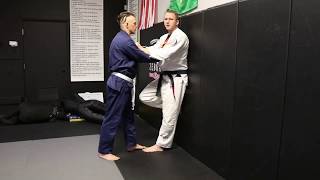
Rather than holding a static collar tie, the instructor emphasizes active manipulation through pushing and directional control to prevent the opponent from escaping or transitioning to an outside two-on-one or body lock. The collar tie functions as a setup mechanism to establish the desired underhook position.
Sabaki Motion and Underhook Entry
The instructor demonstrates stepping outside to the right while executing a sabaki (body shifting motion) to create space for underhook access. This footwork, combined with pulling on the opponent's collar, allows the practitioner to dig under the opponent's arm and establish underhook control.
Upper Body-Driven Throwing Mechanics
Once the underhook is secured, the technique relies primarily on upper body rotation rather than leg position, with the throwing hand driving toward the opposite shoulder while the collar tie hand pulls downward. The leg assists but does not drive the takedown, with the rotational force of the torso generating most of the throwing power.
Near-Leg Takedown Variation
An alternative execution involves pulling down on the head with the collar tie while simultaneously lifting across the body with the underhook, then capturing the near leg to complete the takedown. This method eliminates the need for uchi mata positioning and functions as a simpler leg-trip variation.
Cross-Tap Entry for Tight Defenses
When an opponent maintains extremely tight arm position preventing underhook access, the cross-tap technique uses the non-collar-tie hand to strike the opponent's elbow, opening the space needed to establish the underhook. This method applies whether the opponent controls the collar tie on either side.
Two Primary Underhook Entries
The instructor summarizes two pathways: pulling the opponent's head backward while digging for the underhook, or executing a cross-tap on the elbow to open space for underhook entry. Both methods lead to the same upper-body-driven throwing mechanics and require the same finishing techniques.
Application Within Greco-Roman Wrestling
These upper-body control and throwing methods apply directly to Greco-Roman wrestling, where leg-reaping techniques are prohibited and practitioners must rely on throws generated from upper-body positioning and rotational force. The collar tie and underhook system provides functional offensive tools within these rule constraints.
Head Control Clinch John Saylor
Key Takeaways
- •Limitations of Direct Pummeling
- •Collar Tie as Setup Tool
- •Sabaki Motion and Underhook Entry
- •Upper Body-Driven Throwing Mechanics
John Saylor teaches pummeling skills useful in no gi grappling, MMA, submission grappling or catch wrestling but can also be applied to combat sports using jackets (Judo, Sambo). This video was made at the Shingitai Training Camp in Perrysville, Ohio in 2015.
Related Techniques
Frequently Asked Questions
What does this video teach about head control clinch?
This video covers limitations of direct pummeling, collar tie as setup tool, sabaki motion and underhook entry. It provides detailed instruction from welcomematstevescott.
How long does it take to learn head control clinch?
The basic mechanics can be understood in a single session, but developing reliable execution requires consistent drilling over weeks of practice. This 8-part breakdown helps structure your training by isolating each phase of the technique.
What are the key details for finishing head control clinch?
The instructor summarizes two pathways: pulling the opponent's head backward while digging for the underhook, or executing a cross-tap on the elbow to open space for underhook entry. Both methods lead to the same upper-body-driven throwing mechanics and require the same finishing techniques.