Introduction to Ken Ken Throws
Mark Gilston demonstrates seven variations of ken ken throws at Cooper MMA. Ken ken, meaning "hop, hop," is a hopping footwork technique applicable to nearly every foot sweep in judo. This instructional series covers the fundamental mechanics and practical applications of each throw.
Osoto Otoshi: Major Outer Drop
Osoto otoshi is an effective counter to stiff-arm defense. The instructor places his heel behind the opponent's knee and executes a controlled foot flex with minimal upper body movement. The opponent's own pushing motion provides the momentum for the throw, requiring only a slight additional push to complete.
Ken Ken Osoto Gari: Major Outer Reap
When an opponent resists the initial osoto gari setup by planting their foot, the ken ken variation employs hopping footwork to reposition and generate additional force. The instructor leans forward slightly to prevent reversal while hopping around the opponent. This technique transforms a failed throw into an effective finishing movement.
Ken Ken Ouchigari: Major Inner Reap
Unlike osoto gari, ouchigari targets the inside of the opponent's leg. When the opponent blocks or resists the initial entry, the instructor hops inward toward the opponent rather than away. The hopping motion generates the additional force needed to overcome defensive resistance and complete the throw.
Ken Ken Kosoto Gari: Minor Outer Reap
Kosoto gari begins with the instructor pulling the opponent's elbow down to create forward momentum and encourage backward resistance. When the opponent plants their foot to prevent the sweep, hopping footwork provides the force necessary to overcome this defense. The ken ken variation eliminates any possibility for the opponent to counter the technique.
Ken Ken Kouchi Gari: Minor Inner Reap
Kouchi gari historically employed a hand grab to capture the opponent's foot, now prohibited in modern judo. The hopping replacement achieves the same result through footwork rather than hand techniques. The instructor enters perpendicular to the opponent and hops to generate the necessary sweeping force.
Ken Ken Deashi Barai: Advancing Foot Sweep
Deashi barai targets the opponent's advancing foot with precise timing. When the initial sweep attempt fails due to mistimed entry, hopping footwork repositions the instructor and generates additional force. Critically, the instructor turns away from the opponent to stretch them awkwardly and prevent their recovery.
Ken Ken Uchimata: Inner Thigh Row
Uchimata requires the instructor to enter low and far to the outside with aggressive pulling and pushing. When the initial technique fails to generate sufficient extension, hopping footwork provides the needed leverage to complete the throw. The instructor turns into the opponent while hopping to maximize the technique's effectiveness.
Key Principles of Ken Ken Throws
Ken ken techniques serve as defensive solutions when initial throw attempts encounter resistance or improper positioning. The hopping footwork generates additional force while maintaining control and preventing counter-throws. All variations share the critical principle: if counter-threat is imminent, the technique must be abandoned immediately.
Ken Ken Throws
Key Takeaways
- •Introduction to Ken Ken Throws
- •Osoto Otoshi: Major Outer Drop
- •Ken Ken Osoto Gari: Major Outer Reap
- •Ken Ken Ouchigari: Major Inner Reap
Mark Gilston, 4th degree judo black belt, demonstrates the use of "Ken Ken" or hopping foot sweep techniques in judo and BJJ. http://www.coopermma.com
Related Techniques
Frequently Asked Questions
What does this video teach about right-right ai-yotsu?
This video covers introduction to ken ken throws, osoto otoshi: major outer drop, ken ken osoto gari: major outer reap. It provides detailed instruction from Seiryoku Zenyo.
How long does it take to learn right-right ai-yotsu?
The basic mechanics can be understood in a single session, but developing reliable execution requires consistent drilling over weeks of practice. This 9-part breakdown helps structure your training by isolating each phase of the technique.
What are the key details for finishing right-right ai-yotsu?
Uchimata requires the instructor to enter low and far to the outside with aggressive pulling and pushing. When the initial technique fails to generate sufficient extension, hopping footwork provides the needed leverage to complete the throw. The instructor turns into the opponent while hopping to maximize the technique's effectiveness.
Related videos
Advanced Judo Grip Fighting: A powerful way to avoid the post arm during grip fighting
Rochester Judo
Basic Judo throws and concepts
Shintaro Higashi
Most Secret techniques:Advanced grip fighting Aiyotsu.
FLUID JUDO JAPAN
Grip Fighting Drills - Basic to Advanced
The Judo Coach
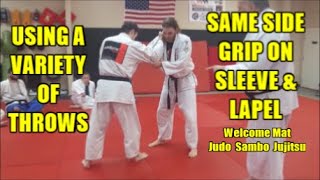
SAME SIDE GRIP ON SLEEVE & LAPEL USING A VARIETY OF THROWS
welcomematstevescott