Introduction to Jigoku Shime
Jigoku Shime, translated as "hell strangle," is a collar-based choke technique that combines gripping mechanics with positional leverage. The instructor demonstrates multiple variations of this tokuyuwaza (special technique) commonly employed in modern grappling.
Bottom Position Variation
From the bottom position, the practitioner inserts the same-side hand deep into the opponent's jacket collar. The opposite hand controls either the pant leg or sleeve, establishing anchoring points before executing a hip-driven pivot that generates choking pressure.
Hip Elevation and Pressure Application
The technique relies on raising the hips rather than simply pushing down and pulling with the arms. The top leg crosses over the opponent's body while the bottom foot creates a pivot point, allowing the practitioner to direct force through the collar into the carotid artery.
High Guard Collar Variation
When the opponent is in a high guard position, the practitioner catches the same-side collar grip and pivots over the opponent. Proper cloth positioning against the artery is critical, achieved through angling the leg back and executing an inversion before spinning to finalize the choke.
Back Control Application
From behind, when the opponent begins to escape traditional sliding chokes, the Jigoku Shime can be applied by maintaining collar control with same-side or cross-side grips. The practitioner controls two points of the opponent's body—typically the collar and a limb—while pivoting with hip-driven wringing motion.
Hip-Driven Mechanics
The fundamental principle of Jigoku Shime involves keeping the arms locked in place while the hips generate all primary choking pressure. This hip-to-arm separation allows the practitioner to continuously adjust angle and intensity throughout the technique's application.
Deception and Transitional Concepts
The practitioner can create openings by displaying one grip aggressively, causing the opponent to focus defensively on that threat, while simultaneously executing the choke from another angle. If the opponent straightens the neck or escapes one variation, the leg can transition over the top to maintain pressure.
Grip Variations and Angles
Jigoku Shime can be executed with various grip combinations—same-side collar to same-side grips or cross-collar configurations. The angle of neck rotation can range from 90 degrees to approximately 45 degrees, with the critical element being cloth placement at the base of the neck rather than cranking pressure.
Leg Positioning and Neck Control
The leg in Jigoku Shime serves multiple functions: binding an arm, pressing the opposite side of the head, or creating positional torque. Proper execution keeps pressure localized to the collar and neck base, avoiding isolated neck cranking while maintaining the choking mechanism.
jigoku jime 1
Key Takeaways
- •Introduction to Jigoku Shime
- •Bottom Position Variation
- •Hip Elevation and Pressure Application
- •High Guard Collar Variation
technique of the month #1
Related Techniques
Frequently Asked Questions
What does this video teach about do jime?
This video covers introduction to jigoku shime, bottom position variation, hip elevation and pressure application. It provides detailed instruction from afields71.
How long does it take to learn do jime?
The basic mechanics can be understood in a single session, but developing reliable execution requires consistent drilling over weeks of practice. This 9-part breakdown helps structure your training by isolating each phase of the technique.
What are the key details for finishing do jime?
Jigoku Shime can be executed with various grip combinations—same-side collar to same-side grips or cross-collar configurations. The angle of neck rotation can range from 90 degrees to approximately 45 degrees, with the critical element being cloth placement at the base of the neck rather than cranking pressure.
Related videos
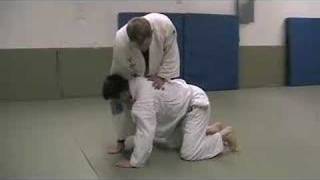
jigoku jime 2
afields71
Can Opener - Illegal BJJ Submission Neck Crank from Top Guard advanced Grappling for MMA - CanOpener
Peter Mettler Martial Arts
The Easiest Way to do the Twister
Stephan Kesting
The Crossface Cradle - Yes, it is Osaekomi
The Judokai Network
Can Opener - Illegal BJJ Submission Neck Crank from Top Guard advanced Grappling for MMA - CanOpener
Peter Mettler Martial Arts