Headquarters Position Overview
The headquarters position is entered by establishing angle control on one side of the opponent, then taking a deep step inside with the leg positioned slightly at an angle toward the bend of the knee rather than the thigh. The stepping leg should be placed with the foot even with the opponent's ribs while the opposite hand transitions from the knee to the collar. The instructor maintains a straight, lowered posture while sitting the hip down on the stepping foot to neutralize both of the opponent's legs.
Basic Headquarters Checkpoints
In the basic headquarters position, the deep-stepping leg is angled toward the opponent's knee bend to maximize pressure and control. The positioning near the centerline provides greater power against all of the opponent's defensive angles. The posture must remain straight and low—neither bent over at the head nor too tall—to neutralize the opponent's legs with the passing player's hip on one side and wall (opposite arm) on the other.
Passing Options from Headquarters
From the headquarters position with a right hand on the collar and right leg in the middle, the top player has multiple passing routes including the X-pass, cross knee pass, and side smash. An underhook attack can also be developed from this position. These options form the foundation of the pressure passing system.
Grip Variations
Beyond the standard collar grip, the instructor outlines several grip options available from headquarters: double collar, cross collar with leg, cross collar with sleeve, and opposite-side collar with pants control. The opposite-side collar and pants grip is presented as an evolved variation that addresses modern defensive strategies common in modern grappling.
Opposite-Side Grip Setup
The opposite-side collar and pants grip can be established by controlling the opponent's ankle during the initial step, securing the pants on the far side, and then transitioning to a collar grip while sitting on the opposite leg. The position of the opponent's knee—whether inside or outside the passing player's arm—determines the direction of the subsequent pass. This grip configuration directly addresses De La Riva, lasso, and inverted De La Riva guard mechanics.
Neutralizing De La Riva Attacks
Controlling the opponent's leg with pressure on the inside of the knee prevents the opponent from extending the leg deeply enough to establish De La Riva hooks. This constant downward pressure on the inside of the knee makes it difficult for the bottom player to generate the leverage required for De La Riva variations.
Shutting Down Lasso Guard
The standard headquarters position with collar control can expose the top player to lasso guard attacks, which create space and complicate the passing sequence. By maintaining control of the leg in the opposite-side grip, the passing player prevents the opponent's foot from achieving the positioning necessary for a lasso on that side, while the trapped foot inside the leg prevents lasso setup on the opposite side as well.
Preventing Inverted Entries
Keeping the opponent's leg controlled and positioned back prevents inversion and rotation between the passing player's legs. Players who attempt to enter inverted De La Riva positions by spinning between the legs find this prevented when leg control is maintained, whereas standard headquarters grips allow the opponent's leg freedom to rotate and enable entries to the inside position.
Evolution of Headquarters Strategy
The opposite-side collar and pants grip represents an evolution of the headquarters position in response to modern De La Riva, lasso, and inverted De La Riva strategies now common in grappling. While the basic headquarters grip remains valid depending on the opponent's specific style, leg control has become increasingly ideal for neutralizing contemporary guard attacks. The series focuses on developing attacks and techniques using this modified grip approach.
How to Get Into Headquarters Position
Key Takeaways
- •Headquarters Position Overview
- •Basic Headquarters Checkpoints
- •Passing Options from Headquarters
- •Grip Variations
Review of how to get into the headquarters and all the checkpoints you need to know to be successful. It's time to use pressure to pass some guards. View more instructionals at: https://jiujitsu.com/blogs/instructionals #bjj #jiujitsu #jiujitsuinstructional #instructional #brazilianjiujitsu #halfguard #sweep #gi #grappling #mma #bjjinstructional #guard #sidecontrol #kimura #submission #submissiongrappling #guard #guardpass #guardpassing #openguard
Related Techniques
Frequently Asked Questions
What does this video teach about headquarters position?
This video covers headquarters position overview, basic headquarters checkpoints, passing options from headquarters. It provides detailed instruction from JiuJitsu.com.
How long does it take to learn headquarters position?
The basic mechanics can be understood in a single session, but developing reliable execution requires consistent drilling over weeks of practice. This 9-part breakdown helps structure your training by isolating each phase of the technique.
What are the key details for finishing headquarters position?
Keeping the opponent's leg controlled and positioned back prevents inversion and rotation between the passing player's legs. Players who attempt to enter inverted De La Riva positions by spinning between the legs find this prevented when leg control is maintained, whereas standard headquarters grips allow the opponent's leg freedom to rotate and enable entries to the inside position.
Related videos
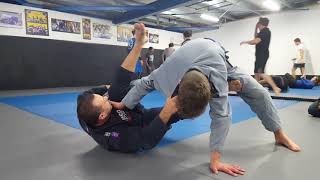
Recovering De La Riva from Headquarters position
Absolute MMA St Kilda - Melbourne
Rubber Guard Fundamentals | Basics and Not-So Basics
Knight Jiu-Jitsu
Rubber Guard TIPS all BEGINNERS should know..
Brandon Mccaghren
Mastering The Rubber Guard by Eddie Bravo
Bernardo Faria BJJ Fanatics
Mounted Rubber Guard - 10th Planet Jiu Jitsu
Brandon Mccaghren