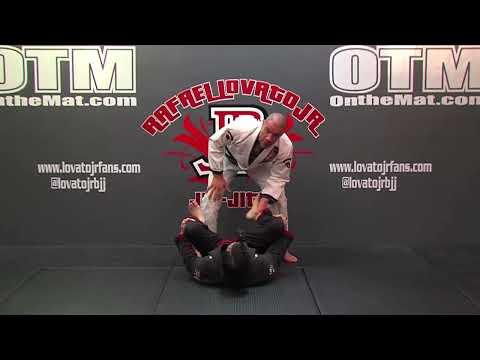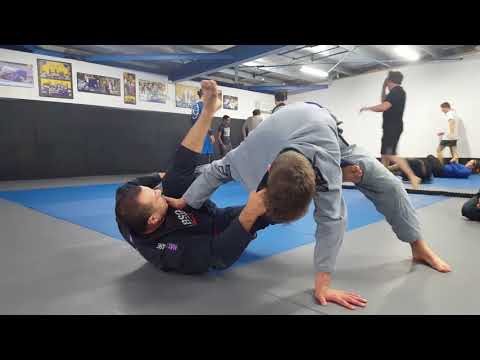
Recovering De La Riva from Headquarters position
0
Headquarters Position·Absolute MMA St Kilda - Melbourne
Follow the links below for detailed instructional series by Lachlan Giles The Guard Passing Anthology: Half Guard can b…
Translation: Headquarters Position (English loanword); Portuguese 'Quartel General' — military headquarters / command post
Headquarters (HQ) is a top control / pre-pass position in modern Brazilian Jiu-Jitsu where the standing or kneeling top player parks one shin across the bottom player's near hip with the foot hooked behind their far hip — converting the bottom player's open guard or De La Riva guard into a stalled, controlled checkpoint from which multiple guard passes (knee cut, leg drag, smash pass, long step) become available. [1],[2] The position was popularised by Rafael Mendes and the Atos lineage as the central hub of their guard-passing system: rather than committing to a specific pass on entry, the top player establishes Headquarters first, neutralises the bottom player's primary attacks (berimbolo, single-leg, leg lasso), and then chooses the pass that fits the moment. [1],[3] The defining structural detail is the shin alignment — the lead shin runs across the bottom player's hipline and traps the lower body, while the trailing leg posts wide for base. [1]
Headquarters was popularised in modern Brazilian Jiu-Jitsu by Rafael Mendes and the Atos / Art of Jiu-Jitsu academy lineage in the 2010s as the central organising position of their guard-passing system. [1],[2] Its rise paralleled the De La Riva and berimbolo era — HQ was specifically engineered to neutralise DLR-based open-guard systems by parking on the bottom player's near hip before they could complete the berimbolo entry. [1],[3] The position is now standard in elite-level no-gi and gi competition guard-passing pedagogy. [1]
Headquarters is regarded as one of the highest-percentage pre-pass positions in elite IBJJF and ADCC competition. [1] By neutralising hip mobility before committing to a specific pass, the position dramatically improves pass-completion rates against high-level open guard play; passes initiated from Headquarters complete at a markedly higher rate than passes attempted directly from standing or kneeling neutral. [1],[2] The Atos competition team's repeated IBJJF World Championship success (Rafael Mendes — five-time IBJJF World Champion at lightweight; Guilherme Mendes — four-time World Champion at featherweight; André Galvão — multiple Worlds and ADCC golds) is the primary visible proof of concept. [1],[3] Since the late 2010s, virtually every elite men's and women's lightweight black-belt match in IBJJF passes through Headquarters at least once, making it one of the most-passed-through transitional positions in modern competition. [1],[2],[4]
Modern Brazilian Jiu-Jitsu — codified by Rafael and Guilherme Mendes and the Atos / Art of Jiu-Jitsu lineage in the early 2010s as a structural counter to the De La Riva / berimbolo era that dominated 2010-2014. [1] Direct lineage: Cobrinha (Rubens Charles) → Atos brown/black belts → Mendes brothers → AOJ-affiliated competitors (Tainan Dalpra, Kennedy Maciel, Mikey Musumeci's training partners). [1],[3] By the late 2010s the position had spread beyond Atos into general BJJ pedagogy via the Mendes brothers' BJJ Fanatics instructionals and is now standard at every major academy. [1],[2]
Standard pre-pass position at IBJJF World Championships and ADCC at black-belt level since ~2014. Notable competitive uses: Rafael Mendes — IBJJF World Championship featherweight finals 2010-2013 (five wins); Guilherme Mendes — Worlds featherweight 2009-2012 (four wins); André Galvão — Worlds and ADCC Absolute golds 2011, 2013, 2017, 2019; Tainan Dalpra — IBJJF Worlds black belt middleweight 2022, 2023 (back-to-back); Kennedy Maciel — Worlds rooster weight 2022. The position is visible in nearly every elite Atos-lineage match in the modern era. [1],[3]
No images yet for this technique.
Sign in to suggest an image.
Follow the links below for detailed instructional series by Lachlan Giles The Guard Passing Anthology: Half Guard can b…
Review of how to get into the headquarters and all the checkpoints you need to know to be successful. It's time to use p…
No instructional courses yet for this technique.
Sign in to suggest a course.
Risk of injury to the person this technique is applied to
Position — no inherent danger; risk is positional disadvantage to the bottom player
Skill level needed to execute this technique reliably
Whether this technique is allowed under major competition rule sets
Mendes Brothers — High Pace Game (BJJ Fanatics, 2016) and Atos / Art of Jiu-Jitsu academy guard-passing system
Description sources — [1] Mendes brothers / Atos pedagogy; [2] Bernardo Faria guard-passing curriculum; [3] modern IBJJF / ADCC competitive guard-pass canon
Description sources — [1] Mendes brothers / Atos pedagogy (BJJ Fanatics High Pace Game series); [2] Bernardo Faria guard-passing curriculum; [3] modern IBJJF / ADCC competitive guard-pass canon; [4] competition video archives 2014-2024
Description sources — [1] Mendes brothers / Atos pedagogy (BJJ Fanatics High Pace Game series); [2] Bernardo Faria guard-passing curriculum; [3] modern IBJJF / ADCC competitive guard-pass canon; [4] competition video archives 2014-2024
hip mobility for the lead-shin parking, base / balance for sustained pressure, grip endurance for upper-body control
hip rotators (sustaining the shin position), quadriceps (lead leg load-bearing), gluteus medius (lateral base)
Headquarters is the central organising position of the modern Atos guard-passing system, popularised by Rafael Mendes. Its rise paralleled the De La Riva era and was specifically engineered to short-circuit the berimbolo before it can complete. Treat HQ as a hub with pass-options branching out, not as a static control.
The main entry to headquarters position is achieved through angling your body against your opponent's leg.
Position your leg at a slight angle going more against the bend of the knee than the thigh, aiming your knee toward the opponent's chest rather than the middle of their body, as this gives you more power and control against their angles.
Neutralize one leg by sitting your butt on top of it, and neutralize the other leg with your wall (your body/hip) on the opposite side.
Collapse your opponent's weight forward and off-balance them—if you time it right and pull them forward, you can create openings for your passes even if you don't maintain a tight leg grip.
Headquarters (HQ) is a top control / pre-pass position in modern Brazilian Jiu-Jitsu where the standing or kneeling top player parks one shin across the bottom player's near hip with the foot hooked behind their far hip — converting the bottom player's open guard or De La Riva guard into a stalled, controlled checkpoint from which multiple guard passes (knee cut, leg drag, smash pass, long step) become available. The position was popularised by Rafael Mendes and the Atos lineage as the central hub of their guard-passing system: rather than committing to a specific pass on entry, the top player establishes Headquarters first, neutralises the bottom player's primary attacks (berimbolo, single-leg, leg lasso), and then chooses the pass that fits the moment.
Headquarters was popularised in modern Brazilian Jiu-Jitsu by Rafael Mendes and the Atos / Art of Jiu-Jitsu academy lineage in the 2010s as the central organising position of their guard-passing system. Its rise paralleled the De La Riva and berimbolo era — HQ was specifically engineered to neutralise DLR-based open-guard systems by parking on the bottom player's near hip before they could complete the berimbolo entry.
IBJJF: legal — Legal at all belt levels; ADCC: legal — Legal; Unified MMA: legal — Legal; IJF: legal — Legal as a transitional position; IJF rules favour standing engagement so HQ …
Danger rating 1/10. Position — no inherent danger; risk is positional disadvantage to the bottom player
The standard setup chain: Engage Bottom Player's Open Guard → Pivot Around Far Hip → Park Lead Shin Across Near Hip → Wide Trailing Leg Post → Settle Weight and Grip Up → Choose Pass Option.
Standard counters include: Hip-out / shrimp before the shin settles — the moment of HQ entry is the only escape window / Inverted recovery — flip under the lead leg into a 50-50 or single-leg X position / Re-establishing De La Riva on the trailing leg — switches the engagement before HQ stabilises / Push-and-shrimp combination to disrupt the lead-shin alignment.
Common variants: Standing Headquarters (top player remains on feet with the shin across the hip, …); Kneeling Headquarters (lead knee on the floor, deeper structural pin; used after…); Reverse Headquarters (mirror version when the bottom player switches De La Riva…).
Standard pre-pass position at IBJJF World Championships and ADCC at black-belt level since ~2014. Notable competitive uses: Rafael Mendes — IBJJF World Championship featherweight finals 2010-2013 (five wins); Guilherme Mendes — Worlds featherweight 2009-2012 (four wins); André Galvão — Worlds and ADCC Absolute golds 2011, 2013, 2017, 2019; Tainan Dalpra — IBJJF Worlds black belt middleweight 2022, 2023 (back-to-back); Kennedy Maciel — Worlds rooster weight 2022.
Top errors to watch for: Shin too high (on the thigh instead of the hip) — bottom player retains hip mobility and recovers guard / Trailing leg posted too narrow — base collapses sideways under the bottom player's hip-bump sweeps / Reaching for grips too early — settle the position first; grip-fighting commitment without a stable HQ creates postin… / Treating HQ as a finish — it's a pre-pass hub; staying static draws stall warnings and lets the bottom player rebuild….
The Headquarters Position is also known as Heddokuōtāzu Pojishon, Headquarters, HQ, HQ Position, Quartel General.