Introduction to Rubber Guard
Rubber guard is a fundamental control position that develops when an opponent's posture is broken down while defending inside closed guard. This technique provides superior control and opens numerous submission and sweep opportunities. Understanding proper positioning prevents common joint injuries, particularly at the knee and hip.
Establishing Proper Positioning
After breaking posture, the practitioner should cut a sharp angle to the side while maintaining contact with the opponent's knee. The foot should establish contact with the opponent's hip while preserving the off-angle position. This angled setup forces the opponent to build structural support to regain posture, making escape significantly more difficult.
Grip Mechanics and Wrist Depth
A secure rubber guard grip requires wrist-deep control of the opponent's knee rather than holding at the hand or overhand positions, both of which create weak contact points. This deeper grip provides maximum control and transitions smoothly into advanced techniques. Proper grip depth is essential for maintaining pressure throughout the position.
Neck Frame and Head Control
From the knee hug position, the practitioner removes the opposite-side hand and establishes a frame against the opponent's neck while clearing the head. This transition creates a high-pressure zone with multiple submission pathways. The neck frame allows the practitioner to pull the foot forward into position for advanced finishing techniques.
Go-Go Plata Setup and Defense Response
When the opponent reacts to neck pressure by pushing the foot away, the practitioner gains wrist control, enabling transition to the armpit position. This escape attempt actually provides access to submission sequences. If the opponent turns away from pressure instead, the position naturally transitions into omoplata setups.
Omoplata Transitions and Arm Control
From neck pressure, maintaining shoulder pressure while controlling the opponent's wrist allows the practitioner to flatten and transition into omoplata sequences. Successful arm positioning enables multiple finishing options including shoulder pressure submissions and straight armbars. Sweep opportunities often precede submission attempts as the opponent rolls defensively.
Knee Hook Technique and Space Creation
The knee hook involves reaching across one's own shin and ankle to create space under the opponent's armpit, a powerful control mechanism in rubber guard terminology. This technique generates submission pressure and sweep setups through space manipulation. An opponent's arm positioned across the created space creates an extremely difficult and painful position to escape.
Sweep Integration and Far-Side Control
From the knee hook position, the practitioner can pull the opponent over while controlling the far-side arm, transitioning into sweep opportunities. Mono plata setups and Kimura sequences develop from this control configuration. Strategic arm positioning creates multiple finishing avenues while maintaining sweep potential.
Go-Go Clinch and Gable Grip Choke
The go-go clinch involves shooting underneath one's own ankle and establishing a gable grip at the opponent's neck for a powerful, submission-level choke. This configuration provides significant control and can be combined with knee pressure for additional pressure application. When opponents attempt to grab the foot for relief, the grip can transition to alternative submissions or sweeps.
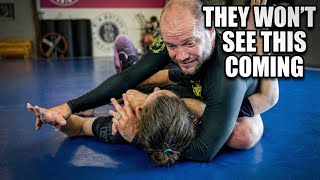
Rubber Guard Fundamentals | Basics and Not-So Basics
Key Takeaways
- •Introduction to Rubber Guard
- •Establishing Proper Positioning
- •Grip Mechanics and Wrist Depth
- •Neck Frame and Head Control
Join this channel or Patreon.com/KnightJiuJitsu for exclusive detailed instructional content! This video has had a lot of requests, so I finally broke down and made it. Here I show some Rubber Guard fundamentals, set-ups, common mistakes, control features and submission opportunities from basic to advanced. This is a sampling/overview of Rubber Guard, which is a versatile and robust position with uses ranging from sport to mma to self defense. There are a ton of great resources out there on this topic, mostly from the 10th Planet System. But this guard system has spread far and wide for decades now, and continually evolves. Hope you like my brief overview here. Rashguard and spats courtesy of North South Jiu-Jitsu Underwear www.northsouthjiujitsu.com Awesome CBD Products with my discount www.titaninfusions.com For 20% Off use discount code: ELIKNIGHT20 Follow me on Instagram @knight_jiu_jitsu_ Follow me on DTube: https://d.tube/#!/c/knightbjj Follow me on Steemit: https://steempeak.com/@knightbjj
Related Techniques
Frequently Asked Questions
What does this video teach about rubber guard basics?
This video covers introduction to rubber guard, establishing proper positioning, grip mechanics and wrist depth. It provides detailed instruction from Knight Jiu-Jitsu.
How long does it take to learn rubber guard basics?
The basic mechanics can be understood in a single session, but developing reliable execution requires consistent drilling over weeks of practice. This 9-part breakdown helps structure your training by isolating each phase of the technique.
What are the key details for finishing rubber guard basics?
From the knee hook position, the practitioner can pull the opponent over while controlling the far-side arm, transitioning into sweep opportunities. Mono plata setups and Kimura sequences develop from this control configuration. Strategic arm positioning creates multiple finishing avenues while maintaining sweep potential.
Related videos
Rubber Guard TIPS all BEGINNERS should know..
Brandon Mccaghren
Mastering The Rubber Guard by Eddie Bravo
Bernardo Faria BJJ Fanatics
Recovering De La Riva from Headquarters position
Absolute MMA St Kilda - Melbourne
How to Get Into Headquarters Position
JiuJitsu.com
Mounted Rubber Guard - 10th Planet Jiu Jitsu
Brandon Mccaghren