Rubber Guard TIPS all BEGINNERS should know..
0
Rubber Guard Basics·Brandon Mccaghren
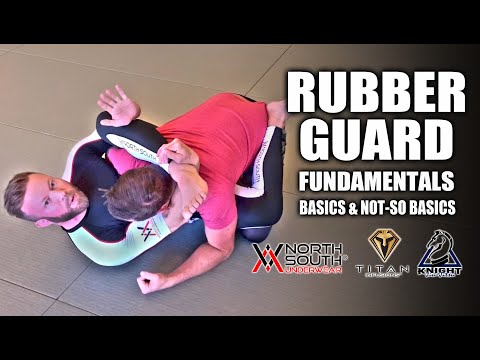
Triangle Chokes, Omoplatas, Gogo Clinch... So many great options to come from playing Rubber Guard with THESE details in…
Translation: rubber guard basics
Rubber Guard uses extreme leg flexibility to control the opponent from closed guard by placing the foot behind the opponent's head, creating a platform for submissions and sweeps without relying on gi grips. [1]
Documented across multiple grappling traditions. [1]
Proven in competition and cross-style challenge matches. [1]
Multi-style grappling tradition. [1]
Used in UFC and professional MMA competition
No images yet for this technique.
Sign in to suggest an image.
Triangle Chokes, Omoplatas, Gogo Clinch... So many great options to come from playing Rubber Guard with THESE details in…
Join this channel or Patreon.com/KnightJiuJitsu for exclusive detailed instructional content! This video has had a lot …
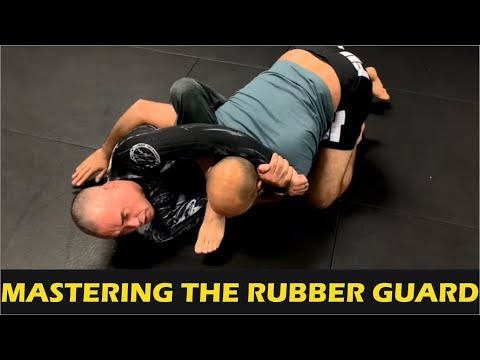
Mastering The Rubber Guard by Eddie Bravo - For The Best BJJ Instructional Videos, Check Out: https://bjjfanatics.com - …
The rubber guard is a closed-guard position initiated when an opponent's posture is broken down with the defender's hands controlling the opponent's upper body while maintaining a specific leg configuration. Eddie Bravo pioneered this position in Brazilian Jiu-Jitsu, and instructors across multiple channels emphasize distinct entry mechanics and applications. Bernardo Faria, citing Eddie Bravo's instruction, stresses that the entry is the critical foundation—establishing what he calls the "cocoon" position (deep overhook and underhook with both knees out in butterfly configuration) through a calculated sacrifice of the knee shield. This requires winning the "battle of the knee" by transitioning from lockdown through a superweapon position, using the "pimp arm" to control the opponent's free leg and forcing them to retreat into the underhook catch. Brandon McCaghren emphasizes early space-clearing mechanics—moving the hips to the side and using the elbow to create separation while securing a meat hook grip, stressing that the grip must be wrist-deep and angled properly to prevent the opponent from establishing heavy pressure. Knight Jiu-Jitsu (Eli Knight) provides the most comprehensive technical breakdown, distinguishing between optimal positioning (off to the side, hugging the knee, maintaining proper angle) and detailing the transition into multiple submission systems including go-go plata, omoplata, triangles, and shoulder locks. All three instructors agree that rubber guard requires proper hip positioning and emphasis on controlling one arm while framing the neck; they diverge in entry sequencing and submission focus, with Bravo prioritizing entry mechanics, McCaghren emphasizing defensive posture-breaking, and Knight cataloging the position's versatile attacking options.
Synthesized from 3 instructors
No instructional courses yet for this technique.
Sign in to suggest a course.
Risk of injury to the person this technique is applied to
Positional technique
Skill level needed to execute this technique reliably
Whether this technique is allowed under major competition rule sets
The Ultimate Guide to Grappling (Sattler, 2007)
description, historyOrigin: sourced from Sattler, J
description, historyOrigin: sourced from Sattler, J
Good body control and flexibility
Rubber guard appears in 421 passages across 7 books — the most documented single guard system in our corpus. Bravo's system uses extreme flexibility to control the opponent's posture from bottom using the legs — specifically designed for MMA where closed guard exposes the bottom player to strikes. (7 books; Bravo, Mastering the Rubber Guard, 2006)
You have to give up position strategically to gain better position—Eddie Bravo calls this 'giving up five yards to gain 10 yards.' Start from Z guard with your shield protecting your neck, then make a trade: remove the shield and offer an underhook in exchange for a lockdown, which opponents will typically accept 99% of the time.
The pimp arm is your control on the opponent's leg, typically positioned palm-up above the knee. It's critical because it prevents your opponent from passing your guard—even if they get an underhook, they still can't advance if you maintain control of their leg.
Don't pull your ankle in front of your knee, as this creates unnecessary torque on your knee and hip. Instead, drape your shin over their arm properly and keep tight control—never let space open up during the setup, or your opponent will gain positioning advantage.
From rubber guard you can transition into omoplata setups by clearing your opponent's arm, or progress to attacks like the saddle and honey hole (also called gaku)—though entry into these positions is the most important fundamental to master first.
Rubber Guard uses extreme leg flexibility to control the opponent from closed guard by placing the foot behind the opponent's head, creating a platform for submissions and sweeps without relying on gi grips.
Documented across multiple grappling traditions.
IBJJF: legal — Legal — guard is fundamental to BJJ, sweeps from guard score 2 points; IJF: restricted — Guard pulling penalized as non-combativity — groundwork from guard permitted …; ADCC: legal — Legal, guard pull penalized -1 point in points portion; Unified MMA: legal — Legal — no penalty for playing guard; FIAS Sport Sambo: legal — Legal
Danger rating 3/10. Positional technique
The standard setup chain: Position → Rubber Guard Basics.
Standard counters include: Technique-specific counters.
Common variants: Standard Rubber Guard Basics.
Used in UFC and professional MMA competition
Top errors to watch for: Poor control / Rushing.
The Rubber Guard Basics is also known as Rubber Guard Basics, 10th Planet Rubber Guard, Mission Control.