Establishing Closed Guard Control
When the opponent attempts to create distance or disengage from closed guard, the instructor demonstrates how to maintain control by securing their posture. The key is establishing this positional dominance before transitioning to the rubber guard setup.
Creating Space with Elbow Clearance
The practitioner moves laterally while simultaneously clearing space with the elbow to prevent the opponent from establishing a strong base. This preventative elbow movement is essential before executing the meat hook grip.
The Meat Hook Grip Setup
After clearing the necessary space, the instructor transitions into the meat hook position by manipulating the opponent's arm. Hip movement is crucial at this stage—the player can use either foot-to-hip contact or ground-based positioning depending on the moment.
Proper Ankle Placement Over Knee Position
A critical distinction is made between dragging the grip over the opponent's ankle versus their knee. Correctly placing the grip over the ankle creates superior leverage and control, while knee placement weakens the position entirely.
Early Space Control and Deception
The instructor emphasizes winning the positional battle before the opponent recognizes the guard transition. By maintaining a calm demeanor and tight control, the practitioner gives false confidence to the opponent while already executing their game plan.
Defending Against Posture Escape
When the opponent attempts to posture up and create separation, the guard player must immediately contest their hand position. This hand-fighting is essential to prevent the opponent from establishing heavy pressure on the guard.
Thumb Grip and Knee Control
The guard player secures a grip by inserting the thumb while maintaining a tight knee position to prevent escape. The spacing must remain compressed throughout—any opening allows the opponent to advance their position.
Peeling the Knee and Directional Pressure
Once the grip is secured, the focus shifts to peeling the opponent's knee backward using frame pressure rather than aggressive manhandling. This controlled approach forces the opponent into a reactive defensive position.
Transitional Adaptability
The instructor demonstrates how to fluidly transition between options based on the opponent's defensive reactions. If space opens, the foot passes through; if the wrist closes, movement transitions over the top while maintaining constant control.
Principle of Least Resistance
The foundational philosophy is to always pursue the path of least resistance rather than forcing submissions. By staying economical with movement and respecting the opponent's defensive positioning, the practitioner can execute high-percentage techniques with minimal wasted energy.
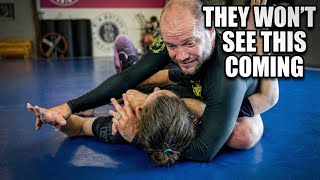
Rubber Guard TIPS all BEGINNERS should know..
Key Takeaways
- •Establishing Closed Guard Control
- •Creating Space with Elbow Clearance
- •The Meat Hook Grip Setup
- •Proper Ankle Placement Over Knee Position
Triangle Chokes, Omoplatas, Gogo Clinch... So many great options to come from playing Rubber Guard with THESE details in mind. If you've ever wondered why people keep crushing your Rubber Guard attempts, these tips will help you understand that battle a lot better. Stay Connected w/ BMAC: Instagram - http://www.instagram.com/brandonmc.ninja/ Facebook - http://www.facebook.com/brandonmc.ninja/
Related Techniques
Frequently Asked Questions
What does this video teach about rubber guard basics?
This video covers establishing closed guard control, creating space with elbow clearance, the meat hook grip setup. It provides detailed instruction from Brandon Mccaghren.
How long does it take to learn rubber guard basics?
The basic mechanics can be understood in a single session, but developing reliable execution requires consistent drilling over weeks of practice. This 10-part breakdown helps structure your training by isolating each phase of the technique.
What are the key details for finishing rubber guard basics?
The instructor demonstrates how to fluidly transition between options based on the opponent's defensive reactions. If space opens, the foot passes through; if the wrist closes, movement transitions over the top while maintaining constant control.
Related videos
Rubber Guard Fundamentals | Basics and Not-So Basics
Knight Jiu-Jitsu
Mastering The Rubber Guard by Eddie Bravo
Bernardo Faria BJJ Fanatics
Recovering De La Riva from Headquarters position
Absolute MMA St Kilda - Melbourne
How to Get Into Headquarters Position
JiuJitsu.com
Mounted Rubber Guard - 10th Planet Jiu Jitsu
Brandon Mccaghren