Introduction to Eight Kamae
The instructor introduces a systematic study of eight fundamental stances in Japanese swordsmanship. Practitioners are instructed to maintain chushin (center/centerline awareness) throughout all stance transitions.
Foundational Practice Method
Practitioners should begin by practicing each stance individually in front of a mirror to develop proper form. Once comfortable with individual stances, they progress to flowing transitions while maintaining centered alignment and controlled breathing.
Jodan (High Guard) Stance
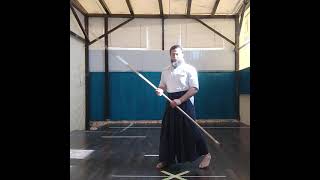
In jodan, the sword is held high with the left hand positioned above the left eye, approximately one fist away from the forehead. The left foot points straight while the right foot angles at 45 degrees, positioning the body at 45 degrees to the opponent. This alignment is called daijodam (large stance) and directs the practitioner's center at a 45-degree angle.
Seisan (Center Guard) Stance
The seisan stance positions the practitioner face-forward with the left hand at center. Both feet point straight ahead, creating a centered alignment that allows for forward and backward movement with equal facility.
Migi and Hidari Haso (Right and Left Middle Guard)
In both variations of haso, the sword's tsuba (handguard) is held at mouth height with one shoulder facing the opponent and the corresponding foot pointing forward while the rear foot angles at 45 degrees. Practicing transitions between right and left haso while maintaining level tsuba height develops mastery of chushin.
Wakigamae (Side Guard) Stance
The wakigamae stance reveals the left shoulder to the opponent while the left hand rests at the tanden and the sword angles at 45 degrees. This defensive posture enables rapid counters including shomen uchi (vertical strike), kesa (diagonal strike), or striking while stepping backward.
Ongan (Concealed Guard) Stance
The ongan stance obscures the sword behind the body to prevent distance calculation by the opponent. The left hand remains at the tanden with the right hand relaxed and the sword at 45 degrees, enabling varied attacks including shomen uchi, kesa, and defensive techniques.
Gedan (Low Guard) Stance
In gedan, the left hand positions at the tanden with the sword tip held just below the navel at a straight angle. Both feet point straight ahead, readying the practitioner to execute upward strikes from the low position.
Progression and Flow Practice
After mastering individual stances, practitioners sequence them together in continuous combinations, then progress to executing the full eight stances while moving freely around the practice space. This integrated practice develops fluidity and responsive positioning across all fundamental kamae.
8 TYPES OF KAMAE (STANCE)
Key Takeaways
- •Introduction to Eight Kamae
- •Foundational Practice Method
- •Jodan (High Guard) Stance
- •Seisan (Center Guard) Stance
8TYPES OF KAMAE (STANCE) These are the 8 fundamental kamae or stances in samurai sword martial arts. Once you learn them you can practice all seven together in a single flow. #kamae #stance #tate #samuraisword #budo #kenjutsu #exercise #stance ■Katana training class has started on my patreon I hope to practice and have fun together ! https://www.patreon.com/KazKobayashi I'm teaching this method from zoom. If you would like to take the session and for work-related requests, please messege. 【CONTACT】 [email protected] 【Instagram】 samurai_kaz_arts About Me KAZ KOBAYASHI (Performer, Writer, Choreographer) is an actor, a Japanese sword combat (Ta Te) performer and choreographer (Ta Te- Shi). He has been appearing extensively on stage, TV, films in Japan. Films include, Rurouni Kenshin Part II: Kyoto Inferno (Warner Bros. Pictures, Inc., 2014), Time Scope Hunter (NHK TV series 2011-2013, Movie in 2013). As a Japanese martial artist. He has a black belt of IAI and studied zen meditation and KI and have been certified in each.
Related Techniques
Frequently Asked Questions
What does this video teach about kamae — stance?
This video covers introduction to eight kamae, foundational practice method, jodan (high guard) stance. It provides detailed instruction from SAMURAI KAZ ARTS / KAZ KOBAYASHI.
How long does it take to learn kamae — stance?
The basic mechanics can be understood in a single session, but developing reliable execution requires consistent drilling over weeks of practice. This 9-part breakdown helps structure your training by isolating each phase of the technique.
What are the key details for finishing kamae — stance?
In gedan, the left hand positions at the tanden with the sword tip held just below the navel at a straight angle. Both feet point straight ahead, readying the practitioner to execute upward strikes from the low position.